









































THE DYNASTY OF PARADOX: WHEN ANTI-NEPOTISM WARRIORS BECOME NEPOTISM ARCHITECTS
-For over a decade, Prime Minister Narendra Modi has built a significant part of his political brand on one recurring theme: the Congress party’s incurable addiction to dynastic politics. From Rahul Gandhi to Robert Vadra, from Sachin Pilot to Priyanka Gandhi Vadra, Modi and the BJP’s rhetorical arsenal has relentlessly hammered the point that the Grand Old Party is less a political organisation and more a family firm. “Parivaarvaad” (familialism) has been elevated to the status of original sin in the BJP’s moral universe. Yet, in the winter of 2025, a rather inconvenient mirror has been held up to the NDA’s own face in Bihar, and the reflection is uncomfortably familiar.

THE DYNASTY OF PARADOX: WHEN ANTI-NEPOTISM WARRIORS BECOME NEPOTISM ARCHITECTS
21-NOV-ENG 5
RAJIV NAYAN AGRAWAL
ARA------------------------For over a decade, Prime Minister Narendra Modi has built a significant part of his political brand on one recurring theme: the Congress party’s incurable addiction to dynastic politics. From Rahul Gandhi to Robert Vadra, from Sachin Pilot to Priyanka Gandhi Vadra, Modi and the BJP’s rhetorical arsenal has relentlessly hammered the point that the Grand Old Party is less a political organisation and more a family firm. “Parivaarvaad” (familialism) has been elevated to the status of original sin in the BJP’s moral universe. Yet, in the winter of 2025, a rather inconvenient mirror has been held up to the NDA’s own face in Bihar, and the reflection is uncomfortably familiar.


On November 20, 2025, when Nitish Kumar expanded his cabinet after yet another flip-flop and realignment with the BJP, a relatively unknown name entered the list of ministers: Deepak Prakash, son of Rashtriya Lok Morcha (RLM) chief and Rajya Sabha MP Upendra Kushwaha. Deepak Prakash has never contested an election, never addressed a village chaupal, never filed his nomination papers, never faced the heat of a Bihar summer campaigning in the badlands of Karakat or Jahanabad. He studied abroad, returned, and within months found himself occupying a ministerial bungalow in Patna and a seat in the cabinet room. When journalists asked the obvious question, the answer was refreshingly candid: “Only my father can explain why I was made a minister.”
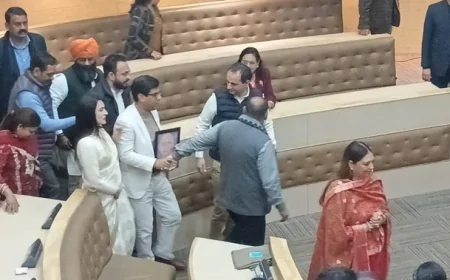
The image that went viral was almost cinematic in its symbolism: while every other minister took oath in the traditional kurta-pajama or safari suit, Deepak Prakash stood on the dais in jeans and a casual shirt, looking less like a public servant and more like a college senior who had wandered into the wrong ceremony. Social media instantly baptised it “campus placement, Bihar government edition”: foreign degree → direct cabinet rank → no election, no problem.
This is not an isolated aberration; it is the logical endpoint of a political culture that the BJP once swore to dismantle.
The Kushwaha Family Compact
Let us lay out the family balance sheet for clarity:
· Upendra Kushwaha: Rajya Sabha MP (unelected upper house seat)
· Snehlata Kushwaha (wife): Sitting MLA from Gaighat
· Deepak Prakash (son): Minister in Bihar Cabinet (never contested an election)
Three members of the same nuclear family holding constitutional positions simultaneously, two of them without ever facing the mandate of the people. If the same photograph had featured Sachin Pilot, Ashok Gehlot’s son Vaibhav Gehlot, or Kanimozhi Karunanidhi, the BJP IT Cell would have produced a hundred memes before the sun set. Yet, when it happens under the NDA’s own umbrella in Bihar, the reaction has ranged from deafening silence to tortured justifications about “coalition compulsions”.
Upendra Kushwaha himself has a colourful political journey. Once a trusted lieutenant of Nitish Kumar, then a bitter rival, then a minister in the Modi government (2014-2019), then an opponent again, and now, in 2025, back in the NDA fold with a Rajya Sabha seat and a cabinet berth for his son as apparent reward. In the great Bihar tradition of “aaya ram, gaya ram”, ideological consistency has never been a prerequisite; only arithmetic. But even by those elastic standards, elevating an unelected son directly into the cabinet sets a new benchmark in unapologetic familial entitlement.
The Larger Pattern in the NDA
The Kushwaha episode is only the latest chapter in a growing volume titled “Do as I Say, Not as I Do”.
Consider the following data points from the last ten years of NDA rule at the Centre and in the states:
1. Union Council of Ministers (Modi 3.0, 2024):
1. Anantkumar Hegde’s brother was reportedly considered for a board position.
2. Jyotiraditya Scindia (who defected from Congress) brought his own coterie, but the BJP also accommodated relatives of several allies.
2. Maharashtra:
2. Ajit Pawar’s wife Sunetra Pawar was fielded for Rajya Sabha and later Lok Sabha within months of the NCP split.
3. His son Parth Pawar remains a perennial “future chief minister” in waiting.
3. Haryana:
3. Manohar Lal Khattar was projected as the anti-dynasty mascot, yet the BJP made Dushyant Chautala (grandson of Devi Lal) Deputy Chief Minister in 2019, and later accommodated several second-generation Jat leaders.
4. Uttar Pradesh:
4. Apna Dal’s Anupriya Patel (daughter of founder Sonelal Patel) and her husband Ashish Patel both hold ministerial positions.
5. SBSP chief Om Prakash Rajbhar’s son Arvind Rajbhar is an MLA, and another son was given a board position.
5. Bihar itself:
5. Jitan Ram Manjhi’s son Santosh Suman is a minister.
6. Mukesh Sahani’s VIP party routinely promotes family members.
The counter-argument offered by BJP sympathisers is predictable: “These are allies, not the BJP itself.” But that defence collapses under scrutiny. When the BJP was in opposition, it never made a distinction between Congress and its allies; the entire UPA was branded a “parivaarvaadi” ecosystem. The same moral logic must apply in the reverse direction. The NDA today is a coalition stitched together by power, not principle, and family fiefdoms are the cement holding several of its bricks together.
The Hypocrisy Premium
What makes the Kushwaha episode particularly galling is the historical context. In the 2015 Bihar assembly elections, Narendra Modi thundered from rally after rally: “Yeh log apne parivaar ke liye raj karte hain, hum desh ke liye” (They rule for their families, we rule for the nation). Ten years later, the son of a Rajya Sabha MP who himself reached Parliament without fighting an election is now a state minister because, well, his father asked for it.
This is not merely political opportunism; it is the normalisation of the very disease the BJP once diagnosed so eloquently.
The second danger is the erosion of internal party democracy within the BJP itself. The old generation of RSS pracharaks who rose through shakhas and sacrifice is retiring. In their place is emerging a new class of leaders whose primary qualification appears to be proximity to the top leadership or, increasingly, bloodline. Pankaja Munde in Maharashtra, Jayant Sinha’s gradual marginalisation in Jharkhand (while second-generation leaders elsewhere flourish), Varun Gandhi’s political exile; the signals are unmistakable.
Even in Gujarat, the original laboratory of anti-dynasty rhetoric, the rise of Chief Minister Bhupendra Patel (a low-profile organisational man) was marketed as proof of meritocracy. Yet the real power centre remains a small coterie, and several ministers owe their positions to long-standing personal or caste loyalties rather than mass base.
The Unelected Minister Phenomenon
Deepak Prakash’s casual attire at the swearing-in was not just a fashion faux pas; it was a metaphor for how lightly the idea of democratic accountability is now treated. In a state where millions still vote barefoot in 45-degree heat, a young man educated abroad can parachute into the cabinet wearing denim and a smirk. The message is clear: elections are for the masses; power is for the connected.
This is not unique to Bihar. Recall that Sachin Pilot became a Union minister at 32 and deputy chief minister of Rajasthan at 36 without ever having lost an election (he did eventually contest and win), but the principle remains: India’s political class increasingly treats constitutional offices as family assets that can be redistributed at will.
The Constitution of India allows unelected individuals to become ministers for a maximum of six months, after which they must get elected to either House. That provision was meant for exceptional talent, not as a backdoor for dynasts. Yet in state after state, we see the same pattern: nominate to Rajya Sabha or Legislative Council, then promote to cabinet, then (if absolutely necessary) fight a by-election from a safe seat. The voter is reduced to a rubber stamp.
The Cost to the Anti-Dynasty Narrative
Every time a Deepak Prakash or a Parth Pawar or a Tejashwi Yadav (son of Lalu Prasad) is handed power on a platter, the BJP’s most powerful electoral plank loses a little more credibility. The urban middle-class voter who cheered Modi’s attacks on “khandaan tanashahi” (dynastic dictatorship) in 2014 is now forced to confront an uncomfortable truth: the alternative the BJP offered was never the eradication of dynasty, merely its redistribution.
In the 2024 Lok Sabha elections, the BJP’s vote share in Bihar fell to its lowest since 2004, and the NDA barely scraped through. One of the under-reported reasons in post-poll surveys was voter fatigue with constant political musical chairs and the perception that “sab mile hue hain” (everyone is hand in glove). When the son of an ally can become a minister in jeans while unemployment among educated Bihari youth touches 20%, the disconnect becomes visceral.
Towards a Genuine Anti-Dynasty Politics
If India is to move beyond family firms masquerading as political parties, three reforms are urgently needed:
1. A law barring immediate relatives (spouse, children, siblings) of sitting MPs/MLAs from contesting elections from the same state for a cooling-off period of at least one term.
2. Strict enforcement of the six-month rule for unelected ministers, with no Rajya Sabha or MLC backdoor entry for relatives.
3. Internal party democracy clauses written into the Representation of the People Act, mandating secret ballots for candidate selection instead of high-command nominations.
None of these will happen as long as the current incentive structure remains: power is the only currency that matters, and family is the safest bank.
Upendra Kushwaha’s son in jeans taking oath as a minister is not just a photograph; it is a political Rorschach test. To some, it is coalition dharma. To others, it is the final burial of the BJP’s anti-dynasty pretensions. What cannot be denied is the irony: the very party that weaponised the charge of parivaarvaad against its opponents has now become its reluctant custodian.
Narendra Modi once asked the nation to choose between “parivaarvaad” and “vikasvaad” (development). Ten years later, the choice appears to have been resolved in the most Indian way possible: why choose when you can have both?
Until the political class, across party lines, finds the courage to institutionalise merit over blood, Deepak Prakash will not be an exception. He is the new normal, dressed in denim, smiling for the cameras, and waiting for his father to explain why, of all the millions of qualified Bihari youth, he alone was found worthy of serving the people without ever having to ask for their vote.
That silence from the father, and from the Prime Minister who once thundered against exactly this, is perhaps the loudest sound in Bihar’s winter of 2025.
What's Your Reaction?
 Like
0
Like
0
 Dislike
0
Dislike
0
 Love
0
Love
0
 Funny
0
Funny
0
 Angry
0
Angry
0
 Sad
0
Sad
0
 Wow
0
Wow
0