
Kavitha Launches “TRS”, Sparks New Power Shift in Telangana Politics
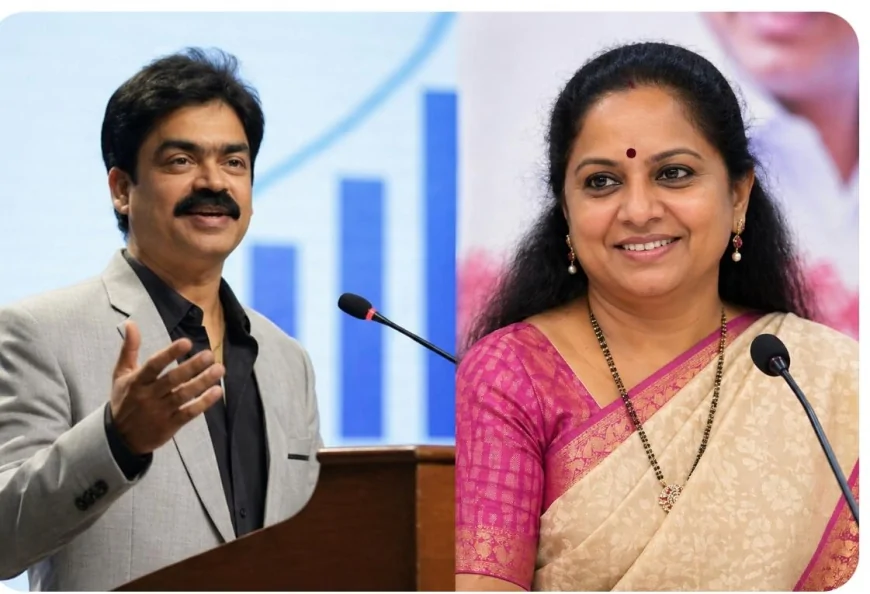
Telangana politics has taken another crucial turn. The formation of the “Telangana Rashtra Sena (TRS)” party by Kalvakuntla Kavitha is not merely the launch of a new political outfit; it signals deep shifts in family political dynamics, the revival of regional ideology, and evolving equations between the ruling and opposition forces. This development cannot be viewed superficially; it reflects the surfacing of an internal crisis within Telangana’s political system.


The differences within the Bharat Rashtra Samithi are not just personal disagreements. A growing perception that the ideological strength built during the movement phase has gradually weakened in the phase of governance, dissatisfaction over centralized leadership, and emerging differences over the future political direction—these three factors together appear to have led to this split. Kavitha’s suspension and subsequent exit from the party should be seen not only as an act of political protest but also as an attempt to carve out an independent identity.
Reclaiming the name “TRS” is a politically significant decision. This name, which once stood as a symbol of the Telangana statehood movement, is now being revived as an emotional force. In a way, it represents a direct contest over political legacy. There is a clear attempt to reconnect with the emotional bond people have with the movement. This is not just a party revival; it is an effort to reclaim a political brand.
Kavitha’s political strategy appears to operate on three fronts: governance-related criticism of the ruling Congress, allegations of corruption and family dominance against the Bharat Rashtra Samithi, and attacks on the Bharatiya Janata Party over issues of regional self-respect. By simultaneously engaging on these three fronts, she seems to be positioning herself at the political center. This reflects a multi-front political strategy.
The impact of this party may not be limited to mere vote division. If there is mobilization among women voters, youth who were active during the movement phase, and rural groups that still resonate with the old TRS ideology, it could reshape Telangana’s social and political alignments. Vote bank politics may take on a new form.
For Congress, this presents a dual situation. In the short term, division of opposition votes may appear beneficial, but in the long term, if Kavitha’s party gains strength, it could emerge as a challenge. From the perspective of the Bharatiya Janata Party, this may seem like a minor development, but if regional sentiment strengthens again, it could hinder the expansion of national politics.
However, the challenges before Kavitha are significant. Building a party structure down to the grassroots level, gaining public credibility, mobilizing financial resources, and developing second-tier leadership—these factors will be crucial for success. Ideology alone is not enough; it must translate into votes through an organized political framework.
This development should be viewed not in terms of immediate success or failure but through the lens of long-term change. It may trigger debates on internal democracy within regional parties, reshape public perception of dynastic politics, and lead to a reassessment of Telangana movement ideologies.
Is this a genuine political alternative, or just another chapter in family politics? The answer will not emerge immediately. The future of this party will depend on three factors: public verdict, the test of time, and the stability of leadership.
What's Your Reaction?
 Like
0
Like
0
 Dislike
0
Dislike
0
 Love
0
Love
0
 Funny
0
Funny
0
 Wow
0
Wow
0
 Sad
0
Sad
0
 Angry
0
Angry
0

Senior Journalist | TYJF President









Comments (0)