



















































































THE SHRINKING SLOPES OF THEE ARAVALLIS AND DELHI’S DETERIORATING ENVIORNMENT: Dr. SATYANARAYAN SAURABH
The Shrinking Slopes of the Aravallis and Delhi's Deteriorating Environment Limiting the scope of Aravalli conservation to a 100-meter definition—a profound environmental blow to the air, water, and temperature of Delhi-NCR.

THE SHRINKING SLOPES OF THEE ARAVALLIS AND DELHI’S DETERIORATING ENVIORNMENT: Dr. SATYANARAYAN SAURABH
7-DEC-ENG 16


RAJIV NAYAN AGRAWAL
ARA----------------------------The Shrinking Slopes of the Aravallis and Delhi's Deteriorating Environment Limiting the scope of Aravalli conservation to a 100-meter definition—a profound environmental blow to the air, water, and temperature of Delhi-NCR.


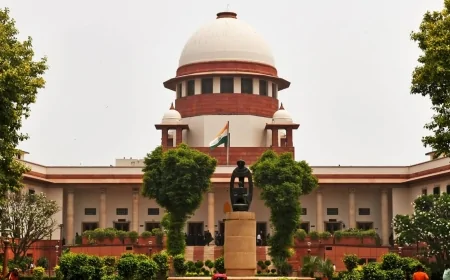
In the northern geography of India, the Aravallis are not just a mountain range, but are known as a living ecological wall, a groundwater reservoir, a cooling system, and a natural dust shield. However, the recent recognition by the Supreme Court of the Environment Ministry's recommendation, which states that only land formations higher than 100 meters above the local ground level will be called "Aravalli hills," puts this entire mountain range in an unprecedented legal and ecological crisis. Smaller and larger ridges, undulating terrain, rocky slopes, scrubland areas, and broken hills below 100 meters, which are most crucial in the actual ecology, are almost excluded from this definition. It is feared that the legal protection of approximately 80-90% of the land area that still protects Delhi-NCR from dust, heat, floods, and water scarcity will be significantly weakened.
The biggest threat posed by this definitional change is that the conservation of the Aravallis is now based on "height," not on "ecological functions." Any mountain system performs its bio-geological role not based on height, but on its location, its connectivity, its drainage systems, soil layers, vegetation, animal movement, windbreak capacity, porosity, and rainwater harvesting. The lower-lying ranges of the Aravallis, which appear as ordinary mounds from a distance, are actually the backbone of the ecological balance of NCR-Delhi. Removing, cutting down, or creating artificial gaps in these hills means that Delhi's pollution will worsen, its water scarcity will deepen, and the heat will become even more scorching.
This degradation of the Aravalli range is not merely a geographical event; it is a question directly linked to Delhi's air quality, water supply, agriculture, wind patterns, temperature trends, and the monsoon patterns of the entire North India. Delhi-NCR is already grappling with extreme pollution, falling groundwater levels, drying reservoirs, and temperatures reaching around 50 degrees Celsius. At such a time, the shrinking, breaking, and continuous weakening of the Aravalli's natural shield due to illegal mining and construction signals a massive ecological collapse that could alter Delhi's habitability in the coming years.
When the Aravalli hills are cut down, their soil loses its binding capacity. This soil turns into dust with the first gust of wind. Sandy particles, rocky debris, and fine layers of broken quartzite—all become part of the large particulate matter in Delhi's air. Delhi's geographical structure is already such that wind speed slows down during winter, trapping pollution and allowing it to accumulate in layers. The broken walls of the Aravalli not only multiply this pollution but also provide an unobstructed path for westerly winds from Rajasthan to carry dust and heat.
The other aspect of this situation is related to Delhi's water. The Aravalli hills are a natural recharge zone for groundwater. Their rocky surfaces, with natural cracks, scattered minerals, rocky channels, and porosity—all draw rainwater deep into the earth, hundreds of feet below the surface. But when the hills are cut down and leveled, or when concrete structures and settlements spring up on them, this entire natural water flow system breaks down. The water no longer seeps in; it simply flows away. Soil erosion increases, small water sources dry up, and groundwater recharge is almost completely eliminated. As a result, the water crisis in the Delhi-Gurugram-Faridabad-Sohna region deepens. In many areas, the groundwater level has already dropped to 800–1000 feet; further destruction of the Aravallis will push this level dangerously lower.
But the biggest crisis today, which Delhi experiences every summer, is "extreme heat." The extensive forest system of the Aravallis, its shrubs, its trees, its rugged slopes—all are part of a natural cooling system. This system not only reduces heat through shade and evapotranspiration but also has the natural ability to block hot winds. But when the hills are swallowed up by concrete, paved roads, and buildings, the entire area turns into a "heat island." Every broken piece of the Aravallis adds 0.2–0.4 degrees to Delhi's temperature. And when this process spreads over several kilometers, Delhi's average temperature increases by several degrees.
And then comes the aspect of the Aravallis that many parts of India do not take seriously—the Aravallis are a "desert-resistant wall." This mountain range stands just beyond the eastern edge of the Thar Desert. If this mountain range weakens, if artificial passages are created between them, if trees are cut down, or if cracks open up due to mining, then large quantities of dust, sand, and dry winds from Rajasthan will start reaching Haryana and Delhi. The Aravallis have been a natural barrier preventing the desert's expansion for centuries. Weakening this barrier means that the sandy areas will gradually shift towards Delhi—this is called "the precursor trend of desertification" in scientific terms. The danger is not limited to dust alone; it can change the entire land's fertility, soil type, water scarcity, and local climate. The most worrying aspect of this entire scenario is that the definition of 100 meters includes the Aravalli range. It will break the mountain range into "fragments." A mountain range can only fulfill its environmental role when it remains a continuous chain. But when it is cut and separated at intervals of 50–100 meters, its roles related to air, water, and temperature collapse. This fragmentation not only weakens legal protection but also gives an open invitation to illegal builders to consider those land parcels as buildable, which will no longer be considered "mountains." As a result, mining, farmhouses, concrete structures, roads, villas, resorts, and industries will continue to hollow out the body of the Aravalli range.
This situation not only increases Delhi's pollution but also makes it permanent. Increased dust in the air means that the levels of both PM-10 and PM-2.5 in Delhi's entire atmosphere remain consistently high. When the Aravalli slopes are broken in the path of air currents, it becomes difficult for smog to dissipate. Delhi's geographical bowl-like shape already traps pollution; if its only western-southern "breathing space," the Aravalli range, is blocked, this crisis will become even more severe.
The impact of falling groundwater levels is not limited to water availability alone. It creates an imbalance throughout the entire ecosystem. When the groundwater level continuously drops, soil moisture decreases, irrigating fields becomes difficult, urban greenery dries up, and ultimately, the temperature rises even faster. Thus, the degradation of the Aravalli range indirectly increases Delhi's heat.
Increased heat leads not only to illness but also to increased electricity consumption, water demand, urban heat stress, and even accidents. Scientific studies have clearly shown that 30–40% of Delhi's heat control depends on the Aravalli forest cover. With the removal of this cover, Delhi will permanently experience temperatures of 50–52 degrees Celsius in the coming decade.
The question is, what is the solution? What is the solution? The first solution is that the legal definition of the Aravalli range should be based not on "height," but on "ecological function." Secondly, forests, pastures, scrublands, and rocky landscapes—all of these should be considered part of the Aravalli range and protected accordingly. Thirdly, a complete ban on mining should be implemented, and illegal constructions should be rigorously removed. Fourthly, the degraded hills should be restored—by filling them with soil, planting indigenous tree species, and constructing water harvesting structures. Fifthly, physical and ecological continuity should be re-established so that the entire NCR-Delhi region can have a dense, uninterrupted environmental shield.
The Aravalli range is not merely an administrative issue for Haryana, Rajasthan, or Delhi; it is the climate security wall of North India. Weakening it means making Delhi's air even more toxic, its water even more critically scarce, and its heat even more intense. The destruction of the Aravalli range is the destruction of Delhi. Only if the Aravalli range survives will Delhi be able to breathe. Only if the Aravalli range is saved will Delhi be saved.
What's Your Reaction?
 Like
0
Like
0
 Dislike
0
Dislike
0
 Love
0
Love
0
 Funny
0
Funny
0
 Angry
0
Angry
0
 Sad
0
Sad
0
 Wow
0
Wow
0