











































ERUPTION OF DISCONTENT WITHIN THE RLM SIGNALS A NEW ERA IN BIHAR POLITICS
--Bihar politics has always been known for leadership ambiguity, the ups and downs of coalition politics, and the complex structure of caste-based politics.
ERUPTION OF DISCONTENT WITHIN THE RLM SIGNALS A NEW ERA IN BIHAR POLITICS
29-NOV-ENG 8
RAJIV NAYAN AGRAWAL
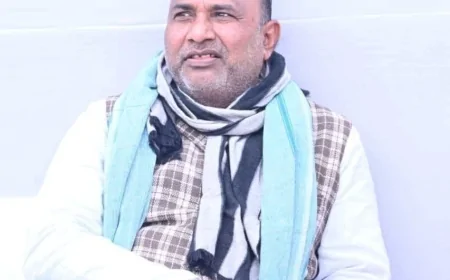
ARA----------------------------Bihar politics has always been known for leadership ambiguity, the ups and downs of coalition politics, and the complex structure of caste-based politics. However, this time, the discontent within Upendra Kushwaha and his party, the Rashtriya Lok Morcha (RLM), is not merely the internal turmoil of a small organization, but rather a symbol of a broader problem that continues to grapple with much of Indian politics: nepotism, distrust of leadership, and the cycle of political opportunism. The simultaneous resignation of seven RLM leaders, including the party's state president, general secretary, and district president, marks the culmination of a discontent that had been brewing for years but was being suppressed. As soon as Upendra Kushwaha's son, Deepak Prakash, was sworn in as the Panchayati Raj Minister in Chief Minister Nitish Kumar's new cabinet, the spark of discontent turned into flames.


This decision became the center of controversy for several reasons. First, Deepak Prakash was neither an MLA nor a member of the Legislative Council, while four RLM MLAs had recently won elections and entered the House, and were naturally considered contenders for ministerial positions. Second, the party structure was already weak at that time, with the party relying on the trust and hard work of experienced leaders. Third, Kushwaha has for many years been positioning himself as a spokesperson for socialist values and ethical politics. Therefore, appointing his son as a minister was seen as contrary to the values he has repeatedly cited on public platforms. When leaders like party president Mahendra Kushwaha and vice president Jitendra Nath openly stated that Upendra Kushwaha promoted dynasty politics and placed family above the organization, it becomes clear that deep distrust has developed within the party. Kushwaha defended his decision, saying that his son is a qualified engineer, has worked hard, and should be given a chance to prove himself. However, competence in politics isn't defined by a degree or profession; it's determined by the ability to work on the ground, a strong support base, a willingness to struggle, and a commitment to the organization. This is where party leaders and workers feel betrayed. Family ties have outweighed age, experience, and political struggle, and this is the root of the discontent.
An interesting, yet bitter, observation from a close associate was that Upendra doesn't trust anyone except his family, and sometimes not even himself. His decisions change frequently. This comment is not merely an emotional reaction, but a vivid political observation. In the past 15 years, Upendra Kushwaha has changed political houses as many times as he has, a number that hardly any other regional leader in Bihar has done. Leaving the JDU in 2009, joining the NCP, then forming a separate party, aligning with the BJP in 2014, becoming a minister, leaving the NDA again in 2018, merging his party with the JDU in 2021, and splitting from the JDU again in 2023—this is a cycle with no sign of stability. This instability may be part of his personal political risks, but it has repeatedly fractured the organizational structure and eroded the trust of leaders.
Political analysts have consistently stated that Kushwaha's problems lie more in the politics of positioning than in ideology. Sensing opportunities and changing alliances has become part of his style, but this style only works as long as the leader's credibility remains intact. As the crisis of credibility deepens, opportunism becomes a burden. The resignation of RLM leaders is the culmination of this burden.
This controversy also relates to the political landscape of Bihar, known as the Luv-Kush equation. The combined Kurmi and Koeri communities have been a crucial force in Bihar's politics for decades. Nitish Kumar and Upendra Kushwaha have been prominent political figures from this social structure. This is why, no matter how political differences grow, Nitish Kumar has repeatedly tried to bring Kushwaha back into his fold, as this alliance is considered the backbone of his power. When the JDU was reduced from 71 to 43 seats in the 2020 elections, a major reason for this was that Kushwaha's party cut between 5,000 and 39,000 votes in 30 seats, directly costing the JDU a dozen seats. This fact demonstrates that, no matter how small Kushwaha's party is, its vote bank plays a decisive role on the margins. This is why the JDU consistently prioritized him, and for the same reasons, the BJP has also considered him a useful part of the alliance. But as the discontent within the RLM makes clear, Kushwaha's personal influence remains intact, but his organizational influence has weakened significantly. The party structure has become increasingly family-centric, and leaders who spoke out against it have now left. This question is not only about the future of a small party, but also whether the social base of Bihar politics, known as Luv-Kush, remains as strong or whether new cracks are emerging within it.
Upendra Kushwaha quoted Nitish Kumar's old advice on Christmas Day—"Flies will buzz while you eat; keep shooing them away with your left hand, and keep eating with your right," and indicated that criticism does not bother him. But in politics, dismissing criticism as a mere bluff often distracts the leadership from reality. The voices emanating today were not just noise but a warning to the party, which went unheeded.
The biggest question now is what the political impact of this entire controversy will be. The first possibility is that the RLM is virtually empty and, without a strong leadership structure, will be unlikely to play an independent role in the future. This situation could benefit the JDU if disgruntled leaders, directly or indirectly, seek refuge in Nitish Kumar's camp. The second possibility is that this controversy may also create turmoil within the NDA, as smaller parties in the alliance are not merely decorative; they also provide important social signals during elections. If the RLM weakens, sooner or later both the BJP and JDU will have to compensate for this situation in some other way. The third possibility, which appears politically tenuous at present but not impossible, is that Upendra Kushwaha may attempt to rebuild his party, but relying solely on his family will not work. He will have to get down to the ground and rebuild the organizational structure.
The future of Deepak Prakash's ministerial appointment is also an important question. It's well-known in politics that ministerial positions can enhance a person's clout, but grassroots influence and organizational acceptance are the true political assets. If Deepak Prakash meets that standard, this controversial move by Upendra Kushwaha could prove successful in the long run. However, if he fails to overcome the image of family privilege, it could mark a decisive downfall in Kushwaha's political journey.
The truth is that the current situation isn't limited to the dynastic debate. It's a multifaceted question involving leadership credibility, political stability, organizational strength, and the layers of social base. Bihar politics has always been complex, but this incident has made it clear that serious questions about leadership accountability are now being raised even within smaller parties.
This is a time for introspection for Upendra Kushwaha. If they continue to brush this aside as a mere "fly," they may remain a mere footnote in Bihar politics in the years to come. But if they take this as a signal and take steps to reshape their organization, workers, and leadership style, they can still play the role they possess and whose social base still exists in many areas of Bihar.
The value of decisions in politics is determined not just by today but by the future. If Deepak Prakash's coronation weakens the party, it will prove to be poison, as Kushwaha himself said, citing the example of churning the ocean. But if it opens a new direction, this same decision could become nectar in the years to come. It would be premature to say which will have the upper hand: discontent or a new beginning, but one thing is certain: this episode has already been recorded as a sign of a new era in Bihar politics.
What's Your Reaction?
 Like
0
Like
0
 Dislike
0
Dislike
0
 Love
0
Love
0
 Funny
0
Funny
0
 Angry
0
Angry
0
 Sad
0
Sad
0
 Wow
0
Wow
0