





















































DR. RAM SEVAK ‘VIKAL: PERSONALITY AND WORKS
Dr. Ram Sevak "Vikal" was born on 1 July 1939 in a civilized family in Ballia district of Uttar Pradesh. His father Shri Bhagwan Ji was a normal educated person but he remembered the teachings of Ramayana, Mahabharata and Geeta. He followed Tulsidas as an ideal in his life. The people of the village are fascinated by his honesty, hard work and good character. He used to eat and drink only after finishing his daily chores in the morning and doing Puja.

DR. RAM SEVAK ‘VIKAL: PERSONALITY AND WORKS
1-JULY-ENG 9


RAJIV NAYAN AGRAWAL
ARA---------------------------Dr. Ram Sevak "Vikal" was born on 1 July 1939 in a civilized family in Ballia district of Uttar Pradesh. His father Shri Bhagwan Ji was a normal educated person but he remembered the teachings of Ramayana, Mahabharata and Geeta. He followed Tulsidas as an ideal in his life. The people of the village are fascinated by his honesty, hard work and good character. He used to eat and drink only after finishing his daily chores in the morning and doing Puja. He had three sons Shri Lakshmi Ji, Ram Kinkar Ji and Ram Sevak Vikal. Shri Bhagwan Ji's financial condition became worrisome due to the complete arrangement of education of all the three sons, however he did not lose courage. The eldest son got the post of a teacher in a primary school. Due to the passage of time, Shri Lakshmi Ji passed away in 1957. A great calamity befell the family but no one can avert the divine law. At that time Shri Ram Kinkar ji was studying at home. He came to Jamshedpur and started trying for a job here. Shri Bhagwan ji's younger son Shri Ramsevak Vikal was studying BA at that time. He also used to write literature. He had an interest in poetry. Hence, he kept his surname as 'Vikal'.


Dr. Ram Sevak Vikal received his primary education from the village school and passed matriculation from Shri Nath High School and obtained IA from Ratasar Inter College and BA from Satish Chandra College, Ballia. After passing BA in 1958, he became a law student in the 1958-59 session but due to the deteriorating financial condition of the family, he came to Jamshedpur. His elder brother Shri Ram Kinkar ji was already living here. After spending some time with him, he was appointed as a teacher in Giri Bharti, a famous school in Haldi Pokhar. While studying personally during his teaching period, he obtained his M.A. degree in Hindi from Ranchi University and under the guidance of Dr. Jayanarayan Mandal, the then Head of the Hindi Department of Ranchi University, he obtained his Ph.D. degree from Ranchi University on the subject “Comparative Study of the Plays of Jaishankar Prasad and Dwijendra Lal Roy”. Clearly, the attempt to study the original plays of Dwijendra Lal Roy in Bengali shows that Dr. Vikal completed this work only after studying the Bengali language well. Vikal ji was a good scholar of Hindi, Sanskrit, Bengali and English and a famous poet and writer of Hindi Bhojpuri. By the way, he has written some poems in Bengali as well. Being in contact with Oriya speaking people, he understood Oriya as well. Since Haldi Pokhar is situated in a place where some people were Hindi speaking, some tribal speaking and some Oriya speaking, but most of the people were Bengali speaking. Living in a Bengali speaking area, Vikal ji could not remain deprived of the sweetness and elegance of Bengali. He found a sweet and attractive ground to learn and understand Bengali language there.
While working in Giribharati Vidyalaya, Dr. Vikal established an evening college called Chota Nagpur College Haldipokhar. He completed the work and research work of the college and also built Chota Nagpur College which is an important contribution for the residents of Haldipokhar area.
Vikalji's personality was a presence bathed in the rays of art, with a bright complexion, high nose, thoughtful, in an environment constantly struggling for the establishment of human values, his voice spread the fragrance of songs sparkling with the aura of the ancient tradition of teachers, developed in his infinite possibilities, shining with the miracle of consciousness, Vikalji was the most luminous signature of this region.
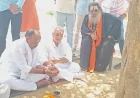
Dr. Vikal was a kind-hearted, sociable person, interested in social, cultural and religious work. Despite living in a non-Hindi speaking area, he mingled with people in such a way that in Haldipokhar, Hindi speaking, Bengali, Oriya, Rajasthani, tribal and Muslim people all respected him. People who went to meet him were respected and became his own. His behaviour was such that whether someone was rich or poor, whether an officer or an ordinary employee, he behaved well with everyone generously. Due to his modesty and grandeur, people of high stature were welcomed in Haldi Pokhar. People would sometimes go to Giri Bharti High School and sometimes to Chhotanagpur College and meet the students, teachers and common people there. At one time, Education Minister Satyendra Narayan Singh, Dr. Lakshmi “Sudhanshu Acharya Vinoba Bhave” and other great men made their debut in Haldi Pokhar and Vikal ji received their blessings. When Jagatguru Shankaracharya Jyotishpeethadhiswar Swami Krishna Bodhashram ji had come to Haldi Pokhar, after welcoming him, Dr. Vikal recited some parts of his Bhojpuri Gita in his honour and he wrote its preface as a blessing. In the age of materialistic comforts, Vikal ji was a person who lived a simple life and had high thoughts, staying away from material pleasures. Seeing him in simple attire, no stranger could easily say that this person wearing dhoti kurta could be so learned and popular. But when he met him, got acquainted with him, discussed literary and social topics, he understood that this ordinary looking person had extraordinary talent hidden in him. Vikal ji used to talk about serious topics with respectful behaviour, a touch of humour and a simple manner, which naturally revealed his image. “Loha Kunj” published from Jamshedpur.
In the weekly magazine, Dr. Bachchan Pathak Salil had written, “Vikal ji is a poet who has been silently worshipping Mother India for two and a half decades by living in the solitude of Haldipokhar village, in the forest of Singhbhum. A poet by heart, an artist by feelings, a teacher by profession, Vikal ji, who is sweet by nature, is a natural friend. For me, my beloved has become my friend. May God continue this friendship for life, so that I will continue to feel proud of the friendship of a natural friend.”
Dr. Vikal’s first published work was the play “Karmaveer”, which was published in 1962 from the press of late Ganga Prasad Kaushal. “Karmaveer” was written on the basis of the narration of the famous Sanskrit story “Veervaropakhyay Namah”. In today’s resentful era, where the youth are feeling distrust and are turning away from their duty, the sacrifice of Karmveer Veervar and his loyalty towards King Shudrak are depicted in an ideal form. This play was successfully staged many times at many places. His second work “Doobey Hue Bhai-Behan” was an adaptation of the play of the famous Bengali playwright late Tadit Basu. The original play is in Bengali which was adapted by Vikal ji. Before publication, this play was staged many times at Giri Bharati’s Sundaram Rangmanch under the direction of Shri Basu. It was published in 1969. Before this play, Vikal ji had edited some poems of his students under the name “Phool Aur Kaliyan”. Vikal ji had edited a compilation of poems of Shri Krishna Kumar Vidyarthi, Dr. Bachchan Pathak Salil and some of his own poems under the name “Asha Kiran”. Asha Kiran was also published in 1969. Vikal ji was not behind in the field of student-friendly books either. Seeing the need of the students, he wrote a book of Sanskrit translation in Bengali “Sanskrit Anuvaadika” and got it published. Many editions of it have been printed. Two collections of Premchand's stories, "Panch Phool" and "Sapt Saroj", were in the syllabus of students, which Vikal ji got published by writing student-friendly reviews. Many editions of these have also been published.
He adapted the plot of the court scene of Bankim Chandra's famous book, "Kamalakant" into a play which was staged many times on Giri Bharati's Sundaram stage. This adaptation was first published under the name "Chhinkar Khaao", but later Vikalji did not like this name, so in the second edition it was published under the name "Kamalakant". Vikalji's third play based on a mysterious and thrilling incident is "Jadugar" which was published serially in "Azad Mazdoor" edited by Kaushal ji. In this play, an officer of the Intelligence Department gets information about secrets while working at his nephew's place to find the murderer of his uncle. In the end, the murderer is caught. This play was staged on the stage of Jamshedpur's famous institution "Layola School". Litterateurs and drama lovers of Jamshedpur praised the story-planning, character building and purpose of this play.
Among Vikal ji's unpublished plays are "Maa ki Aankhein", "Kavi", "Baap ka Aadarsh Beta", "Swarg Mein Kavi Sabha", "Vidhayak ki Bekha", "Swarg Mein Mantri Sabha", "Shoshan Band Karo", "Hamari Behen", "Parivartan" etc. and many collections of poems, stories and essays are pending for publication.
Vikkal ji's works have been published with respect in various souvenirs and collections. Vikal ji's selected works were published in compilations like "Sarvodaya-Suman", "Jyoti Purush", "Badhte Charan", "Indirayan", "Lokpriy Kavi", "Triveni Dhara", "Bikhre Phool", "Van Vaibhav", "Purvanchala" etc. Vikal ji's essays and poems were published in various newspapers and magazines. Prominent among them are:- "Nalanda Darpan", "Dainik Sanmarg", "Sansar", "Aaj", "Azad Mazdoor", "Loh Kunj", "Ballia Samachar", "Bali Satta", "Tulsi Das", "Uditvani", "Dudhadhari Vachanamrit", "Praachya Prabha", "Jamshedpur Post", "Adityapur Times", "Dainik Vishwamitra", "Adivasi", "Dharmayug", "Saraswati Samvad", "Manvi Sakhi", "Nayi Raah" etc.
Poems published in various magazines. Some of the poems have been very popular. They are:- “We need a sword, not a pen”, “Poet, write the history of the country”, “My love for the poet”, “Cow donation”, “Towards Vinoba”, “Nehru's wish bud”, “Towards Tulsi”, “Armstrong's victory over the moon”, “Towards the workers”, “National song”, “One becomes many”, “Politics” etc. Viklal ji's poems reflect love for nature, patriotism and sense of beauty.
Apart from poetry and drama, Vikal ji has also written essays on contemporary topics which are very important. The main published essays of his are:- “Abki Dekhenge”, “In the name of bedbugs”, “Competition letter”, “National language”, “The root of nationalism”, “India's economy is based on cattle”, in the field of prose, Vikal ji mainly wrote critical essays. His literary essays were published in newspapers like "Saraswati Samvad", "Azad Mazdoor", "Purvanchala", "Hum Safar", "Loh Mazdoor", "Ballia Samachar", "Aaj" etc. The main essays are:- "Anarchy in Literature", "Literature", "Chinese Invasion and Hindi Poetry", "Modern Hindi Poets and their Love and Separation Songs", "Era and Poet", "Nature in Swapnavasavadattam", "Rasraj Shringar", "Role of Vishwa Natya", "Form of Tulsi's Devotion", "Ahalya of Ram's Stone", "Premchand and Practical Life", "Famous Plays of Ravindra Thakur", "Classification of Prasad's Historical Plays and Prasad's History".
Cultural sentiments in plays”, “Sanskrit dramatic tradition”, “Dramas of Bharatendu period”, “Post-independence Bhojpuri prose”, “Modern Bhojpuri poetry” etc. Vikal ji’s contribution in the field of story writing is also praiseworthy. His story “Guldasta” presents the picture of the victory of the poor over the rich. “Rekha and Bindu” is a symbolic story. “Anguthi” is a problem-oriented story. “Kalma ki Shadi Ho Gayi” describes the sad condition of refugees. Apart from these, stories like “Paropkar”, “Dronacharya lost”, “Award”, “Meena and Mukul”, “Narada ji in the employment office”, “Influence of Harinam”, “Love marriage of ghosts”, “Teachings of a prostitute” and “As per the wish of Rankini mother” etc. are the living examples of Vikal ji’s story writing art. Sometimes Vikal ji’s articles were broadcasted from Akashvani Ranchi, in which “Spiritual happiness” and “Woman’s makeup” are the main ones.
For the service of national language Hindi Along with this, Vikal ji also served Bhojpuri with full dedication. After coming to Haldipokhar, Vikal ji became an active member of Jamshedpur Bhojpuri Sahitya Parishad and served Bhojpuri literature with great enthusiasm. His “Bhojpuri Geeta” was published with honor by the Parishad. For this translation, he was awarded “Rajnath Rai Shield and Medal”. Along with prose and poetry in Bhojpuri, he also wrote stories. His Bhojpuri poems kept getting published in magazines like “Azad Mazdoor”, “Adivasi”, “Sakhi”, “Shabari”, “Lukar”, “Uttar Bihar”, “Ballia Samachar”, “Janta Lalkaar” and “Bhojpuri Maati”. Vikal ji’s first Bhojpuri poem “Bital Basant Jhagra Lagai” was published in Varanasi’s “Aaj Dainik” in 1961 AD. His poems “Man Pakhi” and “Nirgun” published in “Azad Mazdoor” were very popular in Jamshedpur at one time. Among his popular poems are “Nepal Aur Ladakh Mein Saiyan”, “Geet Se Sajaib”, “Moti Ke Lal”, “Kunwar Singh Ke Prati”, “Laikan Ke Vivaah”, “Desh Ke Tuhi Desh Tohre Ha”, “Birha” etc. are very touching creations. Descriptions of love and separation are found in Vikal ji’s songs and the image of nature love and nationalism is realized in his poems. He translated Rabindranath Tagore’s “Gitanjali” poems into Bhojpuri poems and has written many poems in Bhojpuri on young characters like Prahlad, Dhruv, Bharat. Many collections of Vikal ji’s Bhojpuri poems are pending for publication.
Vikkal ji has equal command in the field of prose as well. His famous travelogue “Ee Has Bhrigu Kshetra”, and critical essay “Nature in Modern Bhojpuri Poetry”, were published in the collections “Fokt Mein Sair” and “Lahalot” published by “Bhojpuri Sahitya Parishad” respectively. Essay based on the topic “Nature Depiction in the Poems of Jagdish Ojha Sundar” Published in “Purvanchala”, “Use of Tatsam words in Bhojpuri”, “Janta Lalkaar” and “Kavi Gustakhi Ke Hasya” have been published in “Bhojpuri Maati”. Most of his Bhojpuri stories were published in “Bhojpuri Maati”, “Ballia Samachar” and “Sakhi”. Prominent among these stories are:- “Minister’s sacrifice”, “Heroic love”, “As you do, you fill”, “Leaving and leaving”, “Ghosts of the mind”, “Heroic love”, “Sadhhu se ghar bar”.
Vikal ji earned a lot of fame in the field of literature. Dr. Vikal ji served the mother tongue Bhojpuri by holding positions like member of “Jamshedpur Bhojpuri Sahitya Parishad”, “President” of Jadugoda Bhojpuri Sahitya Parishad, “Secretary” of South Bihar Bhojpuri Samaj, “Vice President” of Singhbhum branch of All India Bhojpuri Bhasha Sammelan etc. Dr. Ramsevak Vikal was such a poet who lived in the forest area of Haldi Pokhar in Singhbhum for three decades. Living in the solitude of the village, he silently worshipped Mother India. Poet by heart, artist by feelings, teacher by profession, sweet by nature, Vikal ji was a successful litterateur. Vikal ji has translated many poems of Hindi and Bhojpuri into Bengali and he translated Bengali poems into Hindi and Bhojpuri. Dr. Vikal ji was honoured by many institutions for his important work “Bhojpuri Padyanuwad of Shrimad Bhagwat Geeta” and “Akhil Bharatbang Sahitya Sammelan” honoured him with “Mathura Nath Award” in 1980 for his translation work from Bengali to Hindi.
In 1999, Giri Bharti retired from government service as Principal and stayed in Jamshedpur’s Bagbeda Colony for some time. He continued to serve literature by staying there and later came to live in his village Isari Salempur and started serving literature. Meanwhile, he was working fast on Jagannath Purana (four parts) and giving it prose form and doing padyanuvaad. Some work on Jagannath Purana had been completed. Along with this, he was also working on “Puran Purush”, in which work till the Mahabharata era had been completed. But nobody knows the pace of time. Nobody knew that Vikal ji would suddenly leave this world leaving the work of Jagannath Purana and Puran Purush midway. Vikal ji, who was suffering from diabetes for many years and was a deeply religious person, said goodbye to this world on 11 November 2002, on the day of Chhath Puja, just 2 hours after eating Chhath Maiya’s Prasad. Dr. Ramsevak Vikal, who lived the life of a devotee of Saraswati with great vigour, who never lost courage even in bad times, who always fought with a pen like a soldier, has become a resident of another world. Even today, two literary and social institutions are being run on his ideals in Dr. Vikal’s native village, Dr. Ramsevak Vikal Sahitya Kala Sangam Sansthan and Library, and Dr. Ramsevak Vikal Sahitya Seva Trust.
On the occasion of Vikal ji's death anniversary, kavi sammelan, literary seminars and other social programs are often organized in his native village. Various litterateurs of the country are honored from time to time by the organization with "Vikal Samman" and "Dr. Ramsevak Vikal Rashtriya Kriti Samman" in the memory of Dr. Vikal ji. The manager of both these institutions is Vikal ji's eldest son Dr. Aditya Kumar Anshu ji. Vikal ji's eldest son Dr. Aditya Kumar Anshu published the Bhojpuri book "Man-Pakhi" in the memory of his father in 2004. Much later, with the cooperation of all the sons of Vikal ji, the second edition of "Bhojpuri Geeta" was published in 2023 under the leadership of Dr. Aditya Kumar Anshu. Vikal ji's collection of Bhojpuri folk songs "Aakhar" under the editorship of his grandson Anand Kumar was published in 2025 with the courtesy of "Sahitya Samiksha Sanstha". Even after the death of Dr. Vikal, his eldest son Dr. Aditya Kumar 'Anshu' publishes various works of Vikal ji in the country's prestigious magazines like Bhojpuri Maati, Vishwa Kalyan Dhara, Samkaleen Abhivyakti, Bhojpuriya Maati, Vishwakarma Seva Sansthan, Sahitya Parikrama and various books like Bhojpuri Ke Shringar Geet, Madhurima, Dodhari Talwar, Anjuri Bhar Phool etc. Dr. Vikal's literature is very vast. Dr. Vikal ji's incomparable contribution in the service of literature will always be remembered by all literature lovers.
What's Your Reaction?
 Like
1
Like
1
 Dislike
0
Dislike
0
 Love
0
Love
0
 Funny
0
Funny
0
 Angry
0
Angry
0
 Sad
0
Sad
0
 Wow
1
Wow
1