


































































WILL THE AAP BE THE BJP-NITISH’S B-TEAM
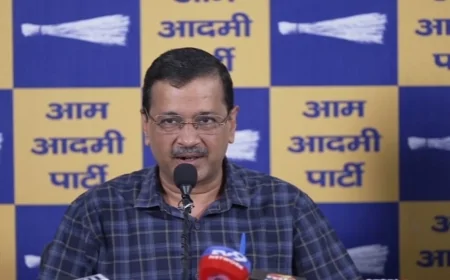
What significance does the Aam Aadmi Party's entry into the Bihar Assembly elections have in Bihar politics? Do they have such a strong support base there that they are likely to win even one of the 243 assembly seats? If they have become a national party, then why was the hasty decision to contest the Bihar elections made? Was the decision to field candidates in Bihar hastily made to stop the panic within the AAP?

WILL THE AAP BE THE BJP-NITISH’S B-TEAM
30-OCT-ENG 23
RAJIV NAYAN AGRAWAL
ARA-----------------------What significance does the Aam Aadmi Party's entry into the Bihar Assembly elections have in Bihar politics? Do they have such a strong support base there that they are likely to win even one of the 243 assembly seats? If they have become a national party, then why was the hasty decision to contest the Bihar elections made? Was the decision to field candidates in Bihar hastily made to stop the panic within the AAP?


These are questions that, if you delve into them, will automatically understand the real reason behind all this. This is the same party that used to say that it would contest elections in any state only after building a strong organization. Yes, the state of Haryana was certainly an exception, where the Aam Aadmi Party contested the elections despite not having a strong organization.
As for the state of Bihar, efforts to establish an organization had already been made before the 2020 assembly elections, but candidates were not fielded in 2020, stating that they would contest the elections only after further strengthening the organization across Bihar. But what happened in 2025 that led to the hasty announcement of candidate names? This is a matter of concern.
The truth is that Arvind Kejriwal's party has released its first list as part of an effort to salvage the Aam Aadmi Party's organization in Bihar. It is being said that the "PK factor" has forced the Aam Aadmi Party to enter the electoral fray.
It should be noted that the Rashtriya Janata Dal (RJD) is one of the parties in the India Alliance, which shares similar views with the Aam Aadmi Party (AAP) on many national issues. The RJD is leading the India Alliance to oust the NDA from power in Bihar. Despite this, the Aam Aadmi Party has announced its first contest in the Bihar assembly elections. The party has already released its first list of 11 candidates, and it is said that the second and third lists will be released soon. Sources within the Aam Aadmi Party (AAP) believe the PK factor, or Prashant Kishor's influence, is the driving force behind the AAP's decision to contest the Bihar elections.
However, Bihar AAP President Rakesh Yadav says this decision was made to demonstrate "alternative politics" to Bihar voters. It's clear that AAP's Organizational General Secretary Sandeep Pathak had previously announced that the party would contest the Bihar elections. However, until the list of candidates was released, there were doubts about this.
A senior AAP leader, speaking on condition of anonymity, stated that Prashant Kishor's influence was beginning to be felt within the AAP's organization. There was a fear that local party leaders and workers would migrate to Jan Suraj. In fact, Prashant Kishor's Jan Suraj model was presenting the same political model as the AAP's core model: people-connected, clean, and issue-based politics. Now, the Jan Suraj Party has gained a strong foothold and has become an alternative.
A senior party leader explained that the Aam Aadmi Party did not contest the 2020 Assembly and 2024 Lok Sabha elections. The Bihar unit had consistently argued that if the party could contest elections in states like Goa, Gujarat, and Haryana, why abandon Bihar? The truth is, the Aam Aadmi Party was not politically active in Bihar, so many of its leaders and workers joined Jan Suraj. But now that the party has announced its intention to contest the 2025 elections, it is hoped that the internal disunity within the party will subside and efforts will begin to bring back former senior members who have left.
Bihar unit Aam Aadmi Party President Rakesh Yadav also clearly believes that Jan Suraj had an impact on the party. He said that about 50% of the workers who had left Jan Suraj are now considering returning. They considered Jan Suraj as an alternative because we did not contest the elections. Now that the first list has been released, enthusiasm has increased. According to Yadav, the party has received approximately 6,000 applications. Scrutiny is underway, and the second and third lists will be released soon, likely containing 30-40 candidates.
Regarding how his party's politics differs from PK, Rakesh Yadav says that PK claims to offer Bihar an alternative political system, but his slogan is simply empty talk. People have seen the Aam Aadmi Party's governance model in Delhi and Punjab. The promises of governance centered on schools and hospitals that PK is making are already implemented.
However, the truth is that the Aam Aadmi Party's performance in the 2025 assembly elections is nowhere in sight. Yes, this certainly seems to be affecting the relationship between the RJD and the Aam Aadmi Party. When the RJD did not contest the Delhi assembly elections, questions arose as to whether the Aam Aadmi Party's participation in the Bihar elections would impact the relationship between the two parties. However, Aam Aadmi Party MLA and Bihar in-charge Sanjeev Jha denies this and argues that they contested elections in Himachal Pradesh as well, but Congress won. This has not affected their relationship. Wherever they contest, they are presenting their model of education and health politics. Our entry into Bihar will also bring the focus back to the real issues.
Political experts say that no matter what arguments the Aam Aadmi Party may make in Bihar, there's no denying the fact that the PK factor helped the party win the Bihar elections. This has forced the NDA alliance to enter the race, and the NDA alliance appears to be reaping the benefits.
On one hand, being in power is expected to benefit from the announcement of populist schemes, and on the other hand, the Aam Aadmi Party's entry into the elections is being seen as the NDA's B-team. While this may not be the reality, this is the message being conveyed by the local people at the grassroots level in Bihar regarding the Aam Aadmi Party. Meaning, the NDA, along with its populist announcements, appears to be benefiting from the Aam Aadmi Party's entry into the elections.
The confident NDA has begun to say that the All India Alliance is unable to counter the strategy of 'Sushasan Babu', and as a result, the NDA, under the leadership of Nitish Kumar, is hoping to return to power. Nitish's strategy is to retain his core voters, this core voter base being women.
The NDA believes that if it once again gains the support of women, it will once again reach the ladder of power. This is why, before the elections, the government transferred a large sum of Rs 10,000 to over 10 million women. Lakhs of other women are yet to receive the money. Meanwhile, the Indi Bloc, led by Tejashwi Yadav, has yet to find a counter to this. However, it has also promised to give women Rs 2,500 per month, which seems paltry compared to Nitish Kumar's initiative.
Nitish Kumar has attempted to woo women by making several important decisions for them. In fact, since 2005, women and Mahadalits have been his silent core support. In particular, women voters have emerged as his biggest X-factor in elections.
When Nitish Kumar came to power in 2005, he knew that the state's politics was entangled in caste dynamics. His caste did not hold a significant weight in this equation. Nitish's caste did not have a strong base in the state. Therefore, he expanded his party's support base among women and Mahadalits and the extremely backward classes. Since then, women voters have played a crucial role in Nitish's victory. He has consistently made specific promises to women in his party's manifesto, which has proven decisive in every election.
In 2015, he promised prohibition and 35% reservation for women in government jobs. This strategy was successful, confirmed by post-election surveys. These showed that over 60% of women voted for Nitish in that election. His announcement to provide bicycles to school-going girls played a significant role in his 2009 victory.
This is also due to the significant increase in women's voting in Bihar. In 2020, Nitish focused on the 'Jeevika Didi' scheme, which became his brand ambassador. Although there have been some rumors about his health, they appear to be having some effect.
But strategists close to Nitish Kumar claim that every time before an election, negative things are said about him, but when the results come, everyone is surprised. These strategists claim that silent voters will stick with him this time too. Even in 2020, when all the surveys were going against him, how these women saved Nitish's fort in the final results is evident to everyone.
But the Indi alliance is also not sitting idle and, under the leadership of Tejashwi Yadav, is trying to break into Nitish Kumar's strong fort through the Mai-Behin scheme. They are promising to give Rs 2,500 to every woman. To counter the Nitish government's plan to transfer Rs 10,000 to women's accounts, they are promising that if they come to power, they will implement the Rs 2,500 scheme and also give a lump sum advance of Rs 30,000 for the entire year to every woman.
The Indi alliance is trying to reach out to women voters by creating data on them. The calculation is that if they succeed in making even a small dent, the political balance will shift in their favor. But the question is, will the opposition alliance be able to break into Nitish's core voter base? If the Indi alliance succeeds in doing so, it will have an undeniable impact on the assembly election results. We will wait for counting day, when leaders' claims will be presented.
What's Your Reaction?
 Like
0
Like
0
 Dislike
0
Dislike
0
 Love
0
Love
0
 Funny
0
Funny
0
 Angry
0
Angry
0
 Sad
0
Sad
0
 Wow
0
Wow
0