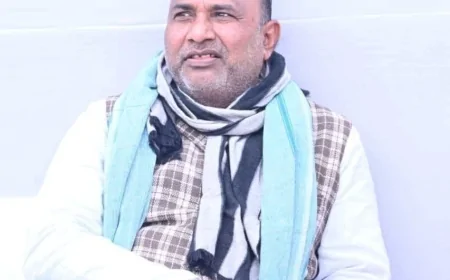



















































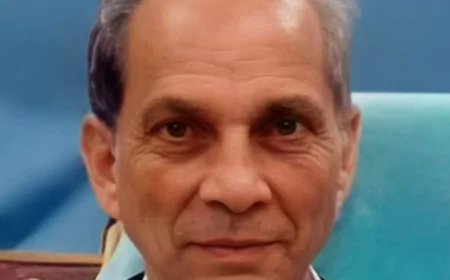



THIS ELECTION’S EXTRAORDINARY MANDATE IS SIGNIFICAT IN MANY WAYS IN BIHAR ELECTORAL HISTORY: DEVANAND SINGH
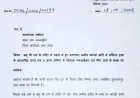
This election's mandate was extraordinary in many ways in Bihar's electoral history. Normally, state politics is characterized by competition, polarization, caste equations, and uncertainty until the last moment. However, this election's results shattered the predictions of almost all experienced analysts and political parties. The image of a fierce contest that emerged during the campaign ultimately proved to be a mere illusion. The public neither believed the Grand Alliance's call for change nor was willing to accept Prashant Kishore's experiment with so-called new politics.
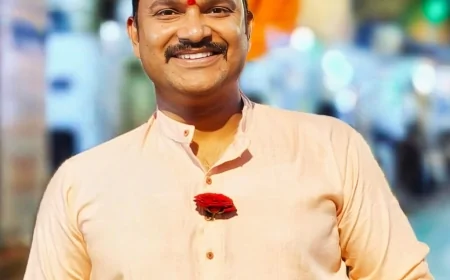
THIS ELECTION’S EXTRAORDINARY MANDATE IS SIGNIFICAT IN MANY WAYS IN BIHAR ELECTORAL HISTORY: DEVANAND SINGH
16-NOV-ENG 15


RAJIV NAYAN AGRAWAL
ARA------------------------This election's mandate was extraordinary in many ways in Bihar's electoral history. Normally, state politics is characterized by competition, polarization, caste equations, and uncertainty until the last moment. However, this election's results shattered the predictions of almost all experienced analysts and political parties. The image of a fierce contest that emerged during the campaign ultimately proved to be a mere illusion. The public neither believed the Grand Alliance's call for change nor was willing to accept Prashant Kishore's experiment with so-called new politics.


The election data will be analyzed in detail in the coming days, but overall, this result leaves many profound messages that will impact not only the future politics of Bihar but also the national level. The foundation for this electoral environment was laid when the state government initiated a special, intensive review process. This administrative exercise, which claimed to be aimed at purifying and updating voter lists, soon became a subject of political accusations and counter-accusations. The Grand Alliance openly portrayed it as a conspiracy to "steal votes."
It is also true that ordinary people faced difficulties during this process, such as paperwork, identity verification, and transportation. In many places, people were even seen as angry. It seemed that this discontent might spark a wave of change, but ultimately, the public accepted it as a necessary process. Deep down, Bihar voters often take a harsh stance on administrative procedures, but they also recognize that such drastic measures are sometimes necessary to maintain the state's functioning.
On the other hand, the most frequently used term by the National Democratic Alliance was "jungle raj." No election in Bihar in the last two decades has been free from this influence. Whether it was the memories of the Lalu-Rabri regime, the old era of crime and kidnapping, or the image of administrative lethargy—all of these were repeatedly invoked. Interestingly, although Lalu Prasad Yadav and Rabri Devi are no longer actively involved in politics, their political image remains alive in Bihar's political memory. This time, the NDA strongly promoted this issue. Throughout the campaign, Tejashwi Yadav focused on dismantling the narrative that the old era will never return. He tried to convey the message that today's young generation in Bihar has a new mindset and that the issues of crime and governance have changed.
He countered with accusations against the Nitish government on crime, saying that the system has become lax and old methods are returning. However, the public did not wholeheartedly accept this. A major reason for this was that Tejashwi did not provide any concrete framework for his election promises, especially the slogan of 'Rozgar Har Ghar' (employment for every household). The people of Bihar understand well how complex the government employment process is. Thus, this promise appealed to the youth, but failed to inspire confidence.
An important aspect of this election was that Nitish Kumar, although the face of the alliance, was not declared the Chief Ministerial candidate this time. This situation arose for the first time in the last twenty years. Furthermore, there were numerous discussions about his health. But when the results were announced, it became clear that Nitish Kumar's political brand still holds the deepest influence on Bihar politics.
Nitish has been sworn in as Chief Minister nine times. He has repeatedly switched political parties, sometimes leaving the BJP, then returning, and sometimes becoming a part of the Grand Alliance. Despite all these ups and downs, his personal trust has remained intact in the minds of the people. This is largely due to his impeccable image and administrative acumen. In a state with a complex social structure like Bihar, a clean public image is a great asset, and Nitish has proven this repeatedly.
Both phases saw record voter turnout. Typically, when voter turnout increases, it is believed that a wave of change is underway. This time too, analysts assumed the public wanted to signal change, but the change the Grand Alliance or other parties sought to demonstrate was not seen as a viable alternative.
Change in politics is only possible when the person or party leading the public is perceived as more trustworthy. Nitish Kumar still holds this belief in Bihar. The results clearly demonstrated that the public prioritized stability, experience, and administrative credibility. This election will also be remembered for the first time in Bihar that freebies were openly advertised. Both camps competed to attract women and youth.
Just days before the elections, the Nitish Kumar government transferred ten thousand rupees to the accounts of approximately 15 million women. This demographic group is already considered Nitish Kumar's supporters due to prohibition. This move proved decisive. The Grand Alliance also promised government jobs to young unemployed people, but a lack of trust and the limitations of the system diminished its impact.
Prashant Kishor, through his party, had championed the cause of new politics in Bihar. During the Jansuraj Abhiyan, he went from village to village and established dialogue, kept issues like migration and corruption at the centre of the debate, but in the election results This effect was not visible. Expectations were high, as he had previously served as a strategist for several political parties, but the public preferred stability over experimentation. Similarly, AIMIM and other smaller parties failed to make any impact. This clearly indicated that the people of Bihar are still not ready to break free from the framework of bipolar politics.
This is a time for deep introspection for the RJD and Congress. The failure to reach a seat-sharing agreement until the last minute proved to be their biggest weakness. The opposition had an opportunity to capitalize on the anti-incumbency wave in an organized manner, but they lost it due to lack of cohesion and leadership. The biggest question now is who will become the Chief Minister. Nitish Kumar has neither been accepted nor rejected. This situation is politically very interesting. The biggest upset is that the BJP has emerged as the largest party in the state, further strengthening its influence on the government. In the future, the BJP's role will not only increase in government governance, but it will also be in a position to determine the state's policy direction. This change will impact Bihar politics for a long time.
This mandate in Bihar is not just an electoral result, but also a mature public decision. It has made clear that the public wants solid leadership, beyond emotional slogans. Stability still trumps uncertain experiments. Political memory and the image of the past regime remain decisive factors. Direct benefits from public welfare schemes are the most effective tool in state politics, and ultimately, Nitish Kumar remains the strongest and most enduring pillar of Bihar politics. As always, Bihar has sent a clear message that trust is the greatest asset in politics.
What's Your Reaction?
 Like
0
Like
0
 Dislike
0
Dislike
0
 Love
0
Love
0
 Funny
0
Funny
0
 Angry
0
Angry
0
 Sad
0
Sad
0
 Wow
0
Wow
0