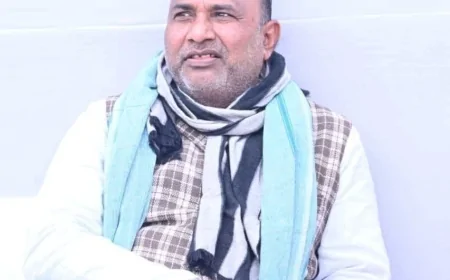


















































REJECTION OF BHIWANI, WE WANTT HISAR DISTRICT: SIWANI’S DECADE-OLD, JUSTIFIED DEMAND:Dr. SATYAWAN SAURABH
In a democratic system, administrative boundaries are not set in stone. They are redefined from time to time in accordance with public convenience, socio-economic realities, and regional balance. When an administrative structure consistently causes inconvenience to the public, its reconsideration becomes not only necessary but also a test of the government's sensitivity. The demand for Siwani sub-division to be separated from Bhiwani district and included in Hisar district stems from this democratic wisdom and the spirit of public interest. This demand has neither arisen suddenly nor is it a product of any political opportunism. It is a quiet, organized, and logical public movement that has been going on for more than a decade, and its roots are deeply embedded in the geographical, social, economic, and administrative realities of the Siwani region.
REJECTION OF BHIWANI, WE WANTT HISAR DISTRICT: SIWANI’S DECADE-OLD, JUSTIFIED DEMAND:Dr. SATYAWAN SAURABH
21-DEC-ENG 9


RAJIV NAYAN AGRAWAL
ARA----------------------------In a democratic system, administrative boundaries are not set in stone. They are redefined from time to time in accordance with public convenience, socio-economic realities, and regional balance. When an administrative structure consistently causes inconvenience to the public, its reconsideration becomes not only necessary but also a test of the government's sensitivity. The demand for Siwani sub-division to be separated from Bhiwani district and included in Hisar district stems from this democratic wisdom and the spirit of public interest. This demand has neither arisen suddenly nor is it a product of any political opportunism. It is a quiet, organized, and logical public movement that has been going on for more than a decade, and its roots are deeply embedded in the geographical, social, economic, and administrative realities of the Siwani region.


The formal beginning of this movement took place in August 2016, when six conscious citizens—Mahendra Lakhera, a prominent social worker from Barwa, Sunil Singhmar (Advocate), Lal Singh 'Lalu', Dr. Satyawan Saurabh, Surender Bhukkal, and Mukesh Bhukkal—together raised this issue, elevating it from a matter of personal inconvenience to a matter of public interest. At that time, perhaps no one thought that this initiative would become the voice of Siwani's collective consciousness in the coming years. Initially, this struggle was limited to a few meetings, memorandums, and discussions, but as ordinary people found their everyday problems linked to this demand, the scope of the movement expanded. Today, almost ten years later, this campaign is not the voice of any committee or individual, but the shared voice of the entire Siwani sub-division.
The first and most solid basis for the administrative affiliation of any district or sub-division is its geographical location. On this criterion, Siwani's connection with Bhiwani appears weak, and its connection with Hisar seems extremely natural. For example, the distance from Badwa to Hisar is approximately 25 kilometers, while the distance to Bhiwani is about 70 kilometers. This difference is not just in kilometers, but also in time, effort, and resources. People from many villages in the Siwani area have to change buses two or three times to reach Bhiwani, while a direct bus is usually available to Hisar. This difference is extremely significant for the average citizen who is already under mental stress due to visits to government offices, hospitals, or courts.
Transportation is the lifeline of any region. In the context of the Siwani sub-division, this lifeline clearly flows towards Hisar. Buses and other modes of transport are available to Hisar every 10-15 minutes. In contrast, one often has to wait an hour or more for transport to Bhiwani. As a result, it becomes almost impossible for the average person to go to Bhiwani, complete official work, and return home the same day. A day's work turns into two days, resulting in not only a loss of time and money but also an additional burden on the working class, farmers, and traders.
In practical life, the Siwani region's dependence is not on Bhiwani, but on Hisar. For higher education institutions, large hospitals, specialized medical facilities, major markets, employment opportunities, and judicial institutions—the citizens of Siwani naturally look towards Hisar. This situation creates a paradox where administrative orders are issued from Bhiwani, but the necessities of life are fulfilled from Hisar. This imbalance has been a cause of inconvenience for the public for years.
Siwani's social and cultural fabric also aligns more closely with Hisar. Family ties, business relationships, educational exchanges, and social participation—in all these areas, Siwani's connection with Hisar is deeper. This similarity is also clearly visible in the local life, language, and social behavior. When administrative boundaries are drawn contrary to social realities, they become an obstacle rather than a convenience for the public. This has been the situation in Siwani for years.
Every major mass movement needs a slogan that encapsulates its entire essence in a few words. The Siwani movement found this identity in the slogan:
“We reject Bhiwani, we want Hisar district.”
This slogan originated from the pen of Dr. Satyawan Saurabh and gradually became the ideological identity of the movement. It is not merely an emotional declaration, but a concise yet accurate statement of the geographical reality, administrative logic, and public aspirations of the Siwani region. This slogan reached every village, hamlet, and community gathering place, and became a common refrain among the people.
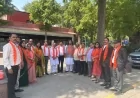
A significant feature of this movement has been that it has never been violent or divisive. The demands were conveyed to the government through memorandums, meetings, dialogues, rallies, and peaceful means. This is why the movement was not limited to any one section of society, but became a shared demand of farmers, traders, youth, women, employees, and social organizations. The ten years of continuous effort prove that this issue is not transient but demands a permanent solution.
As far as political representation is concerned, the movement's demand is balanced and practical. It has been clearly stated that the Siwani sub-division should remain as it is, and the assembly constituency should also be formed under the name of Siwani. This will neither harm the regional identity nor disrupt the administrative balance.
Today, when the government talks about principles like "Ease of Living" and "Ease of Governance," the Siwani issue becomes even more relevant. The question of Siwani becomes a real test. If administrative decisions are not alleviating the daily difficulties of the people, then showing the courage to change them is the hallmark of good governance.
This peaceful, organized, and people-based struggle of nearly ten years clearly indicates that this demand from Siwani is not the demand of an individual, committee, or organization, but the collective aspiration of an entire region. Now, this question is not just about Bhiwani or Hisar, but about administrative wisdom and public sensitivity. This is an opportunity for the government to send a message that in a democracy, the voice of the people is heard, by giving Siwani the administrative affiliation that is consistent with its geographical and social reality.
"No to Bhiwani, we want Hisar district"—today, this is not just a slogan, but a declaration of Siwani's future.
What's Your Reaction?
 Like
0
Like
0
 Dislike
0
Dislike
0
 Love
0
Love
0
 Funny
0
Funny
0
 Angry
0
Angry
0
 Sad
0
Sad
0
 Wow
0
Wow
0