

































































JIVITPUTRIKA VRAT: A TIMELESS TRADITION OF MATERNAL DEVOTION AND CHILD WELFARE
-In the rich tapestry of Hindu festivals and rituals, Jivitputrika Vrat stands out as a profound expression of maternal love and sacrifice. Also known as Jitiya Vrat, Jiutiya Vrat, or simply Jiutiya, this ancient observance is primarily undertaken by mothers to pray for the longevity, health, prosperity, and overall well-being of their children. Observed predominantly in regions like Bihar, Jharkhand, Uttar Pradesh, and parts of Nepal, the vrat involves a rigorous fast, often without water (nirjala), symbolizing the boundless devotion of a mother. The festival typically spans three days, aligning with the Krishna Paksha Ashtami of the Hindu lunar month of Ashwin, which falls in September or October in the Gregorian calendar. In 2025, it is set to be observed on September 14, with the Ashtami Tithi beginning at 5:04 AM and ending at 3:06 AM the next day.

JIVITPUTRIKA VRAT: A TIMELESS TRADITION OF MATERNAL DEVOTION AND CHILD WELFARE
14-SEP-ENG 11


RAJIV NAYAN AGRAWAL
ARA-------------------------In the rich tapestry of Hindu festivals and rituals, Jivitputrika Vrat stands out as a profound expression of maternal love and sacrifice. Also known as Jitiya Vrat, Jiutiya Vrat, or simply Jiutiya, this ancient observance is primarily undertaken by mothers to pray for the longevity, health, prosperity, and overall well-being of their children. Observed predominantly in regions like Bihar, Jharkhand, Uttar Pradesh, and parts of Nepal, the vrat involves a rigorous fast, often without water (nirjala), symbolizing the boundless devotion of a mother. The festival typically spans three days, aligning with the Krishna Paksha Ashtami of the Hindu lunar month of Ashwin, which falls in September or October in the Gregorian calendar. In 2025, it is set to be observed on September 14, with the Ashtami Tithi beginning at 5:04 AM and ending at 3:06 AM the next day.


The name "Jivitputrika" translates to "living sons" or "sons who live long," highlighting its traditional focus on male offspring, though in contemporary times, it has evolved to include prayers for all children, daughters included. This shift reflects broader societal changes towards gender equality while preserving the core essence of parental protection. Rooted in ancient Hindu scriptures and folklore, the vrat is not merely a religious duty but a cultural cornerstone that reinforces family bonds, community solidarity, and spiritual resilience. It underscores the pivotal role of women in Hindu society, where mothers are seen as the guardians of dharma (righteousness) and the nurturers of future generations. As we delve deeper, this article explores the historical origins, religious and traditional significance, legendary sources, intricate rituals, worship practices, regional variations, and modern relevance of Jivitputrika Vrat, drawing from various scholarly and cultural perspectives.
The history of Jivitputrika Vrat can be traced back to the Vedic period, over three thousand years ago, making it one of the oldest ascetic rituals in Hinduism. Vrattas, or vows involving fasting and devotion, are mentioned in ancient texts like the Puranas and Dharmashastras, where they are prescribed as means to achieve specific worldly or spiritual goals. Jivitputrika Vrat, in particular, falls under the category of "kamya vrats" – those performed with a desire, here the desire for children's longevity. Its origins are intertwined with the domestic sphere of Hindu life, where women, often excluded from public rituals, found empowerment through home-based observances that directly impacted family welfare.
Scholarly accounts suggest that the vrat evolved from early agrarian societies where child mortality was high due to diseases, famines, and conflicts. Mothers, bearing the emotional brunt, turned to ritualistic fasting as a form of divine intervention. The ritual's antiquity is evidenced by its mention in regional folklore and texts like the Nagananda, a 7th-century Sanskrit play by Emperor Harsha, which narrates a story akin to the vrat's central legend. Over centuries, it has been passed down orally from mothers to daughters, preserving its essence while adapting to local customs. In medieval times, during the Bhakti movement, such vrats gained prominence as acts of personal devotion, aligning with the era's emphasis on bhakti (devotion) over elaborate priestly rituals.
In colonial and post-independence India, the vrat has faced modernization pressures. While traditionally focused on sons – reflecting patriarchal structures where sons were seen as providers and lineage continuers – contemporary observances increasingly include daughters, influenced by education, women's rights movements, and changing family dynamics. Despite these evolutions, the vrat remains a testament to enduring cultural continuity, observed with fervor in rural and urban settings alike. Anthropological studies, such as those in "Because It Gives Me Peace of Mind" by Anne Pearson, highlight how such rituals provide women with a sense of agency and spiritual fulfillment in a male-dominated society.
The vrat's historical resilience is also seen in its survival through invasions and socio-political upheavals. In regions like Bihar and Jharkhand, it has integrated with local tribal customs, such as those of the Tharu community in Nepal, blending Vedic elements with folk practices. This syncretism underscores its adaptability, ensuring its relevance in a globalized world where nuclear families and urban lifestyles challenge traditional observances.
Religiously, Jivitputrika Vrat is anchored in the Hindu belief system where vrats are pathways to accumulate punya (merit) and mitigate karma. It is dedicated to Lord Jimutavahana, an incarnation or a compassionate figure symbolizing self-sacrifice for protection. The vrat aligns with the principles of dharma, where a mother's role is elevated to that of a divine protector. Scriptures like the Puranas assert that women observing this vrat will never suffer due to their children, emphasizing its protective efficacy. It is considered the most arduous vrat, testing a woman's resolve and devotion, thereby enhancing her shakti (inner power), which she channels towards her family's welfare.
Traditionally, the vrat reinforces the matriarchal bond in Hindu families. In a society where sons historically ensured economic security for aging parents, the vrat was a ritualistic safeguard. However, its importance transcends gender; it embodies unconditional love, fostering emotional security and family harmony. Communities view observant mothers as embodiments of Pativrata (devoted wife and mother), drawing parallels to goddesses like Parvati or Sita. The vrat also promotes social values like charity, as offerings are shared with the needy, Brahmins, and children, symbolizing communal blessings.
In broader cultural terms, it preserves oral traditions through kirtans (devotional songs) and stories, educating younger generations about ethics, sacrifice, and devotion. It strengthens community ties, with group observances in villages fostering solidarity. In modern contexts, it serves as a counterbalance to materialism, reminding families of spiritual priorities. Psychologically, the vrat provides peace of mind, as noted in ethnographic studies, helping mothers cope with anxieties over child-rearing. Its traditional importance lies in perpetuating gender roles while empowering women spiritually.
The vrat's spiritual foundation is enriched by captivating legends that illustrate themes of sacrifice, devotion, and divine intervention. One prominent story from the Puranas involves King Jimutavahana, a Gandharva ruler renowned for his compassion. According to the tale, Jimutavahana encountered an old woman weeping as her son, Shankhachuda (a Naga prince), was to be sacrificed to Garuda, the eagle deity who fed on snakes. Moved by her plight, Jimutavahana offered himself in place of the son. Garuda, impressed by this selfless act, not only spared him but also vowed to cease demanding Naga sacrifices. This legend, echoed in Harsha's play Nagananda, symbolizes a mother's ultimate sacrifice and the protective power of devotion. Mothers invoke Jimutavahana during the vrat, drawing parallels to their own fasting for children's safety.
Another folk legend features an eagle and a jackal (or fox) observing women performing the vrat near the Narmada River. The eagle faithfully fasted, resulting in her chicks thriving, while the jackal, succumbing to hunger, devoured food, leading to her pups' untimely death. This story, recited during rituals, warns of the consequences of breaking the fast and underscores the vrat's efficacy in ensuring offspring's longevity.
These narratives, drawn from Puranas and regional folklore, are not mere tales but moral compasses. They connect the vrat to broader Hindu mythology, involving deities like Shiva and Parvati, who often appear to bless the protagonists. In some versions, the story links to Lord Rama, where a Bariyar plant (sacred fig) carries a mother's plea, emphasizing nature's role in divine communication. Such legends are recited by Brahmins or elders during the vrat, reinforcing faith and cultural continuity.
The rituals of Jivitputrika Vrat are meticulous, blending austerity with devotion, and vary slightly by region but follow a core structure over three days.
Day 1: Nahay-Khay (Purification and Meal) Mothers begin with an early bath in a river or sacred pond (tirtha) for purification. They prepare a vegetarian meal using ghee and rock salt, often including noni saag (greens) and madua roti (millet bread). This day honors ancestors, especially departed mothers, with offerings. A sankalpa (vow) is made, stating the intent for children's welfare. In some areas, like Jharkhand, seeds (rice, gram, corn) are planted in river sand within a bamboo basket, symbolizing growth and prosperity.
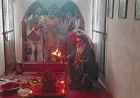
Day 2: Khur-Jitiya or Nirjala Fast The core day involves a strict nirjala fast from dawn to dusk, without food or water. Mothers wake early, perform household chores, and set up a puja altar with idols of Jimutavahana (made from kusha grass), an eagle, and a jackal (crafted from clay and cow dung). Offerings include incense, lamps, rice, flowers, fruits, sweets like thekua and gujia, and sesame-clove dough balls to ward off negativity. The Vishnu Mantra ("Om Namo Bhagavate Jimutavahanaya Namah") is chanted continuously. A red or yellow thread (Jiutya) is tied around the wrist or neck for protection. In the evening, kirtans and the vrat katha (legend recitation) occur, often led by a Brahmin. A havan (fire ritual) may be performed, with ghee and grains offered to carry prayers to the gods. A red cloth soaked in mustard oil is tied around a coconut, rotated seven times over the child's head, and immersed in a river to remove the evil eye.
Day 3: Parana (Breaking the Fast) The fast ends after a bath, with dan-dakshina (donations) to a Brahman woman with living sons. Prasada (offered food) is shared. Special dishes like jhor bhaat (curry rice), noni saag, madua roti, and zucchini stew are prepared. In Jharkhand, a Jitiya branch (sacred fig) is planted, worshipped with eight vegetables, flowers, and fruits, followed by immersion the next day.
Worship involves community singing, Jhumar dances in Jharkhand, and Jhamta dances among Nepal's Tharu women. Children are adorned with flower garlands, emphasizing joy and blessings.
While the vrat's core remains consistent, regional flavors add diversity. In Bihar and Uttar Pradesh, it's a three-day affair with emphasis on nirjala fasting and simple puja. Jharkhand extends it to eight days, incorporating seed planting, riverbank offerings to jackals and eagles, and nocturnal Jhumar dances. In Nepal, especially among Mithilanchal and Tharu communities, it includes pre-fast fish and millet meals, and the fast may extend if Ashtami starts late.
In modern times, urban migration has adapted the vrat: online kathas, virtual pujas, and simplified rituals accommodate working mothers. Social media shares recipes and stories, globalizing the tradition among diaspora communities. Yet, challenges like health concerns from nirjala fasting prompt modifications, with some allowing water. NGOs promote gender-inclusive observances, praying for all children.
Jivitputrika Vrat endures as a beacon of maternal love, blending ancient wisdom with contemporary relevance. Its rituals and legends inspire devotion, ensuring its legacy for generations.
What's Your Reaction?
 Like
1
Like
1
 Dislike
0
Dislike
0
 Love
0
Love
0
 Funny
0
Funny
0
 Angry
0
Angry
0
 Sad
0
Sad
0
 Wow
1
Wow
1