













































JAYPRAKASH’S 123RD BIRTH ANNIVERSARY CELEBRATED
--A grand celebration was held today to commemorate the 123rd birth anniversary of Lok Nayak Jayaprakash Narayan under the aegis of the Lok Nayak Jayaprakash Memorial Institute.

JAYPRAKASH’S 123RD BIRTH ANNIVERSARY CELEBRATED
14-SEP-ENG 15


RAJIV NAYAN AGRAWAL
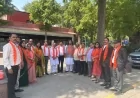
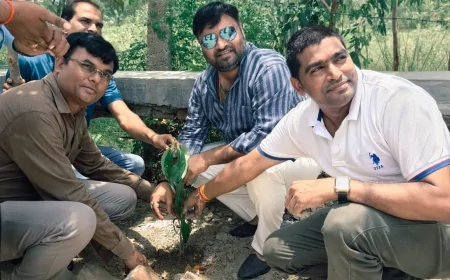
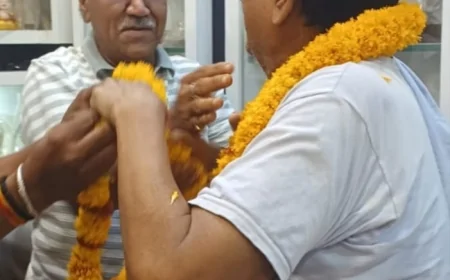
ARA------------------------A grand celebration was held today to commemorate the 123rd birth anniversary of Lok Nayak Jayaprakash Narayan under the aegis of the Lok Nayak Jayaprakash Memorial Institute. Tributes were paid to his statue at Collectorate Pond at 7 a.m. by garlanding it and chanting slogans. JP fighters from the 1974 movement, social workers, theatre artists, youth, intellectuals, and prominent citizens of the city attended in large numbers to pay their respects and offer their tributes. Those who paid tribute included JP activist Ramakant Thakur, the institute's vice-president Rabindra Nath Tripathi, Professor Neeraj Singh, Sushil Tiwari, Nathu Ram, General Secretary Sushil Kumar, Gulabchand Prasad, Ashwani Sinha, Salil Ji, Ashok Manav, Munna Ji, Parshuram Chaudhary, Kapildev Akela, Mintu Singh, Chhotu Singh, Vishwanath Pandey, Indu Devi, Krishnandu Ji, Ashok Sharma, Saheb Lal Yadav, D. Rajan, Vishwanath Ji, Anant Chaudhary, and a large number of students and young theatre artists.


Following the wreath-laying ceremony, a symposium was held under the chairmanship of former MLA Ramakant Thakur. The symposium was moderated by Ashok Manav. Dr. Neeraj Singh, while shedding light on the biography of Loknayak Jayaprakash, said that JP had gone to America to study in his youth. There, he remained involved in the workers' movement while continuing his studies. In 1929, he returned to India, leaving his PhD incomplete, and joined the freedom movement. He played a leading role in the 1942 Quit India Movement. He founded the Congress Socialist Party along with Acharya Narendra Dev and Dr. Lohia. Later, he withdrew from active politics and became a lifeblood of Vinoba Bhave's Bhoodan Movement. In March 1974, a student movement began in Bihar. In April 1974, at the students' request, he accepted the leadership of the movement on the condition that it would be completely peaceful. His transformative philosophy can be read in his book, Meri Vichar Yatra. General Secretary Sushil Kumar stated that J.P. had completed his PhD in America and submitted his thesis, which was recently published in an eight-volume anthology on the history of the 1974 movement. However, he returned without giving an interview for his PhD. The thoughts expressed in that thesis remained true to his philosophy of total revolution. His core ideology was that "public control over power is essential in a democracy." He dedicated his life to establishing this philosophy, while remaining aloof from power. Loknayak Jayaprakash belonged to Mahatma Gandhi's ideological family. On the occasion of Gandhi Jayanti, JP's followers embarked on a march from Varanasi to Delhi to protest the government's illegal occupation and bulldozer demolition of the Sarva Seva Sangh campus in Varanasi. This march, launched under the banner of "Ek Kadam Gandhi Ke Saath," has already moved beyond Allahabad. The march is receiving a grand welcome from ordinary citizens everywhere. This is a result of the deeds of great men like Gandhi and JP.At the end of the seminar, Ramakant Thakur, in his presidential address, stated that we should reflect on the difference between JP's era and today's, and what responsibilities today's youth should shoulder.
What's Your Reaction?
 Like
0
Like
0
 Dislike
0
Dislike
0
 Love
0
Love
0
 Funny
0
Funny
0
 Angry
0
Angry
0
 Sad
0
Sad
0
 Wow
0
Wow
0