























































































EVEN BAD LUCK TURNS INTO LUCK BY DOING KARMA: JIYAR SWAMI
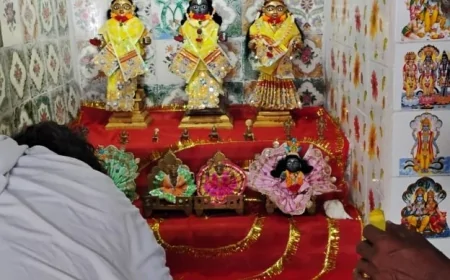
At the Paramanpur Chaturmasya Vrat Sthal, India's great sage, Saint Shri Lakshmiprapanna Jiyar Swami Ji Maharaj explained the meaning of luck and bad luck. Swami Ji said that at the time a creature is born, all the events that will happen in his life are written at that time. When will that person have sorrow in his life? When will he have happiness? The entire story of prestige, honour, respect, contempt from the society, sorrow, trouble, illness etc. is written.

EVEN BAD LUCK TURNS INTO LUCK BY DOING KARMA: JIYAR SWAMI
9-JULY-ENG 4


RAJIV NAYAN AGRAWAL
ARA------------------------At the Paramanpur Chaturmasya Vrat Sthal, India's great sage, Saint Shri Lakshmiprapanna Jiyar Swami Ji Maharaj explained the meaning of luck and bad luck. Swami Ji said that at the time a creature is born, all the events that will happen in his life are written at that time. When will that person have sorrow in his life? When will he have happiness? The entire story of prestige, honour, respect, contempt from the society, sorrow, trouble, illness etc. is written.


But karma is such a medium through which even bad luck can be changed into luck. Sorrow can be changed into happiness. A big accident can be changed into a small incident. But all this is possible only when in human life we do better work with our body through karma.
Luck also supports the one who does karma. That is why karma is said to be the most important in life. Ravi Shankar Tiwari told that Swami Ji said that everything good is written in the fate of the one. But if he abandons his actions in life. If he does not contemplate, meditate, worship, recite, do penance, give charity, or receive education of the divine form through his body, then his good fortune also turns into misfortune.
If the one whose fortune is weak does good deeds, then his fortune becomes strong. Swami ji gave an example and said that two thieves had gone to a saint's place to listen to a story. Where the story was being narrated by Mahatma ji. Mahatma ji said that stealing is a sin. Both the thieves thought after listening to this. One thief said that now we will not steal. The
story was still going on, then at the end Mahatma ji said that one should not abandon one's work. That means whatever work you are doing, you should keep doing it continuously.
Both the thieves started talking to each other. One thief said that Mahatma ji has said in the end that one should not abandon one's work. That is why we will not give up our work of stealing. The other one said we will not steal. Both left from there. One thief went to a place and committed robbery. In which he got ₹10000. The second thief who had given up stealing was crossing a river. There a lead pierced his foot in the river. Due to which he got unbearable pain.
The two thieves met each other again and both told their stories. One told that we have earned 10000 by stealing. He said that you see, you have given up stealing, so you have to suffer.
That is why you should not give up your work. Then once again both of them reached that Mahatma. Both told their stories. Swami ji said that Mahatma ji told that you have earned 10000 by stealing. But it was in your fate to get crores of rupees. But you did wrong things. Due to which your fate and result were received in a subtle form. Because you have worked in a wrong way. The second thief who gave up stealing. A big accident was written in his fate. But he gave up stealing. Due to which a big accident written in his fate also turned into a small incident. As a result of which he felt a small prick in his leg. This is the importance of luck and misfortune.
That is why one should never abandon good deeds in life. Because with good deeds, a person's misfortune also turns into good fortune.
Further Swami Ji discussed the importance of Amrit and many Vedas and Puranas including Shrimad Bhagwat Granth. Swami Ji said that once Lord Indra was weighing Amrit on one side of the scale and Vedas, Granths, Puranas etc. on the other side. At that time, scriptures, Puranas and history texts became heavier than nectar. Swami Ji said that the gods have drunk nectar. Due to which they do not have to be killed. But they have to bear the torture of demons. Because demons take birth again and again and trouble the gods. Whereas according to religion, Puranas, Granth, a person who lives his life with dignity has to die. But according to his deeds, he attains salvation.
Swami Ji told that when Sut Ji was narrating Shrimad Bhagwat Katha to King Parikshit, then Lord Indra brought Amrit. He said that King Parikshit should drink the Amrit and narrate Shrimad Bhagwat to us. Swami Ji said that Shrimad Bhagwat, Ramayana, Ramcharitmanas, Vishnu Purana, Garuda Purana, Vedas, history and all the religious texts in which the deeds of God have been described are the true form of God. God resides in all the texts, Puranas and history. Just like the laws are written in the books by the government, the law is made there. Due to which all the people have to follow all kinds of justice laws etc. All the laws that are made are also written on a simple paper. But the importance of the paper on which the law is written increases a lot. According to which the rules have to be followed. In the same way, Vedas, Puranas, history texts etc. are written on simple pages. They are printed in some press. But when it is printed and published as a book, then it is the manifestation of God himself.
Swami Ji also discussed the curse of Narad Ji. Narad Ji was cursed that he cannot stay at one place. Because once he had made thousands of sons of a king celibate. Due to which the king got angry and cursed him that he cannot stay at any one place. That is why Narad Ji is not allowed to stay at any one place.
Narad ji keeps wandering. But whenever he is engaged in worship, recitation, penance, meditation, at that time this curse does not apply to him. Because it is the blessing of Lord Shriman Narayan that whenever Narad ji remains engaged in worship, he will remain free from the curse.
While discussing an incident during the story, Swami ji also explained the meaning of son-in-law. Son-in-law means the one who thinks of taking some donation whenever he goes to his in-laws' house. He is called a son-in-law. Whatever the situation may be, happiness, sorrow, but the son-in-law has the hope of taking something or the other throughout his life. Further Swami ji explained the meaning of Duvarthi. Duvarthi is called a daughter. Duvarthi is the one who keeps taking money, sarees, clothes from her parents throughout her life with love and smile, she is called Duvarthi. Giving an example, Swami ji said that whenever a girl goes to her parents' house in the village from her in-laws' house, she also has the desire to take something in her mind. I could have got a saree, clothes, some money, that is to say, the one who laughs and plays with the desire to get something from her parents and brothers her whole life, is called a duvarthi (one who is in a bad mood).
What's Your Reaction?
 Like
0
Like
0
 Dislike
0
Dislike
0
 Love
0
Love
0
 Funny
0
Funny
0
 Angry
0
Angry
0
 Sad
0
Sad
0
 Wow
0
Wow
0