















































SHAH-YOGI MEETING ALTERS THE POLITICAL LANDSCAPE FOR THE 2027 UP ELECTIONS
In Uttar Pradesh politics, there are certain meetings where, even if the official agenda remains undisclosed, the political message resonates for a long time. The approximately 40-minute meeting held on Tuesday in New Delhi between Union Home and Cooperation Minister Amit Shah and Chief Minister Yogi Adityanath is viewed as one such encounter.
SHAH-YOGI MEETING ALTERS THE POLITICAL LANDSCAPE FOR THE 2027 UP ELECTIONS
18-JULY-ENG 2
RAJIV NAYAN AGRAWAL
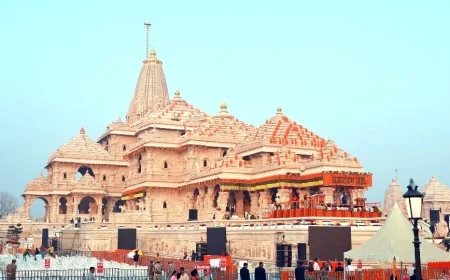
DELHI-----------------------------In Uttar Pradesh politics, there are certain meetings where, even if the official agenda remains undisclosed, the political message resonates for a long time. The approximately 40-minute meeting held on Tuesday in New Delhi between Union Home and Cooperation Minister Amit Shah and Chief Minister Yogi Adityanath is viewed as one such encounter. While the Chief Minister described it as a courtesy call and shared photos on social media, a broader picture emerges when considering the timing of the meeting alongside the political activities preceding and following it. Taking place amidst events such as the controversy over offerings at the Ayodhya Ram Mandir, the Supreme Court issuing notices to the Trust and the government, organizational reshuffles within the BJP, early preparations for the 2027 Assembly elections, and shifting social equations within the opposition, this meeting has sparked numerous questions in political circles. For the Bharatiya Janata Party (BJP), Uttar Pradesh is not merely a state but the pivot of national politics. In the 2024 Lok Sabha elections, the BJP won 240 seats nationwide, yet its tally in Uttar Pradesh dropped from 62 to 33. The NDA, including its allies, secured 36 seats, whereas the Samajwadi Party emerged as the single largest party by winning 37 seats, and the Congress also added six seats to its tally. The most significant political setback occurred in the Faizabad (Ayodhya) Lok Sabha constituency, where the BJP faced defeat despite the construction of the Ram Mandir. Since then, the party has been continuously reviewing the reasons behind its failure to reap the expected political dividends.


Against this backdrop, the BJP’s primary focus has now shifted to the 2027 Assembly elections. The Uttar Pradesh Legislative Assembly comprises 403 seats, requiring a majority of 202 seats to form the government. In 2022, the BJP-led alliance formed the government by winning 273 seats, while the Samajwadi Party alliance secured 125 seats. However, political equations have appeared to shift following the 2024 Lok Sabha elections. Although the BJP operates on the premise that Assembly elections differ from Lok Sabha polls, the party is in no mood to take any risks. The meeting between Shah and Yogi in Delhi is being viewed as part of this broader strategy. Political observers believe the discussion went beyond a mere review of law and order or development projects; it likely covered organizational matters, social equations, the opposition's strategy, and the electoral narrative in detail. This is particularly significant given the opposition's persistent attempts to weaponize the issue of alleged irregularities in offerings at the Ayodhya Ram Mandir. The BJP appears extra cautious following the Supreme Court's notice on this matter, as the party is keen to prevent the opposition from turning a subject deeply tied to religious faith into a political campaign against it.
Interestingly, the recent visit to Uttar Pradesh by BJP leader Nitin Navin—occurring just days before the Shah-Yogi meeting—is also seen as part of this strategic chain. He held separate meetings with the Chief Minister, both Deputy Chief Ministers, the state organization, MPs, MLAs, and office-bearers down to the district level. These meetings placed the greatest emphasis on organizational discipline, booth management, and rectifying weaknesses exposed during the Lok Sabha elections. The party leadership sent a clear message: all leaders must adhere to a unified political line and avoid individual grandstanding or factionalism. The BJP's biggest challenge now lies in managing social equations. The Samajwadi Party achieved remarkable success in the Lok Sabha elections by leveraging the 'PDA' formula—Backward Classes, Dalits, and Minorities. Now, Akhilesh Yadav is attempting to expand this base further; preparations to organize 'Brahmin Sammelans' (gatherings) in Lucknow and several other districts are considered part of this strategy. Political analysts believe that if the Samajwadi Party succeeds in bringing a section of Brahmin voters into the fold alongside non-Yadav Backward Classes, the electoral contest could become significantly tougher.
Consequently, the BJP is working on a parallel social strategy. Special focus is being placed on non-Yadav OBCs, non-Jatav Dalits, women voters, beneficiaries of government schemes, and the youth. The BJP views the crores of beneficiaries of schemes—such as the Pradhan Mantri Awas Yojana, Ujjwala Yojana, Har Ghar Jal, Ayushman Bharat, free ration distribution, and Kisan Samman Nidhi—as its greatest political strength in Uttar Pradesh. According to government data, approximately 15 crore people in the state are receiving free rations under the Pradhan Mantri Garib Kalyan Anna Yojana. The number of beneficiaries of the Kisan Samman Nidhi scheme is also reported to exceed two crore. The party believes that re-establishing a strong foothold among these beneficiaries will be the key to electoral victory. Meanwhile, the opposition is making an all-out effort to craft a new narrative against the BJP. Issues such as the Ayodhya offering controversy, inflation, unemployment, paper leaks, and local discontent are being consistently raised. Political posters that have appeared recently in Lucknow, Mathura, and other cities have further heated up the political atmosphere. While the pro-BJP camp is launching sharp political attacks on the Samajwadi Party, the SP dismisses this as an attempt to divert attention from real issues. In essence, the battle for 2027 will not merely be about 'development versus development'; it will also hinge on narratives, symbols, and emotional issues.
Amidst this, Chief Minister Yogi Adityanath is continuously working to accelerate the pace of development projects—ranging from expressways and medical colleges in Purvanchal, Bundelkhand, and Western Uttar Pradesh... Work is proceeding rapidly on defense corridors, airports, metro systems, and industrial investment projects. It was claimed that investment proposals worth over ₹40 lakh crore were received during the Global Investors Summit held in February 2023. The government states that a significant number of these projects have already materialized on the ground. Showcasing the impact of these projects before the elections will be a priority for the BJP. Political indications also suggest that special emphasis will be placed on better coordination between the party organization and the government. During the Lok Sabha elections, a lack of coordination between the organization and elected representatives at the local level had been a topic of discussion in several constituencies; the BJP does not wish to repeat this mistake. Preparations are underway for a comprehensive campaign ranging from the restructuring of booth committees to the activation of 'Shakti Kendras' (power centers). The party's goal is to establish an active organizational presence at every booth before 2027. The key takeaway from the meeting between Shah and Yogi in Delhi is that the BJP is no longer in a "wait-and-watch" mode regarding election preparations in Uttar Pradesh. While the opposition is focused on expanding its social equations, the BJP is working on a strategy that integrates the organization, the government, development initiatives, and ideological issues. In the coming months, five major issues—Ayodhya, law and order, development projects, social equations, and beneficiary-oriented politics—are likely to form the core of the electoral discourse in Uttar Pradesh. For now, it is certain that this 40-minute meeting in Delhi was not merely a formal interaction but is being viewed as the initial blueprint for the long political battle leading up to 2027.
What's Your Reaction?
 Like
0
Like
0
 Dislike
0
Dislike
0
 Love
0
Love
0
 Funny
0
Funny
0
 Angry
0
Angry
0
 Sad
0
Sad
0
 Wow
0
Wow
0