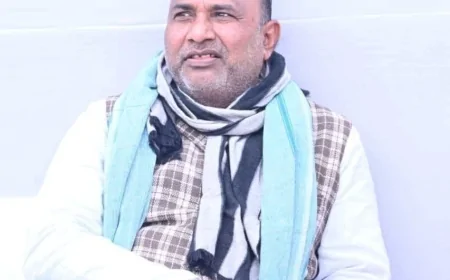


























































THE SAME OLD SLOGANS, PROMISES AND TAUNTS RESONATE AGAIN IN THE ELECTION FEVER: DEVNAND SINGH
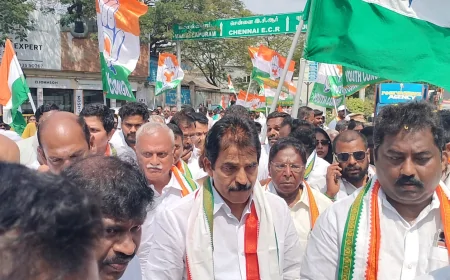
Bihar politics is once again in the midst of an election fever. The same old slogans, promises, and taunts resonate in the air, only the faces and platforms have changed. From Darbhanga to Muzaffarpur, this time, leaders are more concerned with countering the opposition and securing votes than with development. On Wednesday, the picture of the electoral battle in Bihar became clear: on one side, the double engine of the BJP and NDA, and on the other, the Grand Alliance's promise of change.

THE SAME OLD SLOGANS, PROMISES AND TAUNTS RESONATE AGAIN IN THE ELECTION FEVER: DEVNAND SINGH
30-OCT-ENG 22


RAJIV NAYAN AGRAWAL
ARA-------------------------Bihar politics is once again in the midst of an election fever. The same old slogans, promises, and taunts resonate in the air, only the faces and platforms have changed. From Darbhanga to Muzaffarpur, this time, leaders are more concerned with countering the opposition and securing votes than with development. On Wednesday, the picture of the electoral battle in Bihar became clear: on one side, the double engine of the BJP and NDA, and on the other, the Grand Alliance's promise of change.


At an election rally in Darbhanga, Union Home Minister Amit Shah attacked the opposition in his familiar style. He called the Grand Alliance a "thug alliance" and, taking aim at Lalu Prasad Yadav and Sonia Gandhi, said that Lalu wants his son Tejashwi as Chief Minister and Sonia wants her son Rahul as Prime Minister, but both positions are not vacant. Amit Shah's comment was like hitting two birds with one stone: an attack on dynasty politics and the unofficial announcement of the Chief Ministerial face of the NDA. Shah made it clear that Nitish Kumar would take charge of Bihar under the leadership of the NDA, putting an end to political speculation.
Shah's rally was deeply imbued with the symbols and sentiments of Mithila. He credited the BJP government with granting official status to the Maithili language and noted that the Constitution is also available in Maithili. He also spoke about the construction of a temple dedicated to Goddess Sita at Punauradham in Mithila and the expansion of the Ram Circuit, conveying a message of religious and cultural ties. Shah listed a long list of the NDA government's achievements in Bihar—free rations for 85.2 million people, the formation of the Makhana Board, free electricity, pension increases, and the announcement of projects like AIIMS and the Metro—all echoing the double-engine development model. But the political focus of his speech was that the RJD-BJP battle is no longer about ideology, but about character, and this has become the NDA's election mantra.
Yogi Adityanath's arrival in Bihar after Darbhanga was, in a way, a reaffirmation of the BJP's Hindutva campaign. He began by speaking in Bhojpuri and directly engaging with the public, saying that the land of Bihar has been a symbol of bravery and self-respect. Seeing the crowds in the rain, he described it as a shower of flowers. Yogi reminded the public of the 15-year Lalu-Rabri rule, reviving that era of fear, corruption, and unemployment. He said that the safety of daughters was left to God, and the youth were unemployed.
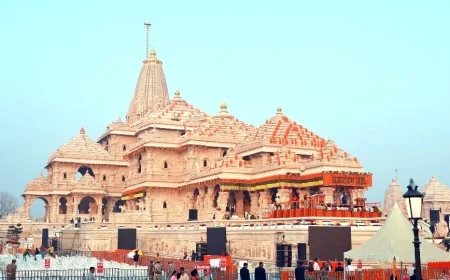
Praising Nitish Kumar's leadership, Yogi said that the work that should have been done 50 years ago was now being done. He listed the development of roads, medical colleges, and connectivity, and by raising the issue of the Ram Temple, he shifted the electoral discourse toward faith. The Congress and RJD did not want the temple to be built, but Modi kept his promise. With this statement, Yogi brought the BJP's election narrative—Ram, nation, and development—back to the center.
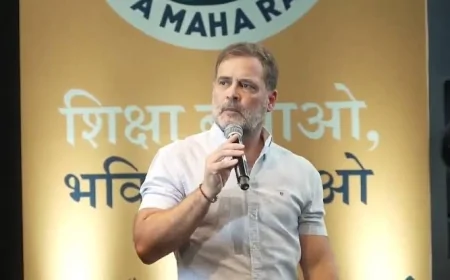
But the other side of this political script in Bihar was Rahul Gandhi's speech in Muzaffarpur, where he attacked both the Prime Minister and the Chief Minister in a completely different tone. Rahul said that the Prime Minister only practices vote politics, not development. He can even dance on stage if given the opportunity. This sarcasm was sharp, but it clearly reflected Rahul's strategy: to transform Modi's image from that of a popular leader to that of a propagandist.
Talking about Bihar's grassroots problems, Rahul Gandhi said that Nitish Kumar has been in power for twenty years, but Bihar's condition remains dire—education, health, and employment are all in shambles. He questioned, "If the hardworking people of Bihar can develop Delhi and Dubai, why not our Bihar?" This statement brings the Grand Alliance's core issues—change and employment—back to the electoral focus. Rahul also said that the Grand Alliance seeks grassroots change, not mere rhetoric, as an attempt to present an alternative approach to the BJP's policies.
Tejashwi Yadav, carrying forward Rahul's momentum, has emphasized youth and unemployment in his manifesto. He stated that if his government is formed, ten lakh jobs will be created in Bihar. For Tejashwi, this election is not just a battle for power, but also a test of his political credibility. Meanwhile, Nitish Kumar repeatedly reiterates that Bihar's development journey is incomplete and must be completed. His statements reflect stability and administrative experience, but also a sense of fatigue and repetition.
In this electoral landscape, on one hand, Amit Shah and Yogi Adityanath are offering a mix of development, religion, and nationalism, while on the other, Rahul Gandhi and Tejashwi Yadav are building an emotional connection with issues of youth, unemployment, and migration. Nitish Kumar is occupying a middle ground—emerging as the face of experience and stability.
The people of Bihar will now choose between these: dynasty and development, promises and experience, religion and employment. Amidst the cacophony of political attacks and taunts, the real question is whether Bihar will give the double engine another chance this time or trust the engine of change. The enthusiasm and sarcasm may be at their peak on election platforms, but the public's expectations remain simple: employment, education, and a life of dignity. These are the issues which are the slowest in this noise of Bihar, but also the deepest.
What's Your Reaction?
 Like
0
Like
0
 Dislike
0
Dislike
0
 Love
0
Love
0
 Funny
0
Funny
0
 Angry
0
Angry
0
 Sad
0
Sad
0
 Wow
0
Wow
0