






























































CELEBRATING THE ETERNAL FLAME: THE 96TH BIRTH ANNIVERSARY OF PANDIT VRAJBHUSHAN MISHRA ‘AAKRANT’ AND THE RELEASE OF ‘BHAWANJALI’
Introduction: A Tribute to a Sanskrit Sentinel In the heart of Bihar's cultural cradle, Ara (Bhojpur), where the echoes of ancient wisdom still resonate through the corridors of time, a momentous gathering unfolded on September 26, 2025. It was precisely at 2:00 PM, under the azure afternoon sky, that the Maruti Sanskrit Research Institute, Prakashpuri, Ara, transformed the opulent confines of Hotel Grand into a sanctum of reverence and intellectual fervor. This was no ordinary assembly; it marked the 96th birth anniversary of Pandit Vrajbhushan Mishra, affectionately and reverentially known as 'Aakrant' ji—a titan of Sanskrit scholarship whose life was a ceaseless crusade for the preservation and propagation of India's classical linguistic heritage.



CELEBRATING THE ETERNAL FLAME: THE 96TH BIRTH ANNIVERSARY OF PANDIT VRAJBHUSHAN MISHRA ‘AAKRANT’ AND THE RELEASE OF ‘BHAWANJALI’
27-SEP-ENG 10


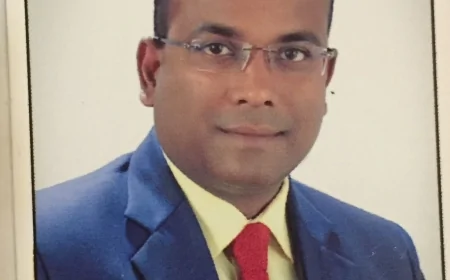
RAJIV NAYAN AGRAWAL
ARA------------------------------Introduction: A Tribute to a Sanskrit Sentinel


In the heart of Bihar's cultural cradle, Ara (Bhojpur), where the echoes of ancient wisdom still resonate through the corridors of time, a momentous gathering unfolded on September 26, 2025. It was precisely at 2:00 PM, under the azure afternoon sky, that the Maruti Sanskrit Research Institute, Prakashpuri, Ara, transformed the opulent confines of Hotel Grand into a sanctum of reverence and intellectual fervor. This was no ordinary assembly; it marked the 96th birth anniversary of Pandit Vrajbhushan Mishra, affectionately and reverentially known as 'Aakrant' ji—a titan of Sanskrit scholarship whose life was a ceaseless crusade for the preservation and propagation of India's classical linguistic heritage.
The centerpiece of the event was the solemn release of Bhavanjali, a meticulously compiled memorial anthology of Aakrant ji's non-professional writings in Sanskrit, Hindi, and literature. Edited with filial devotion by his grandson, Shri Shashi Ranjan Mishra 'Satyakam', and published by the esteemed Sarvabhasha Trust, New Delhi, the volume stands as a testament to Aakrant ji's multifaceted genius. Spanning poetic verses, scholarly essays, and reflective prose, Bhavanjali captures the essence of a man who not only taught languages but breathed life into them, molding generations of minds in the process.
Organized by Aakrant ji's devoted family members—Shri Muktinath Mishra, Shri Arvind Mishra, and Shri Vinit Mishra—the program commenced punctually, a nod to the discipline that defined its honoree. From the flickering diya of the inaugural lamp lighting to the final vote of thanks, every moment was imbued with a sense of timeless continuity. As the current date, September 27, 2025, dawns with the afterglow of yesterday's celebrations, this article delves deeply into the proceedings, weaving together the threads of homage paid by scholars, educators, and family alike. In doing so, it honors Aakrant ji's legacy not merely as a teacher, but as a nation-builder, a rishi in human form, whose indomitable spirit continues to inspire the quest for cultural renaissance.
The Dawn of Devotion: Inauguration and Artistic Homage
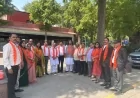
The program, true to its Sanskrit roots, began with rituals that bridged the mortal and the divine. Under the chairmanship of Prof. Mahesh Singh, former Head of the Geography Department at Har Prasad Das Jain College, Ara, the assembly was graced by an august lineup of dignitaries. Prof. Nand Ji Dubey, former Head of the Hindi Department at Veer Kunwar Singh University (VKSU), Ara, served as the Chief Guest, his presence a beacon of literary eminence. Special guests included Prof. Gourishankar Tiwari, former Professor of Sanskrit; Shri Surendra Singh, a resident of Pavna; Shri Ramshwar Mishra; and the organizers themselves, Shri Arvind Mishra and Shri Shashi Ranjan Mishra.
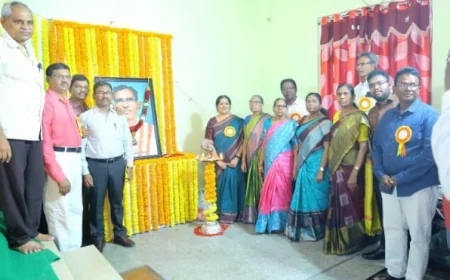
The proceedings were masterfully conducted by Shri Krishna Gopal Mishra, whose poised narration ensured a seamless flow, much like the rhythmic cadence of a Vedic chant. The inauguration proper commenced with the collective lighting of the sacred lamp—a symbolic ignition of knowledge's eternal flame—followed by heartfelt floral tributes to an image of Lord Hanuman and the cherished photograph of Aakrant ji, evoking his memory as a devoted bhakta and scholar.
No Sanskrit sammelan would be complete without the invocation of the divine, and here, Smt. Purnima Pandey, Assistant Teacher at Shri Jain Bala Vishram, Ara, took center stage. With a voice resonant with emotion and precision, she rendered "Namami Vayunandanam," the Hanuman Vandana from Aakrant ji's own composition in the Arghyam granth. This octet, a lyrical paean to the wind-god's son, filled the hall with its melodic fervor: "Namami Vayunandanam, who traverses the skies with unyielding grace..." Pandey's rendition was not mere recitation; it was a bridge to Aakrant ji's soul, reminding all present of his profound devotion to Hanuman, the epitome of selfless service and intellectual prowess.
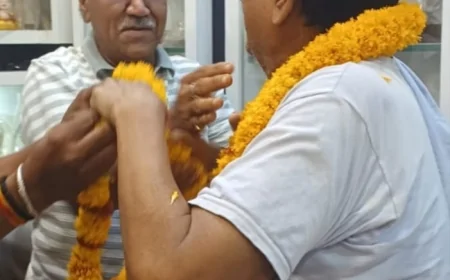
The atmosphere warmed further with a soul-stirring welcome song performed by Smt. Kalindi Bhardwaj, Assistant Teacher of Sanskrit at Shri Jain Bala Vishram, Ara, and Smt. Kalpana Bhardwaj, Assistant Teacher at the Higher Secondary School, Kusumha, Udwantnagar. Their harmonious voices, laced with traditional folk inflections, extended a poetic embrace to the arriving guests: verses extolling hospitality, wisdom, and the guru-shishya parampara. As the notes lingered, the organizers—Shri Arvind Mishra and Shri Shashi Ranjan Mishra—proceeded to honor the platform dignitaries. Garlands of marigold and jasmine were draped with reverence, angavastras (scarves of honor) bestowed, and the inaugural copy of Bhavanjali was unveiled in a moment of collective aspiration. This ritual of malyarpan and angavastra sammman was more than ceremonial; it was an affirmation of the communal debt owed to Aakrant ji's enduring legacy..
Echoes of a Pedagogical Pioneer: The First Waves of Udgar
With the formalities elegantly dispatched, the heart of the program unfolded through a series of udgar—profound reflections that peeled back the layers of Aakrant ji's extraordinary life. These speeches, delivered with the gravitas of seasoned orators, painted a vivid portrait of a man whose classroom was a battlefield for cultural revival, and whose pen was a sword against oblivion.
The first speaker, Shri Ramshwar Mishra, a close associate and witness to Aakrant ji's journey, opened with a shishya-anubhuti that transported the audience back to Pavna's modest schools. He traced Aakrant ji's odyssey from his early postings: the humble beginnings at Belaure High School, the transformative tenure at Beermpur High School, and the crowning glory at Har Prasad Das Jain School, Ara. "Aakrant ji was no ordinary teacher," Mishra recounted, his voice steady yet laced with nostalgia. "Students didn't just follow him; they reshaped their destinies around him. Families would uproot themselves, changing schools mid-year, just to bask in the radiance of his pathan-pathan paddhati—the immersive, dialogue-driven method that made Sanskrit not a dead language, but a living, breathing companion."
Mishra elaborated on anecdotes that underscored Aakrant ji's magnetic influence. At Belaure, where resources were scarce, he improvised with storytelling, turning grammar lessons into epic recitations from the Ramayana. In Beermpur, his emphasis on oral proficiency saw shy adolescents debating Valmiki's verses with the eloquence of scholars. And at Jain School, his innovations—such as integrating Sanskrit with local Bhojpuri idioms—drew enrollment surges, proving that true education transcends walls. "He was the singular shikshak," Mishra emphasized, "for whom enrollment wasn't a metric, but a movement. Students clamored for the vidyalaya where Aakrant ji stood, for in his presence, learning was liberation."
This inaugural udgar set the tone: Aakrant ji as a catalyst, whose pedagogical alchemy turned apathy into ardor, ensuring Sanskrit's flame burned brighter in rural Bihar's heartland.
Chronicles of Editorial Zeal: Surendra Singh's Insights
Building on this foundation, Shri Surendra Singh, a Pavna resident and guardian of literary artifacts, took the podium for the second udgar. His focus was Aakrant ji's editorial prowess, a lesser-sung but pivotal chapter in his oeuvre. Singh introduced the audience to the periodicals that bore Aakrant ji's indelible stamp—humble yet heroic publications like Maruti Sanskrit Anuvad Sudha and other mimeographed journals that disseminated Sanskrit lore to remote corners of Bihar.
"These were not mere magazines," Singh declared, holding aloft a weathered copy from his personal archive. "They were lifelines, threads connecting isolated pandits to the broader sanskriti." He detailed how Aakrant ji, often single-handedly, edited, illustrated, and distributed these issues during the lean post-Independence years. Issues featured translations of Upanishadic gems into accessible Hindi, critiques of colonial linguistic policies, and calls for Sanskrit's reinstatement in curricula. Singh shared a poignant relic: a 1970s edition still pristine in his collection, its pages yellowed but spirit unyielding. "Aakrant ji's editorials were battle cries," he noted, "urging readers to reclaim their heritage from the dust of neglect."
Singh's discourse illuminated the logistical feats—Aakrant ji cycling to printing presses, bartering for paper amid shortages—revealing a man whose commitment to ink and idea rivaled any revolutionary. In an era when Sanskrit journals struggled for survival, Aakrant ji's editions fostered a network of contributors, from village vaids to urban academics, proving that editorial zeal could forge a pan-Indian sanskriti sansad.
Innovations Amid Adversity: Rajendra Pathak's Visionary Gaze
The third udgar came from Shri Rajendra Pathak, journalist and member of the Bihar Sanskrit Shiksha Board, whose words crackled with urgency. Pathak hailed Maruti Sanskrit Anuvad Sudha as a compendium of novelties and trials, encapsulating Aakrant ji's lifelong skirmish with Sanskrit education's demons. "Aakrant ji didn't just teach; he innovated," Pathak asserted. "He confronted the challenges head-on: rote memorization's tyranny, urban-rural divides, and the creeping irrelevance imposed by modernization."
Pathak recounted Aakrant ji's experiments—playful etymological games to demystify shabda-shakti, community sahitya sammelans to democratize learning, and advocacy for Sanskrit as a tool for social cohesion. Yet, he didn't shy from the shadows: the funding droughts, orthodox resistance, and skepticism from English-centric policymakers. "To save Sanskrit from its own aakrantas—internal saboteurs of tradition," Pathak urged, "the new generation must become aakrant: aggressive, adaptive warriors." His call resonated, framing Aakrant ji not as a relic, but a blueprint for revival, where challenges birthed creations like Anuvad Sudha, a bridge blending ancient texts with contemporary crises.
Pathak's eloquence stirred murmurs of agreement, underscoring how Aakrant ji's innovations—such as vernacular glossaries for Vedic hymns—paved the way for Bihar's Sanskrit renaissance, inspiring educators to wield pedagogy as a weapon against cultural erosion.
Familial Tapestries and Policy Triumphs: Rajiv Nayan Agrawal's Intimate Recollections
The fourth udgar shifted to the personal, with Shri Rajiv Nayan Agrawal, former Principal of Har Prasad Das Jain School and independent columnist, sharing a tapestry woven from six decades of kinship. "My bond with Aakrant ji dates to the swinging '60s," Agrawal began, his eyes misting. "As family and fellow educator, I witnessed the alchemy of his home—where dinner debates dissected Kalidasa, and Raksha Bandhan mornings echoed with sloka recitals."
Agrawal chronicled familial vignettes: Aakrant ji mentoring young Rajiv through Panini's sutras, turning familial discord into dialectical harmony. But the udgar's crescendo was Aakrant ji's Herculean lobby for Sanskrit Day. "Through tireless petitions and parliamentary whispers," Agrawal revealed, "his efforts culminated in the central government's 1965 declaration: Raksha Bandhan as a national holiday for Sanskrit observance." This victory, born of nocturnal letter-writing marathons and alliances with ministers, symbolized Aakrant ji's fusion of personal passion with public policy—a shikshak who scripted holidays into history.
Agrawal's narrative humanized the icon, portraying Aakrant ji as a familial anchor whose educational ethos permeated hearths, ensuring Sanskrit's whispers endured in bedtime stories and beyond.
Rishi's Mantle: Deepak Vardhan's Historical Lens
Transitioning to academia's hallowed halls, the fifth udgar was delivered by Dr. Deepak Vardhan, Head of the History Department at Veer Kunwar Singh University, Ara. Viewing Aakrant ji through historiography's prism, Vardhan posited him as "a vahak of the rishi parampara—a living embodiment of the seer-sage tradition." He traced parallels: like ancient rishis who encoded knowledge in oral epics, Aakrant ji democratized Sanskrit via village pathshalas, preserving it against colonial amnesia.
Vardhan delved into Aakrant ji's role in Bihar's post-1947 cultural reconstruction, where he archived folkloric Sanskrit variants, safeguarding indigenous narratives. "In an age of historical erasure," Vardhan reflected, "Aakrant ji was the archivist of the soul, his teachings a bulwark against the tempests of time." This scholarly exegesis elevated the event, reminding attendees that Aakrant ji's legacy was etched not just in tomes, but in the historical continuum of India's intellectual lineage.
Legal Luminary's Lament: Pushp Raj Singh's Judicial Reflections
The sixth udgar brought the gravitas of the bar, with Shri Pushp Raj Singh, Advocate at the Supreme Court, New Delhi, recounting shishya-anubhuti from 1999 onward. "Aakrant ji's sampark was a revelation," Singh shared, "transforming a law student's rote advocacy into eloquent oratory laced with Upanishadic nuance." He illuminated Sanskrit's juridical import—its precision in contracts mirroring Manu's dharmashastras—and credited Aakrant ji's tutelage for infusing his Supreme Court pleas with ethical depth.
Singh wove personal anecdotes: late-night dissections of Arthashastra for modern governance, and Aakrant ji's quiet interventions in rural litigations, invoking shastric equity. "Sanskrit is law's lingua franca," he proclaimed, "its grammar a scaffold for justice." This udgar bridged academia and advocacy, portraying Aakrant ji as a polymath whose wisdom fortified pillars of state and society.
Memoirs of Mentorship: Gourishankar Tiwari's Sanskrit Sojourn
Seventh was Prof. Gourishankar Tiwari, former Sanskrit Professor, whose udgar was a memoir-meander through shared sands. As a contemporary in the department, Tiwari reminisced on collaborative curricula: co-authoring primers that infused Sanskrit with Bhojpuri vitality, and joint expeditions to unearth temple inscriptions. "Aakrant ji's laughter echoed like a sloka's rhyme," Tiwari chuckled, "even as we wrestled with vakya-vishleshan's thorns."
He touched on challenges—budget cuts forcing improvised blackboards—and triumphs, like student-led natyas that revived Kalidasa's plays. Tiwari's narrative was intimate, a peer's paean to a colleague whose mentorship made Sanskrit not a subject, but a shared pilgrimage.
Poetic Interlude: Purnima Pandey's Lyrical Homage
Interwoven as the eighth udgar, Smt. Purnima Pandey returned with a self-composed kavya: "Jai Mridul Manohar Tejpujan, Pavna ke he vidvat mahaan." This verse, a floral offering to Aakrant ji's gentle yet radiant intellect, painted him as Pavna's scholarly sun—nurturing, illuminating, eternal. Her sware-path, voice trembling with authenticity, elicited applause, a poetic palate-cleanser before the chief address.
Nation-Builder's Benediction: Prof. Nand Ji Dubey's Keynote
The chief guest, Prof. Nand Ji Dubey, was then invited, his udgar a clarion call elevating Aakrant ji to "rashtra-nirmata"—nation-builder extraordinaire. "Acharyas do not merely teach; they impart vidvatta and forge the nation's sinews," Dubey intoned. "Governments rise and fall, but rashtra's edifice endures through such souls." He lauded Aakrant ji's contributions: from scripting Sanskrit policy briefs to igniting rural literacy drives, all in service of cultural sovereignty.
Dubey dissected the irony: in a globalized gale, Aakrant ji anchored India to its moorings, his Arghyam and editorials as antidotes to linguistic imperialism. "His every kary—be it a shala's sloka or a sammelan's discourse—was rashtra-nirman's brick," Dubey concluded, his words a wreath on Aakrant ji's unseen throne.
Presidential Peroration: Prof. Mahesh Singh's Closing Counsel
In his presidential address, Prof. Mahesh Singh extolled the family's orchestration, their labor of love in compiling Bhavanjali. "From parijans' pens to printers' plates, this is devotion distilled," he praised. Foreseeing continuity, Singh exhorted: "We may wax or wane, but the centenary jayanti in 2029 must blaze undimmed—a pledge to posterity."
His vision—envisioning annual tributes evolving into a Sanskrit Research Center—sparked nods, cementing the event's forward thrust.
The Volume Unveiled: 'Bhavanjali' as Cultural Corpus
At the event's core loomed Bhavanjali's release, a magnum opus of Aakrant ji's unpublished gems: essays on Hanuman's valor, Hindi-Sanskrit syncretism, and literary critiques blending Tagore with Tulsidas. Shashi Ranjan Mishra, in a poignant aside, revealed the impetus: "Baba's rachnayein are amulya dharohar—our ancestors' legacy. If we falter in preservation, what inheritance for the unborn?" The first edition, 300 copies strong, bears a nominal Rs. 1,499 tag from Sarvabhasha Trust, yet familial munificence ensures gratis dispatch to litterateurs, libraries, and vidwans nationwide.
This philanthropy echoes Aakrant ji's ethos: knowledge as commons, not commodity. Mishra detailed the odyssey—digitizing yellowed manuscripts, soliciting endorsements from peers— a familial symphony culminating in this codex of conscience.
Epilogue: Gratitude and Legacy's Long Shadow
As the sun dipped, Shri Shashi Ranjan Mishra proffered the dhanyawad gyanapan, thanking all: from performers to pundits, family to followers. "This is not closure," he averred, "but commencement—Aakrant ji's adhyatmik yatra continues in us." With the conductor's flourish, the program concluded, leaving an aura of anugrah.
In summation, this 96th jayanti was a microcosm of Aakrant ji's macro-impact: a shikshavid whose classrooms kindled kriti, editor whose pages penned progress, innovator whose challenges chiseled change. As Bihar—and Bharat—grapples with identity's flux, Aakrant ji's Bhavanjali beckons: a chalice of bhav, brimming with the elixir of eternity. His story, etched in these proceedings, urges us: become aakrant, lest the ancients' akhand jyoti flicker to forgetfulness.
What's Your Reaction?
 Like
1
Like
1
 Dislike
0
Dislike
0
 Love
0
Love
0
 Funny
0
Funny
0
 Angry
0
Angry
0
 Sad
0
Sad
0
 Wow
0
Wow
0