



























































WORKSHOP ORGANIZED ON ‘RELEVANCE OF MAHATMA GANDHI’ TO MARK THE 83RD ANNIVERSARY OF QUIT INDIA MOVEMENT
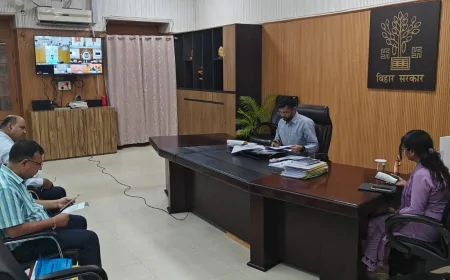
On the occasion of the 83rd anniversary of the historic Quit India Movement, a one-day workshop on the topic “Relevance of Mahatma Gandhi” was organized in the Durbar Hall of Raj Bhavan, Bihar. The purpose of this event was to discuss the usefulness of Gandhiji's thoughts and principles in the contemporary context.

PATNA (RNI) On the occasion of the 83rd anniversary of the historic Quit India Movement, a one-day workshop on the topic “Relevance of Mahatma Gandhi” was organized in the Durbar Hall of Raj Bhavan, Bihar. The purpose of this event was to discuss the usefulness of Gandhiji's thoughts and principles in the contemporary context.
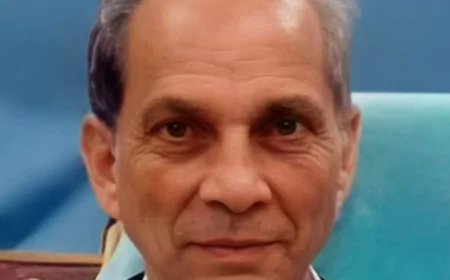
The workshop was inaugurated with the lighting of the lamp and address by Bihar Governor Arif Mohammad Khan. In his inaugural address, he described Gandhiji's principles of truth, non-violence, self-reliance and gram swaraj as essential in today's socio-political scenario. He said that the culture of India has always been of peace and non-violence, which Bapu not only spread throughout his life but also implemented it in practical form. Gandhiji's moral strength still inspires. It is this moral strength, due to which India stands out as a superpower in the world today.


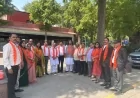
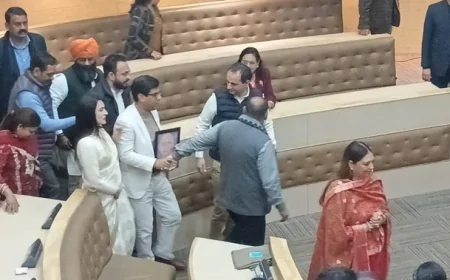
Chief Guest Arif Mohammad Khan said this to Prof. Special honour was given to (Dr.) Rekha Kumari, Prof. Paras Rai, Dr. Shubhlakshmi, Dr. Kumari Rekha, Prof. Parmanand Singh and Wasim Ahmed Khan by giving them commendation letters.
The session was presided over by Nikhil Kumar, former Governor of Kerala and Nagaland. In his presidential address, he shared his views on the relevance of Gandhiji's thoughts in the current social context and said that he will fully support this campaign started to spread the relevance of Mahatma Gandhi. The welcome address was presented by Prof. (Dr.) Devendra Prasad Singh, Convener, Gandhi Pragyaata Sthapnaarth Abhiyan Samiti. Dr. Suraj Mandal, former MP and Vice President, Jharkhand Autonomous Council was present as the special guest. On this occasion, Prof. (Dr.) Dinesh Chandra Rai (Vice Chancellor, B.R.A.B. University, Muzaffarpur), Prof. (Dr.) Tapan Kumar Shandilya (Principal, T.P.S. College, Patna and former Vice Chancellor, DSPMU, Ranchi) and Sanjay Rai (Secretary, Harijan Sevak Sangh, New Delhi) also expressed their views. The session was conducted by Prof. (Dr.) Akhilesh Kumar, Principal, M.D. College, Naubatpur and vote of thanks was given by Dr. Dev Prakash, Assistant Professor, Daudnagar College, Daudnagar.


After the inaugural session, a technical session was organized which was chaired by Prof. (Dr.) Dinesh Chandra Rai. The keynote speaker Prof. (Dr.) Tapan Kumar Shandilya gave a deep explanation of Gandhiji's thoughts in the context of today's challenges - climate change, inequality, unemployment and social disintegration.
Asif Wasi (Joint Secretary, Gandhi Museum, Patna) highlighted Gandhiji's message of sustainable development and peace building through the events of his life.
The session was conducted by Dr. Shashi Bhushan and Dr. Dev Prakash. The vote of thanks was given by Venkatesh Kumar.
The closing session was chaired by Vinay Kumar, Director, Bapu Tower, Patna.
The chief guest was Surendra Kumar, former Secretary, Gandhi Peace Foundation, New Delhi.
The keynote speaker Sanjay Rai (Secretary, Harijan Sevak Sangh, New Delhi) presented Gandhiji's policies as the foundation of social harmony and justice and linked the Gandhian approach to the revival of democratic values. The closing address was given by Dr. Suraj Mandal, in which he described Gandhiji's legacy as a source of inspiration for future generations. The vote of thanks was given by Dr. Shashi Bhushan, Environmental Research and Rural Development Institute, Patna.
In this whole day long program, the need to implement Gandhiji's ideas in education, health, rural development, environmental protection and international peace was emphasized. The participants collectively conveyed the message that Gandhian principles are not only a heritage of the past but also a guideline for socio-economic reconstruction in the present and future.
What's Your Reaction?
 Like
0
Like
0
 Dislike
0
Dislike
0
 Love
0
Love
0
 Funny
0
Funny
0
 Angry
0
Angry
0
 Sad
0
Sad
0
 Wow
0
Wow
0