











































































TEACHER RATIONALIZATION AND TRANSFER IS NO EASY TASK
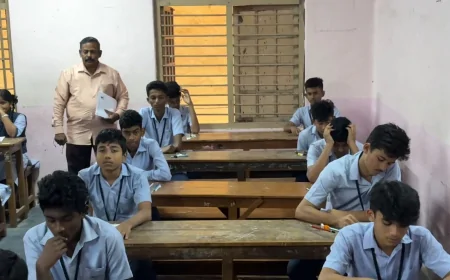
News regarding teacher transfers in Bihar is circulating widely. Education Minister Mithilesh Tiwari has stated that teacher rationalization will precede transfers, with the process based on student enrollment data available on the 'e-Shikshakosh' portal. The government has established a student-teacher ratio; rationalization will be carried out accordingly, followed by the transfer of teachers who require it, based on applications submitted by them.

TEACHER RATIONALIZATION AND TRANSFER IS NO EASY TASK
17-JULY-ENG 6


RAJIV NAYAN AGRAWAL
PATNA--------------------------News regarding teacher transfers in Bihar is circulating widely. Education Minister Mithilesh Tiwari has stated that teacher rationalization will precede transfers, with the process based on student enrollment data available on the 'e-Shikshakosh' portal. The government has established a student-teacher ratio; rationalization will be carried out accordingly, followed by the transfer of teachers who require it, based on applications submitted by them.


Social media platforms, teachers' unions, and the general public are all discussing this matter in various ways. In fact, teachers constitute a significant portion of Bihar's approximately 1.1 million government employees; consequently, any issue concerning the state's roughly 550,000 teachers becomes major news. Another contributing factor is the Education Department's history of controversy and its tendency to issue new directives while disregarding its own previous orders. This pattern has persisted for years, with countless letters and orders issued annually—so many, in fact, that the department itself often loses track of the number and content of the directives it has released.
Teachers associated with unions state that confusion prevails everywhere, and the Education Department shows no interest in resolving it. The prevailing trend seems to be: maintain the confusion, keep the teachers distressed, and ensure the government's agenda moves forward.
Regarding the student-teacher ratio and the data available on 'e-Shikshakosh', two critical points emerge. Following the 'Sakshamta Pariksha-1' (Competency Test-1) in 2024, discussions on transfers began, yet the criteria for these transfers were altered multiple times. After transfer applications were invited and an uproar ensued, then-Chief Minister Nitish Kumar announced in November 2024 that teachers wishing to remain in their current schools could do so. This marked the beginning of the ensuing complications. Teachers who have been waiting years for a transfer argue that unless those long-settled in Patna and other cities are transferred, teachers posted in remote schools cannot secure their preferred locations. Yet, for reasons unknown, the government hastily permitted veteran teachers to remain in their current schools. Consequently, for teachers in remote areas who had long awaited transfers, moving to a preferred block or city remained a pipe dream; meanwhile, those who *were* transferred often ended up in schools that already had sufficient staff or low student enrollment. This occurred because the government failed to assess actual needs or consider the student-teacher ratio during the transfer process.
Now that the transfers have largely concluded—leaving only a few thousand teachers pending—the government has initiated an adjustment process. With talk of determining the student-teacher ratio based on the 'e-Shikshakosh' portal, the role of this platform becomes a crucial point of discussion.
It is essential to understand the basis of the data on e-Shikshakosh. The portal displays data only for students whose Aadhaar and bank account details are updated; for instance, if a school has 300 enrolled students but 50 lack Aadhaar or bank accounts, those 50 are not reflected in the e-Shikshakosh records. However, the department has sought updated data from all schools, which should reveal the actual figures.
Another significant factor is that if transfers are strictly aligned with the student-teacher ratio, the number of available teachers will drop whenever staff members take leave. If two teachers are on casual, special, or other forms of leave, classroom instruction will be disrupted. Since teachers cannot be denied leave, it is important to recognize that having a slightly higher number of teachers in a school would ensure a more effective teaching-learning environment. Many teachers' unions and leaders also believe that, given the technical issues involved, the government should make a well-considered decision. Transfers should be granted only to those teachers who request them—moving them to the nearest possible school—and actual data from all schools should be collected to determine the appropriate student-teacher ratio.
Firstly, teachers have been working in Classes 1–5 for nearly 20 years, yet they have never been promoted to the graduate grade, despite the fact that the highest volume of recruitment historically took place for the 1–5 level. Recently, MLC Banshidhar Brajvasi wrote to the Education Minister expressing his objection to this situation. It is evident that there appears to be a surplus of teachers in primary schools (Classes 1–5) and a relative shortage in middle schools, primarily because the government failed to grant promotions.
The second aspect to consider is this: if a school has 10 students in each class from grades 1 to 5, and the government assigns only two teachers based on numerical strength, one must ask whether two teachers can effectively manage five classes simultaneously. If not, how will the curriculum be completed? Furthermore, if one of these teachers goes on leave, how will the teaching continue?
A third significant point is that there are approximately 70,000 contract teachers (*niyojit shikshak*) who have been stationed at the same school for a long time. They can only be transferred within their own panchayat or block. The government If the service conditions governing their employment have not yet been altered, can the redeployment of such teachers be executed properly without first addressing their formal integration or adjustment?
A fourth crucial aspect concerns teachers who have already been transferred within the last year or eighteen months: will they be reassigned to yet another location? Is it appropriate to transfer teachers again—when they were previously moved based on specific criteria such as spousal employment, serious illness, or other valid reasons?
Given these circumstances, the task of simultaneously managing redeployment and transfers appears extremely challenging for the Education Department. If the government manages to relocate these teachers without triggering disputes or litigation, it would be considered a significant achievement.
What's Your Reaction?
 Like
0
Like
0
 Dislike
0
Dislike
0
 Love
0
Love
0
 Funny
0
Funny
0
 Angry
0
Angry
0
 Sad
0
Sad
0
 Wow
0
Wow
0