







































FIRST BJP GOVERNMENT IN BENGAL
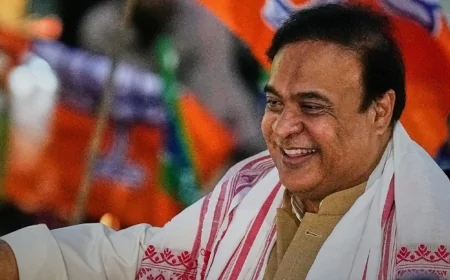
In West Bengal, Chief Minister Suvendu Adhikari and five ministers took their oaths on Saturday at the Brigade Parade Ground, marking the formation of the first-ever Bharatiya Janata Party (BJP) government in the state. Representatives from both the northern and southern regions of the state have been included in the cabinet, though no one from Kolkata has been given a berth.
FIRST BJP GOVERNMENT IN BENGAL
10-MAY-ENG 8
RAJIV NAYAN AGRAWAL
ARA--------------------------------In West Bengal, Chief Minister Suvendu Adhikari and five ministers took their oaths on Saturday at the Brigade Parade Ground, marking the formation of the first-ever Bharatiya Janata Party (BJP) government in the state. Representatives from both the northern and southern regions of the state have been included in the cabinet, though no one from Kolkata has been given a berth.


Reflecting the diverse ethnic fabric of West Bengal, the cabinet features representation from various communities, including the Matuas and Santhals. Brief profiles of the five members of Adhikari’s Council of Ministers who took the oath are as follows:
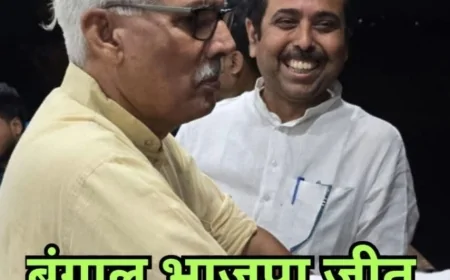
Dilip Ghosh: While the 2026 Assembly elections—in which he defeated Mamata Banerjee in Bhabanipur to emerge as the "hero of an electoral upset"—catapulted Suvendu Adhikari to the center stage of politics, these very elections also scripted a remarkable comeback for Dilip Ghosh, the former President of the BJP's West Bengal unit, thereby cementing his role for a more balanced "second innings" in state politics.
One of the party's most recognizable and combative faces in Bengal, Ghosh played a pivotal role in transforming the BJP from a fringe entity into the principal rival of the Trinamool Congress.
Known for his sharp—and often controversial—statements as well as his grassroots-level politics, Ghosh—a former *Pracharak* (full-time worker) of the Rashtriya Swayamsevak Sangh (RSS)—oversaw the BJP's organizational expansion in the state between 2015 and 2021.
The party achieved a major breakthrough in the 2019 Lok Sabha elections, winning 18 out of the 42 seats in Bengal. This was an unprecedented performance that reshaped the state's political landscape. Ghosh was elected as the Member of Parliament (MP) from Medinipur, further consolidating his influence in the politically sensitive Junglemahal region.
However, in the years that followed, this once-influential leader appeared to drift into a peculiar state of political uncertainty within the party, as the internal dynamics of the Bengal BJP began to shift. Following the 2024 Lok Sabha elections, rifts with certain sections of the state leadership intensified further when Ghosh publicly criticized organizational decisions taken under the leadership of his successor, Sukanta Majumdar.
After shifting from his stronghold in Medinipur to contest from Burdwan-Durgapur, he lost the seat and openly blamed "internal strife" within the party, along with flawed election campaign management, for the defeat. These statements by him exposed the factional tensions prevailing within the state unit.
These tensions became even more apparent when Ghosh, accompanied by his newlywed wife, attended the *Pran Pratishtha* (consecration) ceremony at the Jagannath Temple in Digha, where he was seen engaging in a brief conversation with the then Chief Minister, Mamata Banerjee. The Bengal BJP had officially boycotted this event. This incident drew criticism from certain sections of the state leadership.
Nevertheless, setting these tensions aside, Ghosh re-emerged as a key figure in the BJP's political strategy. His organizational experience and deep connection with grassroots workers were once again viewed as valuable assets as the party began preparations for the 2026 Assembly elections—elections which the BJP ultimately won in a resounding manner.
Ghosh secured a victory from the Kharagpur Sadar seat—the very constituency where he had once commenced his journey in electoral politics. He handed a crushing defeat to the incumbent Trinamool Congress MLA, Pradip Sarkar.
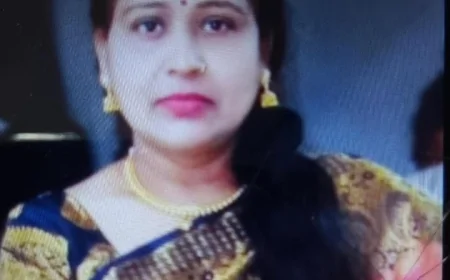
Agnimitra Paul: A fashion designer turned state politician, Paul has emerged as one of the most prominent faces of the BJP's Bengal unit. She is distinguished by her vocal role in opposition politics and her active presence within the Legislative Assembly.
Representing the Asansol South constituency—located in the state's coal-mining belt—Paul first won the seat in 2021 by defeating the Trinamool Congress's Saayoni Ghosh (who is now a Lok Sabha MP), and she successfully retained the seat in the subsequent election as well.
She had joined the BJP in March 2019. She has served in positions such as the State President of the BJP Mahila Morcha and General Secretary of the party's Bengal unit, and currently serves as a Vice President.
Paul contested the 2022 Asansol Lok Sabha by-election but was defeated by Trinamool's Shatrughan Sinha. In the 2024 Lok Sabha elections, she contested again from the Medinipur seat but lost to Trinamool's June Malia.
Since joining the BJP, Paul has consistently raised issues concerning the governance and accountability of the Trinamool Congress government, and has protested—both inside and outside the House—against alleged corruption, violence against opposition supporters, infiltration, and appeasement politics.
Before entering politics, Paul built a career as a fashion designer and entrepreneur. ...entered the fray and emerged victorious. He secured a win by defeating Trinamool Congress candidate Sablu Barman for the Mathabhanga seat in Cooch Behar.
Ashok Kirtania: A BJP leader hailing from the Matua community in the North 24 Parganas district—which borders Bangladesh—Kirtania retained his Bangaon North seat, which he had first won in 2021 by defeating Trinamool's Biswajit Das.
Following the removal of voters' names under the Special Intensive Revision (SIR) process—which had sparked palpable fears of disenfranchisement among the migrant Hindu Namashudra refugee community—Kirtania's victory served to quell speculations regarding anti-BJP sentiments.
Khudiram Tudu: A representative of the Santhal tribal community, Tudu played a pivotal role in the BJP's impressive victory in the forest-clad 'Jangal Mahal' region of central Bengal. He wrested the Ranibandh assembly seat in the Bankura district from the Trinamool Congress, defeating Mamata Banerjee's party candidate, Tanushree Hansda.
For a community that is actively striving to promote the Santhali language among its members in Bengal, Tudu taking his oath in his mother tongue holds significant symbolic importance.
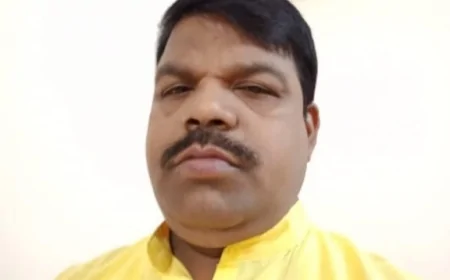
A former youth leader of the Trinamool Congress, Pramanik was expelled from the party following the Bengal Panchayat elections in 2018 and subsequently joined the BJP. In the 2019 general elections, Pramanik defeated his nearest rival, Paresh Adhikari.
Two years later, at the age of 35, following a cabinet reshuffle, he became the youngest member of Narendra Modi's Council of Ministers; he served in this capacity from 2021 to 2024 as the Minister of State for Home Affairs and the Union Minister for Youth Affairs and Sports.
Pramanik began his political journey as a booth president and rose rapidly through the ranks to reach the BJP's state leadership. However, he suffered a setback in the 2024 general elections when he was defeated by Trinamool Congress's Jagadish Basunia in Cooch Behar, North Bengal.
What's Your Reaction?
 Like
0
Like
0
 Dislike
0
Dislike
0
 Love
0
Love
0
 Funny
0
Funny
0
 Angry
0
Angry
0
 Sad
0
Sad
0
 Wow
0
Wow
0