




































































WHY DID BIHAR REJECT THE RAHUL-TEJASHWI MODEL?
-When the results of the Bihar Assembly elections were announced, the entire country was stunned. Rahul Gandhi, who led a 1300-kilometer "Voter Rights Yatra" for 16 days, his Congress contested 61 seats and won only 6. Tejashwi Yadav, who was promising 2.6 million government jobs, his RJD fell from 75 seats in 2020 to just 24-25. And here…the NDA made history by winning 202 seats. But the question is…was this just an electoral defeat? Or does it signal a fundamental shift in Bihar politics?

WHY DID BIHAR REJECT THE RAHUL-TEJASHWI MODEL?
16-NOV-ENG 10


RAJIV NAYAN AGRAWAL
ARA---------------------------When the results of the Bihar Assembly elections were announced, the entire country was stunned. Rahul Gandhi, who led a 1300-kilometer "Voter Rights Yatra" for 16 days, his Congress contested 61 seats and won only 6. Tejashwi Yadav, who was promising 2.6 million government jobs, his RJD fell from 75 seats in 2020 to just 24-25. And here…the NDA made history by winning 202 seats. But the question is…was this just an electoral defeat? Or does it signal a fundamental shift in Bihar politics?


Today, I will take you into the world of statistics…those historical facts…that will explain why the Grand Alliance lost so badly. And why this defeat is a dangerous signal not just for Bihar, but for the entire opposition.
So stay tuned… because in the next 12 minutes, you will learn the truth that no mainstream media will tell you. A Dark Chapter in Bihar Politics The History of 'Jungle Raj': 1990-2005
Friends, to understand today's defeat, we have to go back… to the 1990s, when Lalu Prasad Yadav and Rabri Devi were in power in Bihar.
The Patna High Court first used the term 'Jungle Raj' in August 1997 – when, commenting on waterlogging and poor administration in Patna, Justices V.P. Singh and Dharampal Sinha declared the situation "worse than Jungle Raj." Horrifying Statistics of Jungle Raj:
1. Serious Crimes: In the 1990 assembly elections, 30 independent candidates won, mostly 'Baahubali' – local criminals took over politics.
2. Attacks on Intellectuals and Officials: December 5, 1994: IAS officer G. Krishnaiah brutally murdered – A mob attacked and killed the IAS officer during the funeral procession of criminal leader Chhotan Shukla in Muzaffarpur. Champa Biswas Case: Allegations of sexual assault on Champa, wife of IAS officer B.B. Biswas – Lalu's close aide Mrityunjay Kumar Yadav and his associates.
3. Economic Destruction: Government employees did not receive salaries for months or even years – 35,000 state-owned employees were withheld, leading to suicides. In 2002, Chandan Bhattacharya committed suicide in protest against his father's salary.
4. Fodder Scam: The Fodder Scam was exposed in 1997, in which IAS officer V.S. Dubey exposed Lalu Prasad Yadav's corruption. Following this, Lalu founded the Rashtriya Janata Dal (RJD) on July 5, 1997.
The Rise of Nitish Kumar: 2005 When Nitish Kumar became Chief Minister in 2005, he promised "good governance."
His biggest achievement: sending criminal politicians like Mohammad Shahabuddin, Anand Mohan, Munna Shukla, and Pappu Yadav to jail, regardless of their party affiliation, through speedy trials. (Source: NewsLaundry, November 21, 2020)
This is why the people of Bihar reposed their faith in Nitish in 2025.
Political and Social Analysis: The Real Reasons for the 2025 Defeat
1. The "Vote Theft" Narrative Completely Flopped
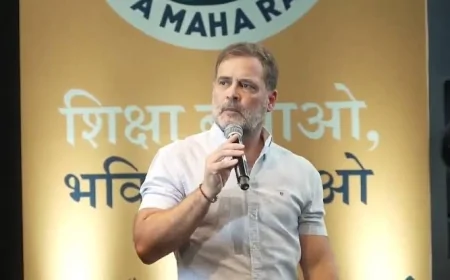
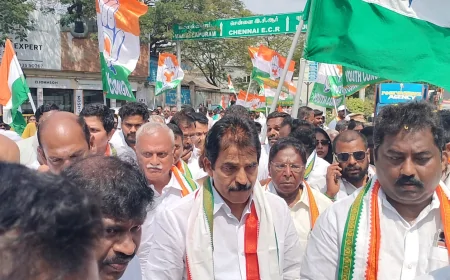
Rahul Gandhi launched the "Voter Rights Yatra" from Sasaram on August 17, 2025.
* The journey covered 1,300 kilometers across 25 districts
* Covered 110 assembly constituencies
* Lasted 16 days
But what was the outcome?
In 2020, Congress contested 70 seats and won 19 (a 27% strike rate). In 2025, it contested 61 seats and won only 6 (a 10% strike rate).
(Source: Zee News, The Quint, November 14, 2025)
Look at the irony:
1. The Grand Alliance lost 9 of the 10 seats where Rahul Gandhi held rallies.
BJP Home Minister Amit Shah said: “The Congress party, led by Rahul Gandhi, has reached the last position in Bihar today… The people have given a befitting reply to the politics that protects ‘infiltrators’.”
2. Women's votes went to the NDA
The voter turnout in 2025 was 67.13% – the highest since 1951.
And women contributed the most to this.
Reasons:
* Nitish Kumar's Chief Minister Women's Employment Scheme: ₹10,000 assistance to over 1 crore women
The 2020 elections saw a similar pattern: female voter turnout was 59.69%, while male voter turnout was 54.45%.
3. RJD's 'M-Y' (Muslim-Yadav) formula failed
Prime Minister Narendra Modi said after the NDA's victory: "The people of Bihar have defeated the 'communal M-Y formula'... Now the new 'positive M-Y' will be 'women and youth'." (Source: Onmanorama, November 14, 2025)
The fact is: RJD's traditional vote bank has disintegrated.
4. Tejashwi Yadav's unrealistic promise
Tejashwi Yadav promised in his 'Tejashwi Prana' manifesto: one government job in every household – that's approximately 2.6 crore jobs!
How is this possible?
The BJP and JDU ridiculed it throughout the campaign, calling it an "unrealistic promise."
5. The Rise of Chirag Paswan
In 2020, Chirag Paswan's LJP (RV) won just one seat. In 2025, it contested 28 seats and won 19.
This was crucial to the NDA's victory – especially in Dalit and EBC (Extremely Backward Class)-dominated areas.
6. Comparative Statistics: 2020 vs. 2025
Party 2020 Seats 2025 Seat Change
BJP 74 89 +15
JDU 43 85 +42
LJP(RV) 1 19 +18
NDA Total 125 202 +77
RJD 75 24-25 -50
Congress 19 6 -13
Grand Alliance Total 110 35 -75
(Source: Business Standard, November 14, 2025)
Vote Share Paradox:
* RJD got the most votes: 11.1 million (11.1 million)
* BJP got 9.9 million (9.9 million)
* JDU 9.5 million
But the RJD only won 24-25 seats! This shows that the RJD's votes were scattered, while the NDA's were concentrated.
The NDA's Strategy for Victory
Strategy 1: Reviving the 'Jungle Raj'
Nitish Kumar, Narendra Modi, Amit Shah—all constantly invoked the 'Jungle Raj'.
And it worked.
People above the age of 30, who had witnessed Bihar from 1990 to 2005, did not want a return to that era.
An 80-year-old man said in Patna: "We have seen the 'Jungle Raj'... We do not want a return to that misrule." (Source: Telangana Today, November 8, 2025)
Strategy 2: Social Engineering
The NDA did not rely solely on Yadav-Muslim voters. It:
* Dalit community (through Chirag Paswan)
* EBC community (through Jitan Ram Manjhi, Upendra Kushwaha)
* Women (through the ₹10,000 scheme)
* Youth (focused on development and employment)
Taking everyone along.
Strategy 3: The 'Infiltrator' Narrative
When Rahul Gandhi and the Grand Alliance opposed the ECI's SIR (Special Intensive Revision), the BJP called it 'protecting infiltrators.'
Amit Shah said: "The people of Bihar have given the message that cleaning the voter list is essential... There is no place for politics that protects infiltrators." (Source: India TV, November 14, 2025)
Strategy 4: Control of the Rajya Sabha
This election wasn't just about the Bihar Assembly.
The term of several Rajya Sabha seats will expire before 2030. The NDA's landslide victory in Bihar means that its dominance in the Rajya Sabha will also increase.
A warning bell for the opposition
The November 14, 2025 election results aren't just about Bihar.
It's an earthquake for the entire opposition.
Three major lessons:
1. Rahul Gandhi's strategy is failing
* Defeat in Maharashtra
* Defeat in Haryana
* A crushing defeat in Bihar
The narrative of 'vote theft' isn't working. The public wants development and good governance, not conspiracy theories.
2. Tejashwi Yadav must reconsider
* RJD in 2020: 75 seats
* RJD in 2025: 24-25 seats
This isn't just a defeat, it's a political disaster. The burden of Lalu Prasad Yadav's 'jungle raj' is so heavy that even his sons are unable to bear it.
3. Lack of unity in the opposition
Only Tejashwi Yadav was visible in the Grand Alliance. Congress and the Left parties were all sidelined.
A young Congress leader said: “There's a difference between one person's presence and an entire coalition fighting together.”
What's next?
Bengal, Delhi, Tamil Nadu—all states are going to have elections next year.
Prime Minister Modi, after the Bihar victory, clearly hinted: “The 'jungle raj' will end in Bengal too.”
This isn't just an electoral victory… it's a sign of a new political system.
What's Your Reaction?
 Like
0
Like
0
 Dislike
0
Dislike
0
 Love
0
Love
0
 Funny
0
Funny
0
 Angry
0
Angry
0
 Sad
0
Sad
0
 Wow
0
Wow
0