



























































BJP IMPLEMENTS LAW PROMOTING CASTE-BASED DIVISION-ATUL PRAKASH
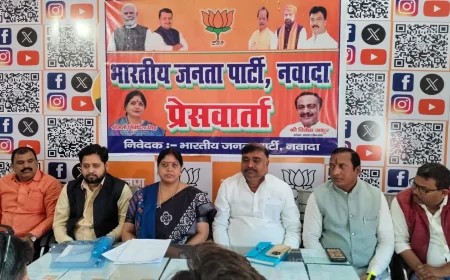
Just as the BJP, under its leadership, first appointed Nitin Naveen as the acting president in an experimental capacity during its presidential election, and then made him the full-time president without any opposition, perhaps with the same intention, the BJP government has implemented a law promoting caste-based division in the UGC so that it can be implemented across the entire country in the future.

BJP IMPLEMENTS LAW PROMOTING CASTE-BASED DIVISION-ATUL PRAKASH
24-JAN-ENG 5


RAJIV NAYAN AGRAWAL
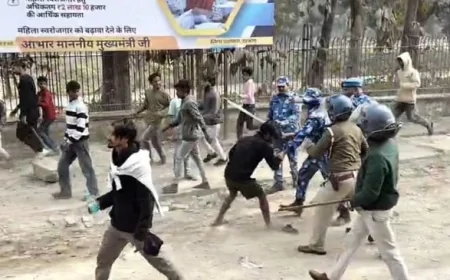
ARA----------------------------Just as the BJP, under its leadership, first appointed Nitin Naveen as the acting president in an experimental capacity during its presidential election, and then made him the full-time president without any opposition, perhaps with the same intention, the BJP government has implemented a law promoting caste-based division in the UGC so that it can be implemented across the entire country in the future. Will the BJP's nationalist government, with its slogan of "divide and rule," divide society? We, as members of a conscious society, should oppose this law impartially. Let's understand what the issue is. The 'UGC Promotion of Equity in Higher Education Institutions Regulations, 2026', issued by the University Grants Commission (UGC) on January 13, has sparked a widespread debate in the higher education sector. These regulations aim to eliminate discrimination based on caste, gender, religion, or disability in higher education institutions, but students and organizations from the general category have intensified their demand for its repeal, calling it a "law promoting caste-based division." The hashtag #UGCRollback is trending on social media, and student organizations have planned protests in several cities, including Delhi, Mumbai, and Bangalore. The UGC says that these regulations are based on the Supreme Court's directives and will ensure equal opportunities for all students, but critics believe that the ambiguity in the provisions and the one-sided focus may harm the general category. Several influencers and users on social media are strongly opposing this UGC regulation and posting various kinds of content. There are also demands for the withdrawal of the new UGC regulations.


The UGC has introduced these regulations in place of the old guidelines from 2012, which are based on the principle of 'complete equity and inclusion' of the National Education Policy 2020. The main provisions include the establishment of an 'Equal Opportunity Centre' (EOC) in every Higher Education Institution (HEI), the formation of an 'Equity Committee', a 24x7 equity helpline, and the provision of 'Equity Squads' and 'Equity Ambassadors'. These mechanisms ensure meetings on discrimination complaints within 24 hours, investigation reports within 15 days, and action within 7 days. Non-compliance can lead to penalties such as withholding UGC grants or closure of degree programs. According to the UGC, these rules are in compliance with directions given in a Supreme Court case, which emphasized eliminating caste-based discrimination in higher education. The rules place the responsibility on institutions to completely eliminate 'caste-based discrimination'. However, general category organizations argue that these provisions are based on the assumption of 'widespread caste discrimination' without any recent data to support it. Swarajya magazine reported that the outrage on social media is primarily focused on the 'Equity Squads' and 'Ambassadors', which are being called a 'draconian monitoring system'. Vague definitions and the risk of false accusations
At the heart of the controversy is the rules' definition of 'discrimination', which includes 'implicit' behaviors, even if unintentional. According to an OpIndia report, these provisions create a lack of procedural balance and could label the general category as 'automatic oppressors'. Critics argue that considering only SC/ST/OBC as 'victims' shows bias against the general category, while ignoring discrimination against them. A major concern is the potential for false accusations. Critics say the rules lack provisions for punishing false complaints, which will encourage 'patently false assumptions'. Taking immediate action on complaints (meeting within 24 hours) and placing the burden of proof on the accused applies the principle of 'guilty until proven innocent'. These rules are inspired by Supreme Court directives, but fears have been expressed about "targeting" general category students. Furthermore, the inclusion of civil society, NGOs, and the police on campus raises the risk of politicization. Expanding the scope to include faculty and staff means that SC/ST/OBC teachers can file complaints against general category students. The equity squads are being described as creating a "snitching culture," which could turn the campus into a "fearful environment."
Supporters are calling it an "essential step towards equality." They believe the central government has made a significant intervention to address caste discrimination. The rules aim to completely eliminate caste discrimination in colleges and universities. Sunil Astey, a Bhim Army leader from Madhya Pradesh, says, "The new guidelines issued by the UGC are not intended to target any particular group, but rather to ensure equality, transparency, and student safety on university campuses. Under these guidelines, provisions such as the Equal Opportunity Centre, Equity Committee, and a 24x7 grievance redressal mechanism have been made mandatory so that timely and impartial action can be taken against any discrimination, harassment, or injustice faced by any student. Presenting these guidelines as being "against a particular group" is misleading and factually incorrect." In essence, this initiative strengthens the fundamental principles of equality, dignity, and justice enshrined in the Constitution and is a necessary step towards creating a safe and inclusive academic environment for all students. No one should fear accountability and equal opportunities in educational institutions. Anyone who believes in the Constitution and democratic values should welcome this effort by the UGC." Dr. Ghanshyam of BASF (Bhim Army Students Federation) says, "Our movement is based on the new UGC (Promotion of Equality in Higher Educational Institutions) Regulations Notification (2026). The definition of discrimination has been broadened to include both overt and covert acts – however, the acts are not specifically listed, which creates ambiguity that could benefit casteists. OBCs are clearly included in this Act, which we welcome – however, OBC leaders should now also understand that only Ambedkarite constitutionalism is fighting for the rights of their children, not the RW ideology. Higher institutions will have to establish Equity Opportunity Centers (EOCs) – which will have an Equity Committee (EC) chaired by the head of the institution and comprising SC, ST, OBC, women, and PwD members. This EOC will prepare and forward a report on its activities every six months. – However, our concern is that such members should not be stooges of the head. They should have independent and investigative minds. One way is to include Ambedkarite student organizations like BASF. We also demand that this committee should have investigative and executive powers to identify and punish casteists, such as expulsion, dismissal from service, suspension, and cancellation of PhDs, so that such offenders are permanently incapacitated. National monitoring and oversight will be provided by the UGC with a committee comprising members from statutory bodies, NGOs, and civil society. – We reiterate that we will involve ourselves at this level and we further demand that a national-level dashboard be established, along with fixed timelines for action on received complaints. This is a good step initiated by the UGC, due to Ambedkarite democratic pressure, but we certainly expect that casteists will try to weaken, derail, and sabotage this process. However, as long as we are here, we will not let any injustice happen to our children." Senior IRS officer Netrapal says, "My biggest objection to the UGC rules is that it is replacing the Scheduled Caste/Scheduled Tribe cell with a common anti-discrimination cell for all. I don't know if this will be effective. What if the anti-discrimination cell or the so-called equality cell does not have a proper voice for Scheduled Caste/Scheduled Tribe students, who face the most problems in universities? Having a liaison officer in the Scheduled Caste/Scheduled Tribe cell is mandated by the Constitution." I don't think any changes should be made to this."
What are the new UGC rules? Understand in simple terms, how will religious, caste, and gender discrimination end in colleges and universities? UGC must frame strict rules on caste discrimination on campus within 8 weeks!
Constant fear, bias in easy evaluations, becoming a weapon in personal disputes, and penalties on institutions that will increase bureaucracy. A significant dimension of the controversy is the safety of women. In an Instagram reel, campaigners have warned that these rules will give 'predatory men' a chance to abuse girls from the general category for rejection or revenge. Reports state that every student should receive protection, but the ambiguity of the provisions could make exploitation easier. The Telegraph India editorial mentions that strict penalties for non-compliance (such as shutting down degree programs) could put institutions under pressure, which will affect justice. A user named Shubham Shukla wrote on X: The rule issued in the UGC notification is actually very dangerous: — It will reduce the confidence of general category children. If children get entangled in investigations over trivial matters, when will they study? What will happen to their careers? This is actually the biggest conspiracy against general category students in independent India. The government should immediately pay attention to this. Another post read, "If the UGC and Union Education Minister Dharmendra Pradhan do not amend the anti-general category notification by January 26, then on January 26, the whole world will see on social media the kind of injustice being done to the students. On January 26, when the country celebrates Republic Day, the oppressed and victimized general category students across the country will demand justice for themselves." That day, UGC will trend on social media all day long."
The growing unease in the country regarding reservations, merit, and social justice has now come to the forefront.
A letter written by a citizen to Prime Minister Narendra Modi has today become the voice of the sentiments of millions of people.
Is the general category of society feeling insecure?
Is the reservation system becoming unbalanced?
Is trust in merit and opportunity being broken?
Can NOTA become a weapon of new protest?
What's Your Reaction?
 Like
0
Like
0
 Dislike
0
Dislike
0
 Love
0
Love
0
 Funny
0
Funny
0
 Angry
0
Angry
0
 Sad
0
Sad
0
 Wow
0
Wow
0