
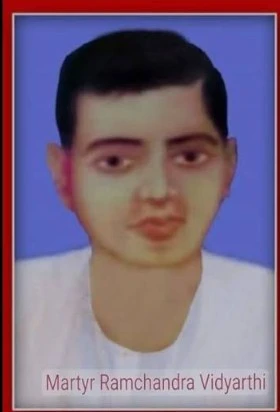
THE BOY WHO HOISTED FREEDOM;SHAHEED RAMCHANDR VIDYARTHI
-In the vast and layered history of India’s struggle for independence, certain figures stand out not because of the length of their political careers or the volume of their writings, but because of the pure intensity of a single decisive act. One such figure is Ramchandra Vidyarthi, a seventh-standard schoolboy from a potter’s family in eastern Uttar Pradesh. Born on 1 April 1929 in the village of Nautan Hatiyagarh (also referred to as Hathiyagarh or Hathia Garh) in Deoria district, he was martyred on 14 August 1942 at the age of thirteen years and four months. On that day, during the height of the Quit India Movement, he climbed the building of the Deoria Kacheri, pulled down the British Union Jack, and hoisted the Indian tricolour. British firing cut short his young life. Local accounts, family memory, school tradition, and consistent reporting in regional newspapers over decades have preserved his story as one of the most striking examples of youthful patriotism in the freedom struggle.
THE BOY WHO HOISTED FREEDOM;SHAHEED RAMCHANDR VIDYARTHI
15-AUG-ENG 13


RAJIV NAYAN AGRAWAL
ARA--------------------------In the vast and layered history of India’s struggle for independence, certain figures stand out not because of the length of their political careers or the volume of their writings, but because of the pure intensity of a single decisive act. One such figure is Ramchandra Vidyarthi, a seventh-standard schoolboy from a potter’s family in eastern Uttar Pradesh. Born on 1 April 1929 in the village of Nautan Hatiyagarh (also referred to as Hathiyagarh or Hathia Garh) in Deoria district, he was martyred on 14 August 1942 at the age of thirteen years and four months. On that day, during the height of the Quit India Movement, he climbed the building of the Deoria Kacheri, pulled down the British Union Jack, and hoisted the Indian tricolour. British firing cut short his young life. Local accounts, family memory, school tradition, and consistent reporting in regional newspapers over decades have preserved his story as one of the most striking examples of youthful patriotism in the freedom struggle.
His sacrifice occurred in a region that was then part of the larger Gorakhpur administrative area and is remembered as a moment when ordinary rural India answered Mahatma Gandhi’s call of “Do or Die” with extraordinary courage. The story of Ramchandra Vidyarthi is not merely a local anecdote; it is a window into the participation of children and adolescents, the role of artisan communities, and the power of symbolic acts in a mass movement that had been left largely leaderless by the sudden imprisonment of the Congress leadership.
Ramchandra Vidyarthi was born into a Prajapati family whose traditional occupation was pottery—the making of earthen pots, vessels, and household items from the clay of the region. His father, Babulal Prajapati, and mother, Motirani (also known as Moti Rani Devi), lived in Nautan Hatiyagarh, a village situated on the banks of the Chhoti Gandak river. He was the eldest of four sons. The family’s economic circumstances were modest, typical of many rural artisan households of the time. Yet accounts suggest that nationalist sentiment was not absent from the home. His grandfather, Bhardul Prajapati, is remembered in local narratives as having leanings toward the freedom movement, and the household is said to have offered shelter to activists when the need arose.
The boy grew up in an environment where the rhythms of rural life—agriculture, pottery, seasonal festivals, and the slow circulation of news—were increasingly intersected by the national struggle. By the early 1940s, stories of earlier martyrs, the impact of the Civil Disobedience Movement, and the rising tempo of anti-colonial feeling had reached even remote villages through newspapers, travelling activists, schoolteachers, and oral transmission. Ramchandra attended Shri Krishna Junior High School in Basantpur Dhusi, a village some distance from his home (estimates of the walking distance range between eleven and twenty kilometres depending on the route taken). By August 1942 he was studying in the seventh standard. Teachers and later community recollections describe him as an intelligent, energetic, and nationally conscious student, already deeply affected by the idea of a free India.
The socio-economic background is important. The Prajapati community, traditionally associated with pottery and related crafts, was not among the elite castes that dominated early nationalist leadership in many regions. Ramchandra’s emergence as a symbol therefore carries additional resonance: it illustrates how the freedom movement drew participants from across the social spectrum, including rural artisans and their children. After his death the family is said to have faced periods of hardship and displacement, a common fate for the dependents of those who challenged colonial authority. Yet the same family has remained central to the preservation of his memory across generations.
To understand the significance of what happened on 14 August 1942, it is necessary to place the event within the larger context of the Quit India Movement. On 8 August 1942 the All India Congress Committee meeting in Bombay passed the Quit India Resolution. The following day, Mahatma Gandhi and most of the top Congress leadership were arrested. The sudden removal of the leadership did not extinguish the movement; instead, it released a wave of spontaneous, decentralised, and often militant activity across the country. In the United Provinces (present-day Uttar Pradesh), the response was particularly strong in several districts. Eastern districts such as Gorakhpur, Deoria, and surrounding areas witnessed processions, strikes, attacks on symbols of colonial authority, and attempts to establish parallel authority in some localities.
Courthouses, police stations, railway stations, and government offices became focal points. The Union Jack flying over these buildings was not merely a piece of cloth; it was the most visible emblem of British sovereignty. Removing it and replacing it with the tricolour was both a practical act of defiance and a profound political statement. In many places, students and young people played a conspicuous role, partly because adult leaders had been arrested and partly because the emotional appeal of the movement resonated strongly with the young.
In Deoria, the atmosphere in mid-August 1942 was charged. News of the national call and of local actions elsewhere travelled quickly. School students in the rural hinterland, including those at Basantpur Dhusi, were drawn into the ferment. On the morning of 14 August, a group of students and local supporters set out from the school area toward the district headquarters. Ramchandra Vidyarthi, despite his young age, is consistently described as being among the most determined and as moving near the front of the contingent. The journey was made entirely on foot—accounts differ slightly on the precise distance, with some placing it around twenty kilometres and others closer to thirty-two, but all agree it was a significant walk undertaken in the heat of an August day.
Upon reaching Deoria, the group made its way to the Kacheri, the old collectorate and courthouse complex. Contemporary local descriptions identify the building as the one that later came to be associated with the Gandhi Ashram premises and a health department store. The Union Jack flew from the structure. With the assistance of companions, Ramchandra climbed up. One detailed recollection identifies Shivraj (also known as Sona Sonar) of Sahodar Patti as the person who lifted or supported the boy so that he could reach the flagstaff. Ramchandra pulled down the British flag and raised the Indian tricolour in its place.
The response from the authorities was immediate and lethal. Local narratives name the joint magistrate or pargana officer Umrao Singh (or Umarao Singh) as the official who ordered or initiated the firing. Three bullets struck Ramchandra in the chest. Even as he fell, accounts state that he shouted “Bharat Mata ki Jai.” He died at the site. In the same incident, several others were also killed, including Shivraj Sonar, Bandhu (also referred to as Ghinhu or Ghinhoo), and Gopi Mishra.
The news of the boy’s death spread rapidly through the countryside. His body was carried back to the village area and cremated on the banks of the Chhoti Gandak near Nautan Hatiyagarh, wrapped in the tricolour, in the presence of a large gathering of local people. The event is remembered as having intensified the local expression of the Quit India Movement, adding emotional force to an already charged atmosphere.
The martyrdom of a thirteen-year-old schoolboy left a deep impression on the region. In the absence of extensive contemporary official documentation in easily accessible national archives, the story has been sustained primarily through family testimony, school tradition, oral history, and repeated coverage in regional Hindi newspapers. Over the decades, Dainik Jagran, Amar Ujala, Hindustan, and other publications have returned to the narrative around the anniversary of 14 August, keeping the essential details in circulation. The consistency of the core elements—date of birth, date of death, the act of flag-hoisting, the location, the companions, and the family’s later recognition—gives the account a durable character.
The school at Basantpur Dhusi was later renamed Shaheed Ramchandra Inter College. A statue of the young martyr was installed on the school premises. In the village of Nautan Hatiyagarh itself, a memorial and statue were erected with the cooperation of local residents and government support. In Deoria town, memorials came up at Ramleela Maidan and at the historic Kacheri site. These physical markers have served as focal points for annual commemorations.
In 1949, Prime Minister Jawaharlal Nehru visited the area. Upon hearing the account of the boy’s sacrifice, he met Babulal Prajapati and Motirani. Moved by the story, he presented the family with a silver plate (thali), a glass, and a certificate of honour. The certificate is reported to have contained words acknowledging that Ramchandra had watered the garden of freedom with his blood, and it bore Nehru’s signature. This early post-independence recognition by the Prime Minister of India elevated a local episode into a nationally acknowledged chapter of the freedom struggle and provided the family with a tangible mark of honour.
The gesture also reflected a broader pattern in the early years of independent India: efforts to acknowledge the contributions of lesser-known martyrs and to weave regional stories into the larger national narrative of sacrifice.
In more recent times, the Uttar Pradesh government has taken steps to institutionalise the memory of Ramchandra Vidyarthi in a more substantial way. During the tenure of Chief Minister Yogi Adityanath, particular attention has been paid to developing the site associated with his martyrdom. Cabinet decisions approved the transfer of land in the old Kacheri premises for the development of a memorial complex and museum. Significant financial allocations have been reported for curation, interior development, landscaping, and related infrastructure. A life-size bronze statue has been installed. The project has been framed as both a tribute to the young martyr and an educational initiative aimed at conveying the history of the Quit India Movement in eastern Uttar Pradesh to younger generations.
The development of the memorial has not been without community involvement and, at times, contention. Members of the Prajapati community have organised programmes, rath yatras, and public meetings to ensure that the site remains focused on the martyr’s memory and is not diverted to other administrative uses. Such engagement reflects the deep emotional ownership that the community feels toward the story of one of its own who made the supreme sacrifice at such a young age.
Annual observances on 14 August have grown in scale and variety. They typically include floral tributes at the various memorials, cultural programmes, discussions on the freedom struggle, blood donation camps, and tree plantation drives. Schools, local administrative officials, political representatives, and community organisations all participate. The school that once taught the seventh-standard boy continues to observe the day with special solemnity, ensuring that successive generations of students learn the story as part of their own institutional heritage.
For the Prajapati community, Ramchandra Vidyarthi has become a powerful symbol of historical contribution and collective pride. Community organisations across Uttar Pradesh and beyond have organised commemorative events, published literature, and used the anniversary as an occasion for social service. The narrative is often presented not only as a story of individual bravery but also as evidence of the community’s participation in the national movement. In this sense, the memory serves both patriotic and community-affirming purposes.
The annual cycle of remembrance has helped transmit the story across generations. Grandchildren and other relatives of the martyr have spoken publicly about the family’s experiences, adding personal texture to the historical account. Local cultural productions, including a novel based on his life and occasional dramatic or filmic representations, have further embedded the narrative in popular consciousness.
Ramchandra Vidyarthi’s story invites reflection on the role of the young in the independence movement. While the leadership of the Congress and other organisations was largely adult, the emotional and physical energy of the movement often came from students and adolescents. In 1942, with most senior leaders in jail, young people in many parts of the country stepped into the space that had been created. Flag-hoisting actions, processions, and confrontations with authority frequently involved teenagers and even younger children. Ramchandra’s age—thirteen years and four months—places him among the youngest of those who paid with their lives in this phase of the struggle.
The symbolic power of the act itself should not be underestimated. In the political culture of the time, the flag was a concentrated representation of sovereignty. To remove the Union Jack from a government building and replace it with the tricolour was to assert, in the most public and visible way possible, that British authority no longer commanded legitimacy in the eyes of the people. That a schoolboy performed this act and died in the process gave the moment a particular moral force.
Comparisons with other young martyrs of the freedom struggle are sometimes made in popular discussion. Figures such as Baji Rout of Odisha, who was even younger when he was killed in 1938 for refusing to ferry British forces, or Kanaklata Barua of Assam, who died while leading a procession to hoist the flag during Quit India, belong to the same broader category of youthful sacrifice. Ramchandra Vidyarthi’s distinctiveness lies in the combination of his extreme youth, the clarity of the symbolic act, the rural and artisan background from which he came, and the sustained local and community memory that has kept his name alive.
The various memorials, the renamed school, and the developing museum serve an educational purpose that extends beyond mere commemoration. They provide physical spaces where the abstract idea of sacrifice can be connected to a concrete human story. For students in Deoria and surrounding districts, the figure of Ramchandra Vidyarthi is not a distant textbook name but a boy from a nearby village who walked the same kinds of roads, studied in a similar school, and made a choice that altered the course of his short life.
In an age when historical memory can sometimes become fragmented or contested, the endurance of this particular story offers a reminder of the value of regional and community-level remembrance. National narratives of the freedom struggle are necessarily selective; they cannot contain every local episode. It is through the persistence of family memory, school tradition, local journalism, and community organisation that stories such as Ramchandra’s continue to be told.
The developing museum and memorial complex at the old Kacheri site has the potential to place the episode within a wider historical context—the Quit India Movement in eastern Uttar Pradesh, the participation of rural populations, the role of students, and the broader tapestry of sacrifice that made independence possible. If developed with care and historical sensitivity, such a space can serve both as a site of pilgrimage and as an educational resource.
Eighty-four years after that August day in 1942, the image of a thirteen-year-old boy climbing a colonial building under fire, tearing down one flag and raising another, continues to move those who encounter the story. Ramchandra Vidyarthi’s life was brief. His public political activity lasted only a few hours. Yet the moral clarity of his action and the completeness of his sacrifice have given his memory a lasting power.
He was a potter’s son from a village on the Chhoti Gandak. He was a seventh-standard student who walked for kilometres because the call of the nation had reached his heart. He died with the name of the motherland on his lips. In the years that followed, a Prime Minister honoured his family, a school took his name, statues were raised, and a community claimed him as a source of pride and inspiration. In more recent times, the state government has moved to create a more permanent institutional memorial.
The story of Shaheed Ramchandra Vidyarthi remains a living chapter in India’s long journey toward freedom. It is a chapter written not in lengthy resolutions or prolonged campaigns, but in a single, luminous act of courage performed by a child who understood, with a clarity that still astonishes, what the moment required. For the people of Deoria, for the Prajapati community, and for all who value the memory of those who gave everything so that the country might be free, his name continues to stand as a quiet but powerful summons to patriotism, service, and remembrance.
What's Your Reaction?
 Like
0
Like
0
 Dislike
0
Dislike
0
 Love
0
Love
0
 Funny
0
Funny
0
 Wow
0
Wow
0
 Sad
0
Sad
0
 Angry
0
Angry
0


Comments (0)