
RJD’S RAJ BHAWAN MARCH
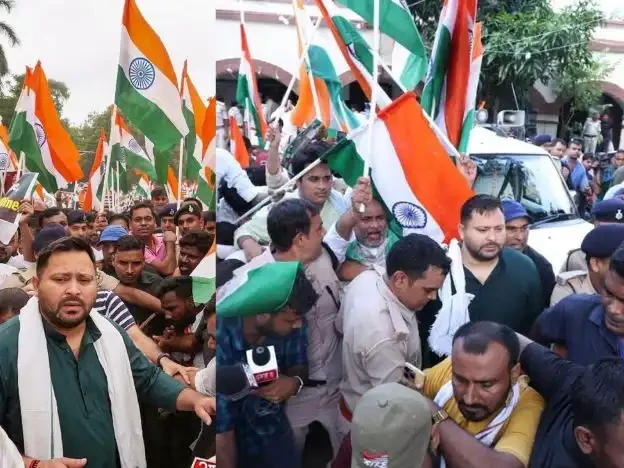
-Rashtriya Janata Dal (RJD) leader Tejashwi Yadav led a march to the Raj Bhavan (Lok Bhavan) on Wednesday to protest against the alleged firing of AK-47s during student agitations in Bihar and the recurring incidents of exam paper leaks. The march was scheduled to proceed from the JP Golambar at Gandhi Maidan in Patna to the Lok Bhavan. As the convoy moved forward, police attempted to halt the protesters near the Income Tax (Aaykar) Golambar and deployed water cannons to bring the situation under control. Amidst powerful jets of water, Tejashwi Yadav, along with several senior party leaders and activists, was taken into custody. Although the administration indicated that everyone would be released later, an atmosphere of tension and unease prevailed in the city for some time.
RJD’S RAJ BHAWAN MARCH
20-AUG-ENG 1


RAJIV NAYAN AGRAWAL
PATNA----------------------------Rashtriya Janata Dal (RJD) leader Tejashwi Yadav led a march to the Raj Bhavan (Lok Bhavan) on Wednesday to protest against the alleged firing of AK-47s during student agitations in Bihar and the recurring incidents of exam paper leaks. The march was scheduled to proceed from the JP Golambar at Gandhi Maidan in Patna to the Lok Bhavan. As the convoy moved forward, police attempted to halt the protesters near the Income Tax (Aaykar) Golambar and deployed water cannons to bring the situation under control. Amidst powerful jets of water, Tejashwi Yadav, along with several senior party leaders and activists, was taken into custody. Although the administration indicated that everyone would be released later, an atmosphere of tension and unease prevailed in the city for some time.
The police and administration had been on high alert in anticipation of the march. Traffic was regulated on roads leading from Patna Junction and surrounding key areas toward the march route to minimize crowd pressure and avert any untoward incidents. Barricades were erected, additional forces were deployed, and surveillance was intensified at multiple locations. The police had devised a strategy to halt the march at Dakbungalow Chowk itself; however, a large number of RJD workers and supporters gathered there and pushed past the security cordon. Ultimately, the administration managed to stop them near the Income Tax Golambar, where the situation appeared most tense.
This agitation is viewed not merely as a one-day event but as a manifestation of the resentment stemming from issues that have long caused dissatisfaction among Bihar's youth and students. Demands for transparency in the examination system, timely declaration of results, fairness in recruitment processes, and strict action against paper leaks have been raised repeatedly. This time, Tejashwi Yadav sought to exert direct pressure on the government by centering his campaign on these very issues. The RJD claims that the student and youth communities are facing repeated disappointment, while the government's response remains limited to rhetoric and token actions. Tejashwi Yadav has consistently spoken out and written against the government across various platforms. He has adopted a strategy of cornering the state government through social media, press conferences, legislative assembly debates, and public rallies. In 2018, he took the initiative to mobilize opposition leaders at Delhi's Jantar Mantar over the Muzaffarpur shelter home scandal—a move viewed at the time as carrying a significant political message. Similarly, the RJD has never lagged behind in opposition-led events like the 'Bharat Bandh' or 'Bihar Bandh'. When Rahul Gandhi visited Patna on July 9 last year during the 'Bihar Bandh', Tejashwi Yadav and other opposition leaders were seen sharing the stage with him. These events further highlighted Tejashwi's active role in the opposition.
Tejashwi Yadav did not limit himself merely to protests; he maintained a visible presence among the public through continuous tours and outreach campaigns. Campaigns such as the *Janadesh Apman Yatra* (Mandate Insult Yatra), *Aarakshan Badhao Yatra* (Increase Reservation Yatra), *Berozgari Hatao Yatra* (Eradicate Unemployment Yatra), *Jan Vishwas Yatra* (Public Trust Yatra), and *Voter Adhikar Yatra* (Voter Rights Yatra) were aimed at conveying that he is active at the grassroots level in state politics and prioritizes the issues faced by the youth. However, despite these earlier tours, the recent march to the Raj Bhavan marked a rare occasion where the zeal for struggle and a combative spirit were openly visible among RJD workers and supporters. Within the party, this is also being viewed as a display of organizational energy.
RJD leaders state that the march was organized with the intention of holding the government accountable. Party national spokesperson Jayant Jigyasu remarked that in a democracy, the government is expected to engage in meaningful dialogue and move towards finding solutions. He added that citizens who protest for legitimate demands—disagreeing with the government yet remaining vigilant—represent the beauty of the democratic system. Treating such citizens like criminals or using excessive force against them runs counter to the spirit of democracy.
Jayant Jigyasu specifically highlighted the gravity of the allegation that lethal weapons, such as AK-47s, were used under the guise of crowd control during the student protests. In their words, "Firing an AK-47 under the guise of controlling the crowd during a routine demonstration is an unforgivable offense." They questioned why no action was taken if such an order had originated from a senior official. The RJD claims that the lack of action reflects the government's undemocratic, unaccountable, and irresponsible attitude. According to them, such incidents breed fear, resentment, and mistrust among the youth—a dangerous sign for any state.
The party also argues that paper leaks and examination irregularities disproportionately harm children from poor, rural, and middle-class families who prepare for competitive exams despite limited resources. Many students spend years preparing—with their families investing in coaching, books, and living expenses—only to see their hard work and futures jeopardized when the integrity of the examination system itself is called into question.
A political strategy on the part of the RJD is also evident behind the 'Raj Bhavan March.' When the opposition takes to the streets, it does not merely protest government policies; it also signals to the public that it stands as a viable alternative to the ruling power. Under the leadership of Tejashwi Yadav, this demonstration The march is being viewed as an attempt to boost morale, mobilize the party cadre, and strengthen the party's hold over young voters. Especially at a time when issues such as employment, recruitment, examinations, and education play a significant role in electoral discourse, the RJD aims to place these topics at the core of its political agenda.
Arrests and the use of water cannons during the march further amplified the event's visibility. Supporters argue that such action against peaceful protesters betrays the government's unease. Conversely, the administration often maintains that upholding public order and the rule of law is essential, and that crowd control falls within its mandate. Yet, politically, such scenes—leaders being arrested amidst water jets, barricading, and scuffles—send a powerful message; the opposition frames this as a "fight for the public interest," while the government portrays it as "maintaining order." This is why the RJD describes the march not merely as a protest, but as a campaign to "ensure accountability."
This march to the Raj Bhavan in Patna has brought student and youth-related issues back to the forefront of Bihar politics. Tejashwi Yadav has positioned it as a clear political challenge to the government.
What's Your Reaction?
 Like
0
Like
0
 Dislike
0
Dislike
0
 Love
0
Love
0
 Funny
0
Funny
0
 Wow
0
Wow
0
 Sad
0
Sad
0
 Angry
0
Angry
0







Comments (0)