
DIALOGUE OF HUMANITY, NOT A CLASH OF CIVILIZATIONS
-Amidst rising fears of war, violence, and ideological conflict in the modern world, the issues of humanity, coexistence, and global peace have become more critical than ever. While weapons, missiles, and fighter jets can safeguard the world, lasting peace requires a positive shift in human thinking. When walls of ‘I’ versus ‘He’ and ‘Us’ versus ‘Them’ are erected in the mind, conditions arise that lead to everything from social divisions to international conflicts.

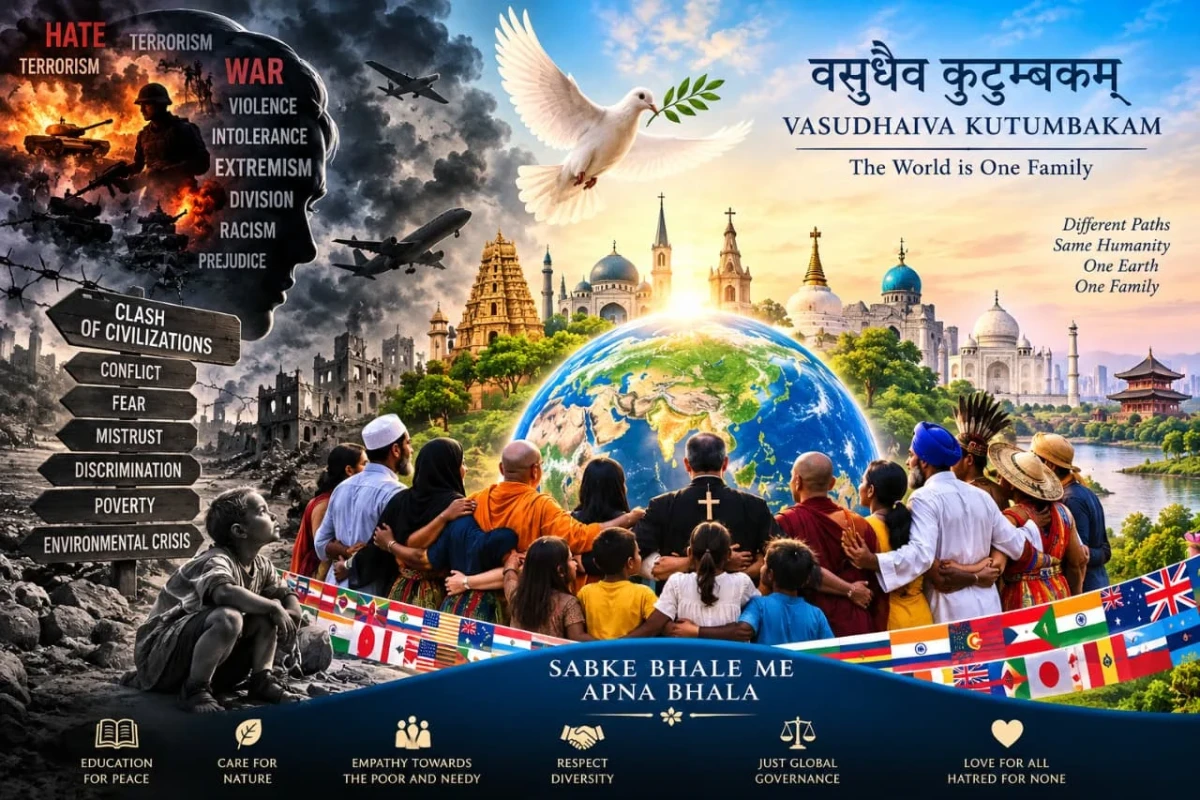
DIALOGUE OF HUMANITY, NOT A CLASH OF CIVILIZATIONS
14-OCT-ENG 3


RAJIV NAYAN AGRAWAL
SASARAM--------------------------Amidst rising fears of war, violence, and ideological conflict in the modern world, the issues of humanity, coexistence, and global peace have become more critical than ever. While weapons, missiles, and fighter jets can safeguard the world, lasting peace requires a positive shift in human thinking. When walls of ‘I’ versus ‘He’ and ‘Us’ versus ‘Them’ are erected in the mind, conditions arise that lead to everything from social divisions to international conflicts.
The preamble to the Constitution of the United Nations Educational, Scientific and Cultural Organization (UNESCO) states: “Since wars begin in the minds of men, it is in the minds of men that the defenses of peace must be constructed.” This message remains as relevant today as it was at the time of the organization's inception.
In his thought-provoking article, Colonel (Dr.) Baldev Singh ‘Manav’ emphasizes the need to prioritize humanity, respect religious and cultural diversity, and foster dialogue between civilizations rather than conflict.
An alleged violent incident in the cockpit of Flydubai flight FZ1073 on September 30, 2026, has raised questions regarding aviation safety as well as the role of human behavior and mindset. According to available details, reports emerged that the co-pilot attacked the captain during the flight from Dubai to Tel Aviv. It was reported that the aircraft suddenly lost altitude and was subsequently landed safely in Tabuk, Saudi Arabia. However, definitive conclusions regarding the circumstances and motives behind the incident should be drawn only after an investigation. It is inappropriate to hold any religion, community, or civilization collectively responsible based on a single incident.
This incident certainly raises a significant question on a broader scale: will humanity's next conflict play out merely along national borders, or will it also persist within the minds of individuals?
In his renowned book *The Clash of Civilizations and the Remaking of World Order*, American political scientist Samuel P. Huntington expressed apprehension that, in the post-Cold War era, conflicts in global politics would increasingly arise from cultural and civilizational identities.
However, it would be incorrect to regard a clash of civilizations as humanity's inevitable future. Instead, the world should consider how to foster dialogue and cooperation among diverse cultures, religions, and ideologies.
The author believes that a human being's primary identity should be their humanity. Religion, caste, language, region, nationality, and political ideology are secondary identities; human dignity must stand above them all.
To express this very idea, he includes the word 'Manav' (Human) in his name. His message is: humanity first, then identity; life first, then ideology; and compassion first, then differences of opinion.
For centuries, Indian thought has conveyed the message of unity in diversity, tolerance, and coexistence. A famous verse from the *Maha Upanishad* states:
“Ayam nijah paro veti ganana laghuchetasam;
Udaracharitanam tu Vasudhaiva Kutumbakam.”
This means: "This is mine, and that is another's"—such thinking is a sign of a narrow mindset. For those with a broad heart, the entire earth is one family.
The *Bhagavad Gita's* message of equanimity also offers humanity a broader perspective. Verse 29 of the sixth chapter of the Gita expresses the sentiment of seeing one's own self in all beings and all beings within oneself.
Similarly, the prayer ‘Sarve Bhavantu Sukhinah’ (May all be happy) wishes for the happiness, health, and well-being of everyone. It does not seek the victory of any single religion, community, or nation; rather, it conveys a message of welfare for all of humanity.
At the Parliament of the World's Religions held in Chicago in 1893, Swami Vivekananda began his address with the heartfelt salutation, "Sisters and brothers of America." His ideas were rooted in religious tolerance and the acceptance of diverse faiths.
His message remains relevant even today. If religion teaches humans love, compassion, forgiveness, and self-restraint, how can the promotion of hatred and violence in the name of religion be justified? Likewise, if the purpose of a nation is the safety and well-being of its citizens, then nationalism should not stand in opposition to humanity.
Many global thinkers, including the Dalai Lama, have also regarded compassion, tolerance, and human equality as the foundations of peace.
Strengthening security arrangements alone is not enough to ensure lasting peace. A spirit of tolerance, sensitivity, and respect for the views of others must also be cultivated in the minds of children and the youth.
Schools and universities should teach students that disagreement does not equate to enmity. Holding diverse views is a natural characteristic of nature and society; no two individuals can have identical interests, thoughts, and perspectives. In such a context, expecting all of humanity to share the same mindset is not practical.
The author believes that the purpose of education should not merely be to provide employment but also to mold sensitive, responsible, and peace-loving citizens. Religious institutions, social organizations, and political leadership must also demonstrate harmony and responsibility in their conduct and statements needs to be introduced.
Today, challenges such as climate change, water crises, pandemics, food security, energy issues, poverty, and economic inequality are not confined to any single country. Solutions to these problems are possible only through international cooperation, transparency, accountability, and the equitable use of resources.
Mahatma Gandhi's principle of trusteeship is also significant in this context. Gandhi believed that wealth, property, and talent should be utilized not merely for personal gain but for the welfare of society.
Expanding upon this sentiment, one might consider that nations, too, should act as responsible custodians of the Earth's natural resources. Air, water, sunlight, and nature's many gifts are not limited to any specific religion or nation; therefore, all countries share the responsibility for the conservation and equitable use of global resources.
The author holds the view that the world must move beyond the concept of a "clash of civilizations" and step towards a "dialogue of civilizations." Instead of seeking to obliterate one another, diverse religions and cultures should look for opportunities to learn from each other.
It is essential to build a world where believers and non-believers, followers of all faiths, and people of diverse ideologies are entitled to equal human dignity—a world where nations protect their borders but do not confine humanity within them, and where power signifies the protection of the weak rather than their oppression.
Political leaders, religious figures, academics, and international institutions must introspect on how peace can be expected when the minds of children are filled with hatred. If every nation prioritizes its own interests over humanity and every civilization seeks to assert its superiority by defeating others, the entire world will ultimately have to bear the consequences.
The actual circumstances surrounding the incident involving Flydubai flight FZ1073 should be determined based on an investigation. However, the broader human message inherent in this is clear: positive change in human thought, behavior, and social outlook is essential for lasting peace.
Colonel (Dr.) Baldev Singh ‘Manav’ conveys the message that the world must decide whether it wishes to remain divided along lines of religion, caste, region, nation, and ideology, or—while respecting all these identities—make humanity its supreme moral foundation. His clear conviction is: humanity first, then identity; life first, then ideology; compassion first, then differences.
A solid foundation for peace can be laid only by integrating the spirit of ‘Vasudhaiva Kutumbakam’ (the world is one family) into the practices of schools, universities, religious institutions, parliaments, and international bodies.
The greatness of civilizations lies not in defeating one another, but in contributing to the welfare of humanity. Ultimately, what matters is not which religion, nation, or ideology triumphs, but whether humanity survives and remains secure.
The true victory of humanity is the triumph of love over hatred, non-violence over violence, coexistence over intolerance, unity over division, and life over destruction. This is true civilization—not a ‘Clash of Civilizations,’ but ‘Civilizations for Humanity.’
What's Your Reaction?
 Like
0
Like
0
 Dislike
0
Dislike
0
 Love
0
Love
0
 Funny
0
Funny
0
 Wow
0
Wow
0
 Sad
0
Sad
0
 Angry
0
Angry
0










Comments (0)