
QUESTIONS REGARDING DISCIPLINE WITHIN JDU
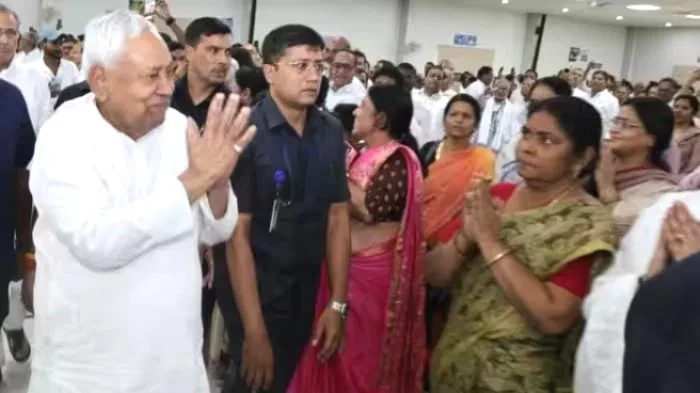
A debate regarding discipline and disciplinary action is intensifying within Chief Minister Nitish Kumar's Janata Dal (United) (JDU) in Bihar politics. Following the demand to terminate the Lok Sabha membership of party MP Girdhari Yadav, questions are being raised about the criteria used for taking action against leaders who deviate from the party line. The party's strategy is under scrutiny amidst political developments involving Maheshwar Hazari, Girdhari Yadav, Bima Bharti, and Anant Singh.

QUESTIONS REGARDING DISCIPLINE WITHIN JDU
11-OCT-ENG 1


RAJIV NAYAN AGRAWAL
PATNA----------------------A debate regarding discipline and disciplinary action is intensifying within Chief Minister Nitish Kumar's Janata Dal (United) (JDU) in Bihar politics. Following the demand to terminate the Lok Sabha membership of party MP Girdhari Yadav, questions are being raised about the criteria used for taking action against leaders who deviate from the party line. The party's strategy is under scrutiny amidst political developments involving Maheshwar Hazari, Girdhari Yadav, Bima Bharti, and Anant Singh.
The political debate also raises the question of whether the approach to disciplinary action has been consistent across different leaders. However, drawing a conclusion about caste-based discrimination would require a separate examination of the facts, allegations, and the party's official stance in each case.
Sunny Hazari, the son of senior JDU leader Maheshwar Hazari, contested the 2024 Lok Sabha elections as a Congress candidate. He ran from the Samastipur (Reserved) constituency, where Shambhavi Choudhary of the Lok Janshakti Party (Ram Vilas)—representing the NDA—was the opposing candidate.
Maheshwar Hazari's political position was also a subject of discussion during this election. However, it would be incorrect to view his son contesting on a different party's ticket as grounds for formal disciplinary action against the father. In this instance, it is important to distinguish between political criticism and official disciplinary action.
Regarding JDU MP Girdhari Yadav (representing Banka), the party had requested the Lok Sabha Speaker to terminate his membership. The party alleged that during the 2025 Bihar Assembly elections, Girdhari Yadav's son, Chanakya Prakash Ranjan, contested the Belhar seat on an RJD ticket, and Girdhari Yadav engaged in activities against the party's official candidate.
However, Girdhari Yadav denied the allegations and reaffirmed his loyalty to Nitish Kumar. In this context, the matter should be viewed in light of both the party's allegations and the MP's own stance.
This sequence of events has reignited the debate within the JD(U) regarding disciplinary action and the accountability of leaders towards the party.
Bima Bharti has also frequently been at the center of controversies within JD(U) politics. Her absence during the Nitish Kumar government's trust vote in February 2024, coupled with her differences with the party leadership, sparked significant political discussion.
At that time, the JD(U) accused her of colluding with the opposition. Subsequently, Bima Bharti left the JD(U) and later aligned herself with the RJD.
Her case brings to the fore questions regarding trust, discipline, and political differences between the party leadership and its legislators.
Amidst the debate on discipline within the JD(U), the names of leaders like Anant Singh and Neeraj Kumar are also being cited. Questions are being raised about the criteria used to determine the party's stance in different cases involving various leaders—specifically, what forms the basis for action when anti-party activities are alleged.
However, without presenting comparable evidence regarding similar allegations, formal notices, or actions taken against these other leaders, it would be unfair to claim that they were deliberately spared. The circumstances of each case and the party's official decisions can vary significantly.
Caste representation is another facet of the ongoing debate regarding disciplinary actions within the JD(U). Critics question how strict the party's stance has been regarding leaders from Dalit and backward classes compared to the procedures followed for other leaders.
However, instances involving only a few leaders are insufficient to prove caste-based discrimination. Establishing this would require a detailed analysis comparing the party's disciplinary actions, the nature of the allegations, the available evidence, and the decisions reached in each specific case.
Nitish Kumar's party faces the dual challenge of maintaining discipline while simultaneously fostering trust and organizational unity among its leaders. Developments such as the demand to terminate Girdhari Yadav's membership raise questions about how the party defines the boundaries of political conduct expected from its leaders.
For now, a crucial aspect of this entire controversy is the clarity and uniformity of the criteria for disciplinary action within the JDU across all its leaders. The answer to this question will emerge more from official decisions and comparative facts than from the allegations themselves.
Sources and Fact-Check: Information regarding the JDU's action against Girdhari Yadav, the MP's stance, and the development concerning Maheshwar Hazari's son contesting the election on a Congress ticket was published in reports. Claims regarding caste-based discrimination and alleged leniency shown to other leaders have not been presented as independently established facts.
What's Your Reaction?
 Like
0
Like
0
 Dislike
0
Dislike
0
 Love
0
Love
0
 Funny
0
Funny
0
 Wow
0
Wow
0
 Sad
0
Sad
0
 Angry
0
Angry
0











Comments (0)