
FAREWELL TO BIJALI RANI: ANOOP NARAYAN SINGH
-Even today, if the song—evoking the image of someone wiping their cheeks with a handkerchief—plays in some corner of one’s memory, an entire era of Bhojpuri folk culture springs back to life. It was through this very song that I was first introduced to Bijli Rani. Little did I know then that Bijli Rani was not merely a folk artist, but the embodiment of a cultural heritage—a legacy deeply intertwined with the memories, emotions, and prestige of thousands of people. Later, as I heard stories about the ‘Chand-Bijli’ performances, I realized that hosting this troupe in the villages of Shahabad was more than just entertainment; it was a symbol of social status and influence.

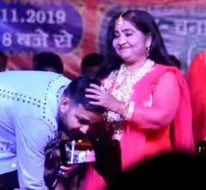
FAREWELL TO BIJALI RANI: ANOOP NARAYAN SINGH
26-OCT-ENG 10


RAJIV NAYAN AGRAWAL
ARA--------------------------Even today, if the song—evoking the image of someone wiping their cheeks with a handkerchief—plays in some corner of one’s memory, an entire era of Bhojpuri folk culture springs back to life. It was through this very song that I was first introduced to Bijli Rani. Little did I know then that Bijli Rani was not merely a folk artist, but the embodiment of a cultural heritage—a legacy deeply intertwined with the memories, emotions, and prestige of thousands of people. Later, as I heard stories about the ‘Chand-Bijli’ performances, I realized that hosting this troupe in the villages of Shahabad was more than just entertainment; it was a symbol of social status and influence.
It was on this very day last year that Bijli Rani bid farewell to this world. Her passing plunged the tradition of Bhojpuri folk dance—a tradition that held sway for decades across the villages from Shahabad to Saran and Champaran—into a state of profound sorrow. Once, people in every village would eagerly await her voice, her graceful gestures, and her stage performances; today, only memories remain to bear witness to that bygone era.
In Bhojpuri society, the name ‘Bijli Rani’ never required an introduction. Her actual name was Bijli Rani, but the inherent sweetness of the Bhojpuri language and the local dialect transformed it into ‘Bijuri Rani.’ Just as names like Pawan Singh, Khesari Lal Yadav, Dinesh Lal Yadav ‘Nirahua,’ and Ravi Kishan are celebrated in contemporary Bhojpuri cinema, the duo of Chand and Bijli Rani once commanded a unique and dazzling presence in the world of traditional Bhojpuri folk dance. The only difference was that, in those days, the yardstick for fame was not social media views or likes; rather, it was the buzz in village communal squares (*chaupals*), the size of the crowds that gathered at weddings, and the respect accorded to the performers.
In the Shahabad region during the 1980s and 1990s, the 'Chand-Bijli' dance troupe was so sought-after that not everyone could afford to hire them for their weddings or *tilak* (pre-wedding) ceremonies. Anyone who managed to host a 'Chand-Bijli' performance was considered a person of great wealth and influence in the area. In fact, one’s economic status could be gauged by whether or not this famous troupe had come to perform at one’s event.
At that time, the availability of the troupe was even a factor when setting wedding dates. Families would try to schedule their *tilak* or wedding ceremonies on days when the troupe was not already booked. Bijli Rani mentioned this during a recent conversation. This goes to show that an artist's popularity was not confined to the stage; it extended to shaping the social life of the villages and even determining the dates of their celebrations.
The scale of these dance troupes back then was quite significant. While there is mention of a troupe that once had as many as 108 members, Bijli Rani recalled a particular iteration of her group that consisted of about 24 performers. The composition of the troupe evolved over time and across different performances. It included women, young girls, male dancers, and various other artists, while the musicians formed a separate group. Depending on the requirements and demand, the troupe could be split up to cover different events; if performances were scheduled in two separate locations on the same day, the team would be divided accordingly.
Managing such an elaborate operation was no easy task. Bearing the expenses for the artists—including their travel, lodging, and meals—along with the costs for musical instruments, stage decorations, and a multi-day event, was no small feat. Consequently, anyone who organized a performance by 'Chand-Bijli' (a renowned dance troupe) earned widespread fame and prestige.
Traditional Bhojpuri dance performances were not limited to dance alone; they encompassed songs, music, acting, comedy, and glimpses of local life, creating a spectacle that kept the audience captivated throughout the night. In Bhojpuri society, the comedians were known as 'labar'. The role of the 'labar' within the troupe was crucial, as their witty banter, dialogues, and quick-witted responses kept the audience thoroughly engaged. Shri Bhagwan Sharma, who was associated with Bijli Rani’s troupe, later gained significant renown.
There was also a distinct tradition of songs sung during weddings. Genres such as 'sehra' (songs for the groom), 'nazrana' (tributes or offerings), and 'shukriya' (songs of gratitude) were reserved for specific occasions. These songs offered more than mere entertainment; they reflected the dignity of relationships, familial sentiments, social norms, and the authentic essence of folk life. The performers would sing while they danced; thus, their shows were not confined to a single art form but served as a mobile stage for Bhojpuri folk culture.
In those days, wedding processions (*baraats*) would stay for as long as three days, with the dance performances continuing over several nights. Over time, this tradition gradually shortened to two days. The wedding party would typically be hosted at a location slightly removed from the village. Unlike today, there were no grand stages, LED screens, or modern lighting; instead, a stage was constructed by joining wooden platforms (*chowkis*) together, and 'petromax' (pressurized kerosene) lamps were used for illumination. In that light, the graceful movements of the artists, the resonance of the songs, and the applause of the audience kept the village atmosphere vibrant all night long. There was a demand for the 'Chand-Bijli' dance performances across Rohtas, Kaimur, Sasaram, Aurangabad, Ara, and Buxar, as well as in other Bhojpuri-speaking regions of Bihar. Programs were organized in places ranging from Uttar Pradesh all the way to Nepal. Wherever the troupe arrived, the arrival of the artists was considered a special event. According to Bijli Rani, artists in that era enjoyed respect, fair remuneration, and social prestige. It was the host's responsibility to ensure that the artists were not subjected to any form of indecency and that their dignity remained intact.
The popularity of Bijli Rani and Chand was not limited to It was no longer confined to village events. In later years, companies like T-Series recorded these performances, using video to bring the art form to a much wider audience. Artists who once performed in village squares or at wedding venues found their work reaching people in their own homes through video.
However, this expansion in popularity also accelerated changes within the world of folk dance. The trend of 'orchestras' (live musical troupes) gradually gained ground. Wedding celebrations began to shrink; a three-day-long wedding procession was reduced to a single night. People no longer had the time to sit for hours watching dance performances. Then came the era of mobile phones and social media, bringing entertainment directly into the palms of people's hands.
Bijli Rani was deeply saddened by these shifts. She believed that the rise of these 'orchestras' had devastated traditional folk dance. As public tastes and the nature of events evolved, veteran artists faced a livelihood crisis. Performers whose dates were once booked months in advance found themselves increasingly sidelined. In her own words, things are no longer what they used to be; she could now only just manage to scrape by.
This was not merely the personal anguish of Bijli Rani; it was the plight of an entire folk art tradition—a field to which generations of artists had dedicated their lives, only to find that, as times changed, they no longer received the support or respect they deserved.
In the final stage of her life, Bijli Rani battled kidney disease, which only added to her hardships. During this difficult period, Bhojpuri 'Power Star' Pawan Singh extended a helping hand. He brought her to Lucknow, arranged for her medical treatment, and provided financial assistance of 10 lakh rupees. This gesture served as a poignant tribute to an artist who had once played a pivotal role in bringing recognition to the Bhojpuri folk stage.
Hindi film producer Sadhana Singh also created a film titled 'Bijli Rani: The Untold Story,' which chronicles the struggles and life journey of Bijli Rani. Her life story is not merely an account of an artist’s successes and struggles; it serves as a document of a profound social transformation—a shift in the stages where folk art was performed, a change in the tastes of the audience, and the gradual shrinking of the world inhabited by these artists.
Though Bijli Rani is no longer with us, her songs, her performances, and the memories of the ‘Chand-Bijli’ dance remain alive in the minds of those who witnessed that era firsthand. It is essential to remember that Bhojpuri culture is not confined solely to films, glittering stars, or modern music. Its roots lie deep within village folk songs, wedding rituals, communal gatherings in village squares (*chaupals*), traditional dances, and the artists who—despite having limited resources—entertained millions.
Once, hosting a ‘Chand-Bijli’ dance was a hallmark of affluence. Today, recalling this very tradition has become a necessity for preserving our collective cultural memory. Times change, modes of entertainment evolve, and new faces replace the old; yet, a society should not so easily forget the history of its own folk art.
What began with a song—in which a handkerchief was used to wipe one’s cheeks—evolved into a life story defined by both fame and struggle, the sweetness of folk life, and the poignant ache of changing times.
Her passing is not merely the loss of a single artist; it marks the silencing of a vibrant voice within the tradition of the Bhojpuri folk stage—a tradition that, for decades, reigned over the hearts of people from Shahabad to Saran and Champaran. While the nights once filled with the ‘Chand-Bijli’ dance will now reside only in the annals of history, their echoes will long linger in those villages where, under the glow of *petromax* (pressurized kerosene) lamps, the night would once come alive with folk songs and playful banter.
What's Your Reaction?
 Like
0
 Dislike
0
 Love
0
 Funny
0
 Wow
0
 Sad
0
 Angry
0











Comments (0)