
SOLUTION THROUGH DIALOGUE:THE CULTURE OF DIALOGUE AND PATHWAYS TO RESOLUTION IN MAHAVIRA’S PHILOSOPHY:SWAMI DEVENDRA BRAHMCHARI
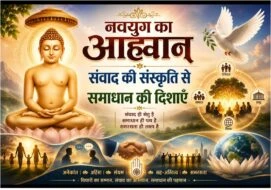
Today, human civilization stands at the pinnacle of unprecedented scientific progress; yet, the irony is that while technology has connected the world rapidly, humans have drifted just as quickly away from one another. Means of communication have multiplied, but genuine dialogue has diminished. There has been an explosion of information, yet no corresponding expansion of understanding. Consequently, individuals are stressed, families are disintegrating, society is becoming fragmented, nations are entangled in ideological conflicts, and the world is grappling with crises of war, terrorism, violence, and mistrust. If one seeks the root cause of all these problems, a single reason becomes evident: the lack of dialogue. This is why "Solutions through Dialogue" (*Samvad se Samadhan*) has become not merely a program, but the most pressing need of the hour. This national initiative, launched by the Mahavirayatan Foundation, is remarkably visionary and relevant to the times. By bringing together governors, policymakers, religious leaders, academicians, social activists, and thinkers from various states onto a single platform to revive the culture of dialogue, this effort is essentially a campaign to restore the very soul of Indian thought. In this series, the "Solutions through Dialogue" program—scheduled to be held in Dehradun, the capital of Uttarakhand, in August 2026 under the chairmanship of Governor Shri Gurmeet Singh—is not just an event; it is a clarion call for social harmony, national unity, and global peace.

SOLUTION THROUGH DIALOGUE:THE CULTURE OF DIALOGUE AND PATHWAYS TO RESOLUTION IN MAHAVIRA’S PHILOSOPHY:SWAMI DEVENDRA BRAHMCHARI
4-AUG-ENG 16


RAJIV NAYAN AGRAWAL
ARA--------------------------Today, human civilization stands at the pinnacle of unprecedented scientific progress; yet, the irony is that while technology has connected the world rapidly, humans have drifted just as quickly away from one another. Means of communication have multiplied, but genuine dialogue has diminished. There has been an explosion of information, yet no corresponding expansion of understanding. Consequently, individuals are stressed, families are disintegrating, society is becoming fragmented, nations are entangled in ideological conflicts, and the world is grappling with crises of war, terrorism, violence, and mistrust. If one seeks the root cause of all these problems, a single reason becomes evident: the lack of dialogue. This is why "Solutions through Dialogue" (*Samvad se Samadhan*) has become not merely a program, but the most pressing need of the hour. This national initiative, launched by the Mahavirayatan Foundation, is remarkably visionary and relevant to the times. By bringing together governors, policymakers, religious leaders, academicians, social activists, and thinkers from various states onto a single platform to revive the culture of dialogue, this effort is essentially a campaign to restore the very soul of Indian thought. In this series, the "Solutions through Dialogue" program—scheduled to be held in Dehradun, the capital of Uttarakhand, in August 2026 under the chairmanship of Governor Shri Gurmeet Singh—is not just an event; it is a clarion call for social harmony, national unity, and global peace.
The entire philosophy of Lord Mahavira is rooted in the spirit of dialogue. He never imposed his views on others; instead, he inspired people to view truth from multiple perspectives. His philosophy of *Anekantavada* (the doctrine of the multiplicity of viewpoints) teaches us that truth is not held captive by any single individual, ideology, or perspective. Each person perceives a fragment of the truth based on their own experiences and outlook. True dialogue begins only when we listen to others' views, respect them, and strive to understand them. This is the practical essence of *Anekanta*. Today, the world faces a major crisis: people want to speak but do not want to listen. Everyone considers their own views to be the absolute truth. Consequently, differences of opinion turn into personal animosity, and that animosity escalates into conflict. Lord Mahavira warned that ego is the greatest enemy of truth. Where there is ego, there is no dialogue; and where there is no dialogue, a resolution is impossible.
The family offers the most natural example of this. The generational gap between a father and son does not become a problem as long as they continue to communicate. Most disputes between husband and wife arise not from differences of opinion, but from a lack of dialogue. Whether between brothers, parents and children, or grandparents and grandchildren, the foundation of a strong relationship is dialogue coupled with love. When people stop talking to each other, misunderstandings inevitably grow. Silence often signals not peace, but the death of a relationship. The same situation is visible in society at large. The root cause of rising tensions based on caste, class, language, region, and ideology is a lack of dialogue. If different communities were to meet regularly, listen to each other's grievances, and seek shared solutions, most social tensions could be resolved. Society Dialogue is more essential than law; while law can establish order, only dialogue can build trust.
Dialogue holds a paramount place in politics as well. The soul of democracy is not elections, but dialogue. Institutions like parliaments, legislative assemblies, and public forums were created to facilitate a healthy exchange of ideas. Democracy begins to weaken when political parties view each other as enemies and an atmosphere of mutual recrimination replaces dialogue. A healthy democracy is one where, despite sharp differences of opinion, the doors to dialogue remain open. This truth applies to global politics as well. History bears witness that even the longest wars have ultimately ended at the negotiating table. Whether it involves border disputes between nations, economic conflicts, or strategic tensions, solutions emerge from conversation, not weaponry. War brings only destruction, whereas dialogue builds the future. Bombs and missiles may alter borders, but they cannot unite hearts; only dialogue possesses the power to connect hearts.
Many of the world's great thinkers have acknowledged this power of dialogue. Mahatma Gandhi’s entire life was a pursuit of dialogue, truth, and non-violence; he never abandoned the path of dialogue, even with his adversaries. Nelson Mandela chose dialogue over retribution after enduring years of injustice, thereby saving South Africa from civil war. The United Nations, too, serves as a global platform for dialogue between nations. This proves that humanity's greatest achievements have stemmed from dialogue, not conflict. Lord Mahavira spoke not only of external dialogue but also conveyed the message of inner dialogue. One who does not converse with oneself cannot engage in meaningful dialogue with others. Introspection, self-examination, and self-purification are the core elements of Mahavira’s philosophy. When an individual recognizes their own anger, ego, greed, and malice, their behavior naturally becomes harmonious. Such a person fosters an atmosphere of harmony rather than conflict in society.
In today's era of social media, dialogue has often been supplanted by heated arguments and accusations. People seek to defeat one another rather than understand each other. The decorum of speech is eroding, and sensitivities are diminishing. In such times, Lord Mahavira’s message of restrained speech, non-violent thought, and *Anekant* (the doctrine of manifold aspects) has become more relevant than ever. If we think before we speak, listen before we react, and strive to understand before we judge, many disputes could be resolved before they even begin. The Mahavirayatan Foundation’s ‘Samvad se Samadhan’ (Resolution through Dialogue) campaign is immensely significant in this context. It is not merely a platform for discussion but a bridge of trust connecting various segments of society. When religious leaders, politicians, administrators, intellectuals, and representatives of society sit together to deliberate on issues concerning the nation and humanity, new paths will undoubtedly emerge. This culture of dialogue represents a revival of India’s ancient tradition—a tradition that, for centuries, conveyed the message of tolerance, harmony, and coexistence to the world.
Today, there is a need to ensure that dialogue is not confined merely to public platforms. Dialogue must take place in every home, school, office, *panchayat*, and parliament; the tradition of dialogue must be strengthened among all nations of the world. If dialogue survives, trust survives; if trust survives, relationships survive; and if relationships survive, humanity remains secure. The present era calls not just for reading Lord Mahavira’s philosophy but for embodying it in our lives. His doctrine of *Anekant* shows us the path of coexistence amidst differences; his principle of non-violence fosters sensitivity; and his emphasis on self-restraint instills the virtue of humility. The synthesis of these three elements forms the cornerstone of meaningful dialogue. Today, the world needs a new dialogue, not a new weapon; a new understanding, not a new competition; and new cooperation, not a new conflict. If humanity is to choose the path of lasting peace, harmony, and progress, it must embrace Lord Mahavira’s timeless message: where there is dialogue, there is resolution; where there is resolution, there is peace; and where there is peace, there lies a bright future for humanity.
What's Your Reaction?
 Like
0
Like
0
 Dislike
0
Dislike
0
 Love
0
Love
0
 Funny
0
Funny
0
 Wow
0
Wow
0
 Sad
0
Sad
0
 Angry
0
Angry
0









Comments (0)