
NOT JUST A LANGUAGE BUT OUR IDENTITY A DIALOGUE NOT BETWEEN MAITHILI AND BHOJPURI BUT IN FAVOUR OF RESPECT AND BALANCE
It is this very land that bestowed the tenderness of Maithili, the vibrancy of Bhojpuri, the intimacy of Magahi, and the sweetness of Angika. This diversity constitutes the true strength of Bihar. However, when one language receives institutional recognition while another feels neglected, it is only natural for questions to arise. Today, this very question is being felt deeply within the Bhojpuri-speaking community.

NOT JUST A LANGUAGE BUT OUR IDENTITY
A DIALOGUE NOT BETWEEN MAITHILI AND BHOJPURI BUT IN FAVOUR OF RESPECT AND BALANCE


26-MAY-ENG 19
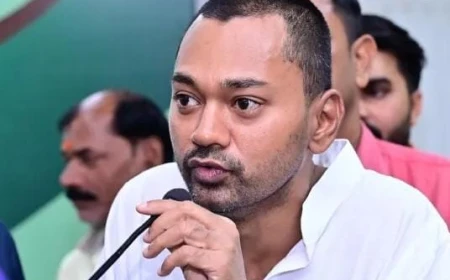
RAJIV NAYAN AGRAWAL
ARA--------------------------It is this very land that bestowed the tenderness of Maithili, the vibrancy of Bhojpuri, the intimacy of Magahi, and the sweetness of Angika. This diversity constitutes the true strength of Bihar. However, when one language receives institutional recognition while another feels neglected, it is only natural for questions to arise. Today, this very question is being felt deeply within the Bhojpuri-speaking community.
Maithili Studies received constitutional recognition; it was incorporated into academic curricula and secured a place at both academic and administrative levels. This is a welcome development. Maithili’s literature, history, and cultural heritage are immensely rich, and it rightfully deserves such honor. Yet, alongside this, a significant question emerges: Should not Bhojpuri Studies—a language spoken by tens of millions of people—be accorded equal opportunity and respect?
Bhojpuri is not merely a language; it is the language of labor, struggle, migration, folk life, and collective sentiment. From agricultural fields to the film industry, from folk ballads to international platforms, Bhojpuri has carved out a distinct identity for itself. In numerous countries across the globe today, memories of the *Girmitiya* (indentured labor) era remain alive through the medium of Bhojpuri.
The irony lies in the fact that a language whose resonance is heard on a global stage is, within its own home state, often confined to the debate of "dialect" versus "language." This article is not intended to pit Maithili against Bhojpuri. It is not a question of competition, but one of representation. It is not an attempt to prove one language superior or inferior to another, but rather a demand for linguistic justice. To truly understand Bihar, one must embrace and carry forward all of its languages together.
If Maithili has been accorded a place of honor within the academic curriculum, then Bhojpuri, too, deserves that same opportunity. For education is not merely a means to employment; it also instills cultural self-confidence. When a child encounters their own mother tongue within the pages of books, it fosters a profound sense of self-respect within them. He feels that his dialect—his home and his community—is as much a part of knowledge and history as any other.
The need of the hour is this: Bhojpuri must be systematically integrated into the school curriculum. Research and publication in the language must be encouraged. Its representation within government and cultural institutions must be enhanced. And most importantly, languages must be elevated above the realm of politics and viewed as a shared cultural heritage. Both Maithili and Bhojpuri constitute the very soul of Bihar; the progress of one should not be predicated upon the neglect of the other. Languages do not disintegrate on their own; they are broken apart. And when a society unites to uphold the dignity of its languages, both its culture and its democracy are strengthened. Bhojpuri is not merely demanding respect; it seeks its rightful place—a recognition commensurate with its contributions. And in any civilized society, such a demand can hardly be deemed unreasonable.
What's Your Reaction?
 Like
0
 Dislike
0
 Love
0
 Funny
0
 Wow
0
 Sad
0
 Angry
0








Comments (0)