
IRAN-ISARAEL WAR: RETALIATORY STRIKES ESCALATE CRISIS
-The Iran-Israel war has plunged the Middle East into a serious crisis. Iran's retaliatory strikes and US involvement following the death of the Supreme Leader have further escalated the conflict.

IRAN-ISARAEL WAR: RETALIATORY STRIKES ESCALATE CRISIS
2-MARCH 3


RAJIV NAYAN AGRAWAL
DELHI---------------------------The Iran-Israel war has plunged the Middle East into a serious crisis. Iran's retaliatory strikes and US involvement following the death of the Supreme Leader have further escalated the conflict.
Iran vowed on Sunday to avenge the killing of its Supreme Leader, Ayatollah Ali Khamenei, in a joint Israeli and US attack. Iran, in retaliation, attempted to target US bases in Gulf countries and Israel with drones and missiles. The US and Israel continued their bombing on Sunday. Explosions in the Iranian capital, Tehran, sent huge plumes of smoke billowing into the sky, especially in the area where government buildings are located. Iranian officials say more than 200 people have been killed since the beginning of the US and Israeli strikes that killed Ayatollah Ali Khamenei and other senior leaders.
Earlier, Iran retaliated by firing missiles at major targets in Israel and Gulf Arab countries, while Israel vowed to carry out "continuous" attacks against Iran's leaders and military. In Israel, loud explosions, caused by missile strikes or intercepted missiles, were heard in Tel Aviv. Israeli rescue services reported that eight people were killed and 28 injured in an attack on a Jewish synagogue in the central city of Beit Shemesh, bringing the total death toll in the country to 10. The US military confirmed on Sunday that three soldiers were killed and five others seriously injured since the operation began. These are the first known US service members killed in the fighting. Meanwhile, Iranian President Masoud Pezeshkian said in a pre-recorded message broadcast on state television that a new leadership council had begun its work. Iranian Foreign Minister Abbas Araghchi said that a new supreme leader would be elected in "a day or two." These attacks and counter-attacks, Khamenei's killing, and US President Donald Trump's call to overthrow the decades-old Islamic Republic have raised fears of a protracted conflict that could engulf all of Central Asia. This is the second time in the past eight months that the US and Israel have launched a joint military operation against Iran. The US president's display of military might is surprising, given his rise to power with the slogan "America First" and a pledge to avoid "endless wars." In the 12-day war last June, Israeli and US attacks significantly weakened Iran's air defenses, military leadership, and nuclear program. However, the death of Khamenei, who ruled Iran for more than three decades, has created a leadership vacuum, increasing the risk of regional instability. Iran vows to avenge Khamenei's death. Iranian Parliament Speaker Mohammad Bagher Qalibaf said in a televised address on Sunday, "You have crossed our red line, and you will pay the price." He added, "We will inflict such devastating blows on you that you will be forced to beg for your lives." Trump warned that any retaliation would only worsen the situation. The US president responded on social media, saying, "They should not do this. If they do, we will attack them with a force never seen before!"
The attack, raising fears of regional unrest, came after hundreds of people stormed the US consulate in Karachi, Pakistan, on Sunday. Police and paramilitary forces used batons and tear gas to disperse the crowd. According to officials, at least nine people were killed in the clashes. Iran retaliated with missiles and drones. In response to the US and Israeli attacks, Iran retaliated with missile and drone strikes against US military bases in Gulf countries. An air war could create chaos in global markets, especially if Iran makes the Strait of Hormuz unsafe for commercial traffic. Approximately 20 percent of the world's oil trade passes through this vital waterway, and oil prices are already subject to fluctuations. According to the Israeli military, at least 10 people were killed and more than 120 injured in a series of attacks across the country. The military reported that several missiles were intercepted. Israeli Defense Minister Israel Katz said on Sunday that his country would launch continued airstrikes against military and leadership targets in Iran.
The situation in West Asia has disrupted air traffic. Dubai, the commercial capital of the United Arab Emirates, has long attracted businessmen and expatriates by presenting itself as a safe haven in a volatile region, but this time it too is in the grip of conflict.
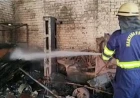
According to UAE state media, two people were killed in Iranian attacks on the capital, Abu Dhabi, and debris from the airstrikes set fire to the city's main port and the facade of the iconic Burj Al Arab hotel.
The Iranian crackdown has spread to Oman, a longtime Iranian interlocutor with the West and not previously involved in the conflict.
Saudi Arabia condemned Iran's attacks on its capital, Riyadh, and its eastern region, saying it successfully repelled them. Saudi Arabia clarified that it did not allow its airspace or territory to be used to target Iran.
Jordan said it encountered 49 drones and ballistic missiles. Kuwait, Bahrain, and Qatar also claimed to have intercepted Iranian missiles on Sunday morning. Iran's Foreign Minister blamed the United States and Israel for the attacks. According to the Iranian Foreign Minister, he has spoken to his counterparts in the Gulf countries and urged them to pressure the United States and Israel to end the war.
Iran has formed a council to govern until a new Supreme Leader is elected. As Iran's Supreme Leader, Khamenei has had the final say on all major policies since 1989. He led Iran's religious establishment and Revolutionary Guard, the two main centers of power in the ruling theocracy. Although Trump called on the Iranian people on Saturday to "capture" their government, there was no sign of unrest in Tehran or elsewhere. According to Iran's state television, at least 115 people were killed and many others injured in an attack on a girls' school in the southern part of the country. Israeli army spokesman Lieutenant Colonel Nadav Shoshani said he was not aware of an Israeli or American attack on the school. US Central Command spokesman Captain Tim Hawkins said he was aware of the reports and officials were investigating.
What's Your Reaction?
 Like
0
 Dislike
0
 Love
0
 Funny
0
 Wow
0
 Sad
0
 Angry
0








Comments (0)