
ARA MP DEMANDS ‘SPECIAL STATE’ STATUS
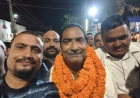
On the occasion of the Bihar Diwas celebrations held at the historic Ramna Maidan Stadium in Bhojpur district, Arrah MP Sudama Prasad delivered an address in which he highlighted Bihar's glorious history while placing special emphasis on the fact that the state's reconstruction is possible only if the Central Government fulfills the demand for 'Special State' status.

ARA MP DEMANDS ‘SPECIAL STATE’ STATUS
23-MARCH-ENG 9


RAJIV NAYAN AGRAWAL
ARA-----------------------------On the occasion of the Bihar Diwas celebrations held at the historic Ramna Maidan Stadium in Bhojpur district, Arrah MP Sudama Prasad delivered an address in which he highlighted Bihar's glorious history while placing special emphasis on the fact that the state's reconstruction is possible only if the Central Government fulfills the demand for 'Special State' status.
The MP stated that the history of the state of Bihar has been a unique saga of struggle and vitality. Since its establishment as an independent province—separated from Bengal and Odisha on March 22, 1912—Bihar has traversed numerous milestones of development. However, the bifurcation that took place on November 15, 2000, had a profound impact on the state's economic structure. The majority of its mineral wealth and heavy industries went to the neighboring state of Jharkhand. Currently, the primary resources remaining with Bihar consist mainly of water, sand, fertile land, and its own hardworking farmers and laborers.
Agriculture serves as the backbone of Bihar's economy; however, this sector is currently grappling with a deep crisis. MP Sudama Prasad expressed concern over the fact that farming is gradually becoming an unprofitable venture. He specifically and prominently raised the issues faced by 'sharecroppers.' In Bihar, more than 70 percent of agricultural activity is conducted under the sharecropping system; yet, the benefits of crucial schemes—such as the 'Kisan Samman Nidhi'—are extended only to those in whose names the land is registered. The actual cultivators—the sharecroppers—remain completely deprived of these benefits.
The state's canal network is currently in a dilapidated condition. Highlighting the significance of the 'Indrapuri Reservoir Project'—which has been pending since 1990—the MP noted that the obstacles hindering its progress have now been cleared. If the construction of this dam on the Son River is completed, it will ensure irrigation for approximately 8.4 million acres of land across eight districts of Central Bihar. This project will not only eradicate the problem of drought at its roots but also provide protection against the devastating floods caused by the Son River, thereby lending new strength to the regional economy.
He strongly advocated for the construction of a state-of-the-art sports stadium to hone the talents of local youth, as well as for the establishment of an agricultural university in Bhojpur. He argued that unless the youth are provided with quality education and sporting opportunities at the local level, it will be impossible to curb the problem of the "brain drain." He urged the district administration to forward these proposals to the State and Central governments on a priority basis.
While discussing development funds and administrative coordination, the MP adopted a pragmatic approach. He stated that the annual allocation of ₹5 crore from the MP Local Area Development Scheme (MPLADS) is extremely limited for fulfilling public aspirations, whereas the demands for infrastructural development are far more extensive. To address this, he emphasized the efficient utilization of the substantial budgets allocated by the Central and Bihar governments. He appealed to the district administration and the Honorable Ministers to take prompt administrative action regarding the list of development schemes submitted by him, ensuring that the benefits of development reach the doorsteps of the common people with ease.
What's Your Reaction?
 Like
0
 Dislike
0
 Love
0
 Funny
0
 Wow
0
 Sad
0
 Angry
0






Comments (0)