
VIKSIT BHARAT 2047-THE DILAPIDATED STATE OF GOVERNMENT SCHOOLS:LALIT GARG
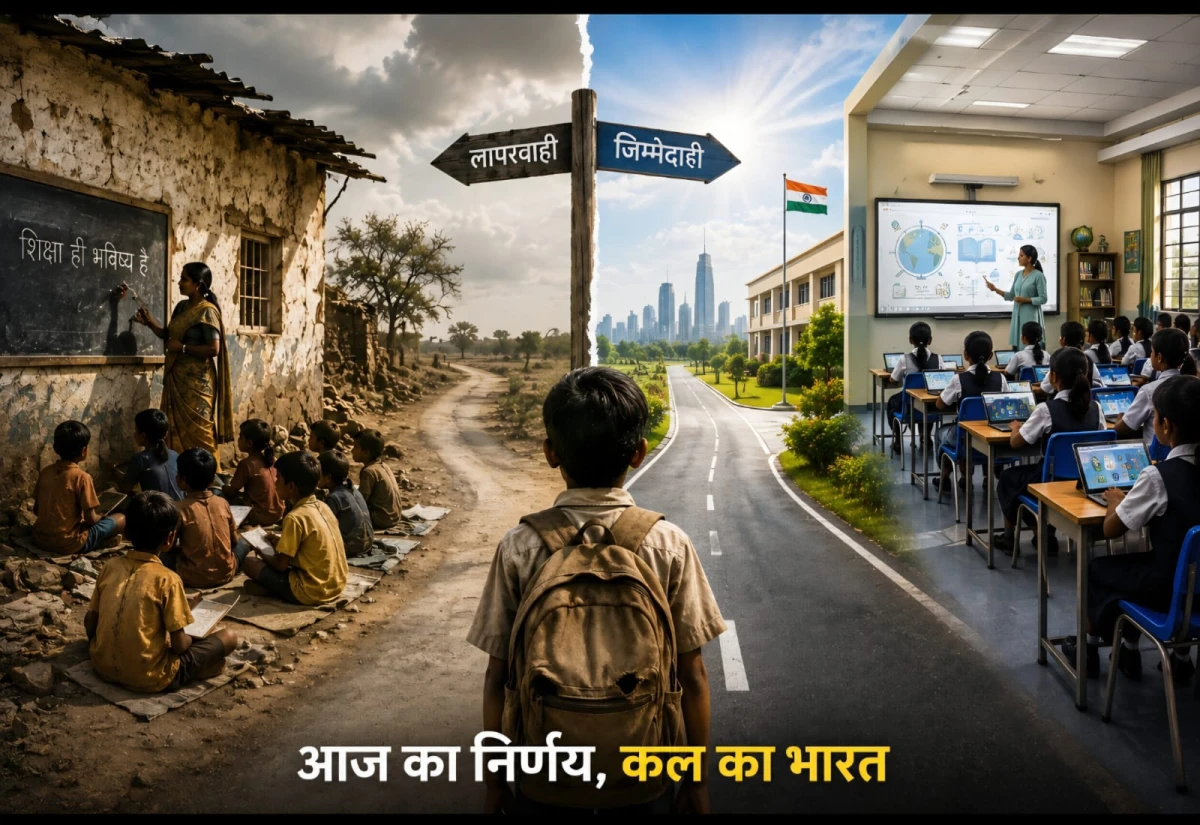
India is moving forward today with the resolve to become a developed nation by 2047. A lone teacher, crumbling walls, and dwindling government schools—can the dream of 2047 be realized without education? The country's progress toward becoming the world's third-largest economy, the digital revolution, achievements in space, infrastructure expansion, and growing influence on the global stage are certainly matters of pride. However, behind this glittering picture, if we look at government schools, a different India emerges—an India where thousands of children still struggle for adequate teachers, safe buildings, clean drinking water, toilets, electricity, and quality instruction. The question arises: if the foundation of the education system—upon which a developed India is to be built—is itself weak, how strong will the India of 2047 truly be? Government statistics further deepen this concern. According to UDISE+ 2024-25, there are 104,125 schools in the country with only one teacher, catering to approximately 3.377 million students. This means a single teacher is forced to manage the education of children across multiple classes and subjects while also handling administrative responsibilities. These are not merely statistics; they represent the future of millions of children for whom government schools are the most accessible—and often the only—medium of education.

VIKSIT BHARAT 2047-THE DILAPIDATED STATE OF GOVERNMENT SCHOOLS:LALIT GARG
26-AUG-ENG 22


RAJIV NAYAN AGRAWAL
ARA---------------------------India is moving forward today with the resolve to become a developed nation by 2047. A lone teacher, crumbling walls, and dwindling government schools—can the dream of 2047 be realized without education? The country's progress toward becoming the world's third-largest economy, the digital revolution, achievements in space, infrastructure expansion, and growing influence on the global stage are certainly matters of pride. However, behind this glittering picture, if we look at government schools, a different India emerges—an India where thousands of children still struggle for adequate teachers, safe buildings, clean drinking water, toilets, electricity, and quality instruction. The question arises: if the foundation of the education system—upon which a developed India is to be built—is itself weak, how strong will the India of 2047 truly be? Government statistics further deepen this concern. According to UDISE+ 2024-25, there are 104,125 schools in the country with only one teacher, catering to approximately 3.377 million students. This means a single teacher is forced to manage the education of children across multiple classes and subjects while also handling administrative responsibilities. These are not merely statistics; they represent the future of millions of children for whom government schools are the most accessible—and often the only—medium of education.
We discuss universities, IITs, IIMs, medical institutes, and state-of-the-art educational campuses, yet we fail to pay adequate attention to the village child dreaming of the future while sitting beneath a broken roof. In some places, there is one teacher for five classes. In others, school buildings are dilapidated; there is a lack of drinking water, toilets, electricity, or fans. In recent months, students in several districts of Uttar Pradesh have had to take to the streets to demand more teachers, better meals, drinking water, fans, and basic amenities. In Fatehpur, for instance, nearly a thousand students protested for basic facilities such as safe classrooms, roofs that do not leak, and access to safe drinking water. This situation is not merely the failure of a single state or government. It is the result of an administrative mindset that has persisted for years—one where education was prioritized in speeches, yet its quality and accountability failed to secure a place among the administration's top priorities. Education departments possess vast networks of officials and staff, along with budgets, schemes, committees, and inspection mechanisms; yet, how did over a hundred thousand single-teacher schools continue to exist? This question must be directed not just at the government, but at the entire administrative machinery.
Certainly, the picture is not entirely bleak. According to UDISE+, in 2024-25, the country had a total of 14.71 lakh schools, approximately 24.69 crore students, and over one crore teachers. There are 10.13 lakh government schools, while recognized private schools number around 3.40 lakh. Government data also indicates that the number of single-teacher schools dropped from 110,971 in 2023-24 to 104,125 in 2024-25, and the proportion of schools with computer facilities rose from 57.2 percent to 64.7 percent. While these improvements should be acknowledged, regarding them as the ultimate achievement would amount to complacency; the true yardstick of education is not buildings, computers, or statistics, but a child's learning capacity and the shaping of their future.
A recent NITI Aayog report presents another significant picture. In 2014-15, there were 11.07 lakh government schools in the country, a figure that fell to 10.13 lakh by 2024-25. Conversely, the number of recognized private schools rose from 2.88 lakh to 3.39 lakh. This shift represents more than just a fluctuation in school numbers; it signals the changing preferences of parents and a declining confidence in government education. The biggest question is this: when the government possesses buildings, land, trained teachers, the capacity to pay salaries, and a vast administrative machinery, why do government schools lag behind private schools? While it is easy to criticize private schools, one must also consider why parents choose them despite the burden of fees on their limited incomes. The answer lies in factors such as the quality of education, discipline, regularity, English and technical instruction, parent-teacher communication, and the overall learning environment in government schools. Data from ACER also highlights this disparity. According to a NITI Aayog report, in 2024, the proportion of Class 3 students capable of reading a Class 2-level text was 23.4% in government schools, compared to 35.5% in private schools. Similarly, for Class 5, the figure stood at 44.8% for government schools and 59.3% for private schools. In other words, the issue is not merely about school infrastructure but also about learning outcomes.
Parallel to this, the situation regarding higher education and competitive examinations is also a cause for concern. Reports of paper leaks, examination irregularities, recruitment delays, and youth protests have been frequent. Disputes surrounding examinations have fueled widespread discontent among students and aspirants. This implies that the problem permeates the entire education system, from the primary level to higher education. A weak foundation in primary school, a crisis of quality in secondary education, and issues regarding transparency in higher education and competitive exams—none of these can be resolved in isolation. Government schools are, in fact, the most vital instrument for fostering social equality in India. Large numbers of children from rural households, laboring families, the poor, marginalized sections, and low-income groups attend these schools. If When the quality of schools declines, the hardest hit are those who lack the option of expensive private schools. Therefore, the dilapidated state of government schools is not merely an educational crisis but a crisis of social justice as well.
A bold yet meaningful suggestion deserves consideration here: could a system be devised—under specific conditions—to encourage or mandate that the children of elected representatives and senior administrative officials attend government schools? When policymakers themselves experience the system firsthand, issues like broken windows, non-functional toilets, teacher shortages, and poor-quality mid-day meals will cease to be mere file notations and become personal experiences. Education cannot be reduced to schemes providing mid-day meals, scholarships, uniforms, or free textbooks. While these are essential, the true purpose of education is not simply to get a child into school, but to mold them into a citizen equipped with knowledge, wisdom, skills, values, and self-confidence. How can we expect a child denied quality education today to make a meaningful contribution to building a developed India tomorrow?
The government must move beyond mere announcements and consider comprehensive initiatives like a ‘National Government School Transformation Mission.’ Clear standards must be established for every school regarding teacher availability, building safety, drinking water, electricity, digital facilities, toilets, libraries, playgrounds, and learning outcomes. Each school should have a public dashboard reporting annually on how many children have mastered reading, writing, and basic mathematics. Teacher recruitment must be transparent, with strict curbs on political interference. School management committees should be empowered with genuine authority, and officials at the district level must be held accountable. Above all, education must be elevated above politics. Both the government and the opposition need to understand that government schools do not belong to any specific party; they belong to India’s future. If a political party highlights the poor state of schools, it should be welcomed, but the focus must remain on the children's future rather than on political mileage.
What's Your Reaction?
 Like
0
 Dislike
0
 Love
0
 Funny
0
 Wow
0
 Sad
0
 Angry
0









Comments (0)