
MODI SPEAKS TO CHINMAYANAND AFTER 33 YEARS OF HIS DEATH
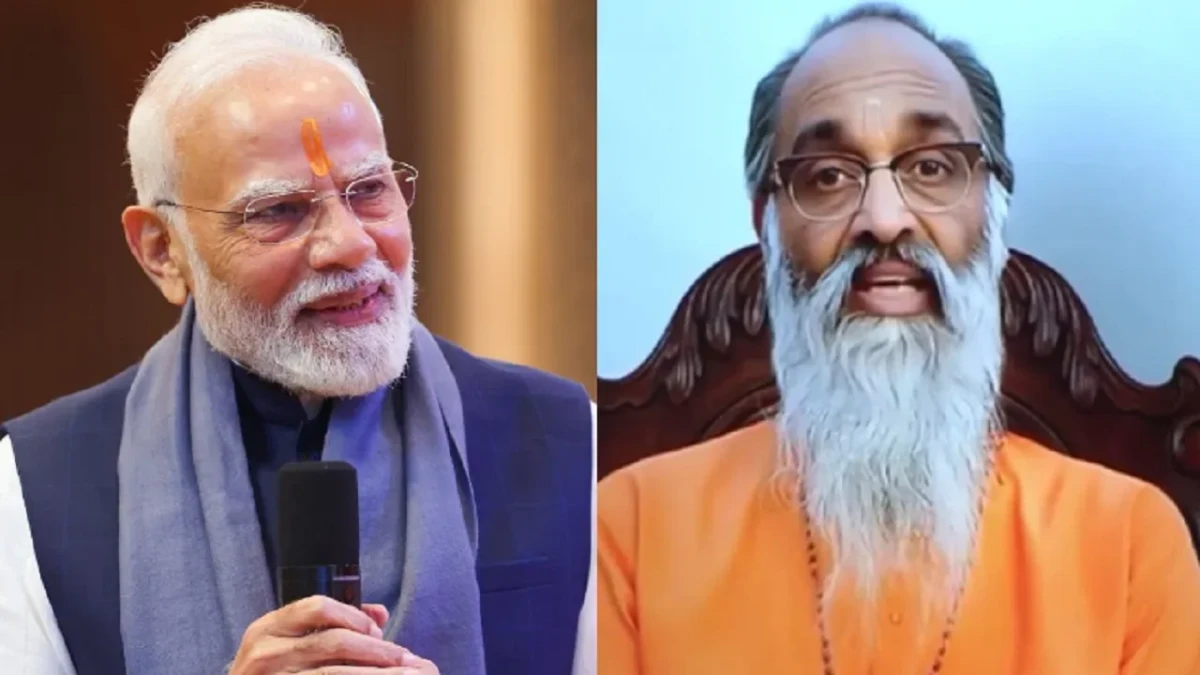
-Prime Minister Narendra Modi has "spoken" to Swami Chinmayananda, who passed away 33 years ago. You might be wondering how this is possible; let us explain. On October 23, 2026, during the 'Chinmaya Amrit Mahotsav' global conference held at Bharat Mandapam in New Delhi, PM Modi interacted with a 'holobot' (a virtual avatar) of Swami Chinmayananda Saraswati.

MODI SPEAKS TO CHINMAYANAND AFTER 33 YEARS OF HIS DEATH
26-OCT-ENG 2


RAJIV NAYAN AGRAWAL
DELHI--------------------------Prime Minister Narendra Modi has "spoken" to Swami Chinmayananda, who passed away 33 years ago. You might be wondering how this is possible; let us explain. On October 23, 2026, during the 'Chinmaya Amrit Mahotsav' global conference held at Bharat Mandapam in New Delhi, PM Modi interacted with a 'holobot' (a virtual avatar) of Swami Chinmayananda Saraswati.
Remarkably, the technology created the impression that Swami Chinmayananda himself was sitting before the Prime Minister, engaging in conversation. PM Modi recalled a meeting he had with Swami Chinmayananda in 1993 and sought his blessings.
Swami Chinmayananda Saraswati was a renowned Indian spiritual leader, a scholar of Vedanta, and the founder of the Chinmaya Mission. He played a pivotal role in disseminating the wisdom of the Bhagavad Gita and the Upanishads to the general public, the youth, and the Indian diaspora abroad. He believed that spiritual knowledge should not be confined to religious study alone, but should instead contribute to the development of the individual, society, and the nation.
Swami Chinmayananda Saraswati was born on May 8, 1916, into a highly distinguished and elite family in Ernakulam, Kerala. Swami Chinmayananda Saraswati was born Balakrishna Menon. His father, Kutta Menon, was a prominent judge in the judicial department. Furthermore, as a nephew of the Maharaja of Cochin, he belonged to a family held in high esteem within society.
His mother, Paru Kutty—affectionately known as ‘Manku’—was a devout housewife. When Balakrishna was only five years old, his mother passed away unexpectedly while giving birth to her third child. Following this, Balakrishna was raised by his maternal aunt, Kochunarayani.
Swami Chinmayananda Saraswati began his formal schooling at the age of five at the Sree Rama Varma High School in Kochi (1921–1928). He later moved to Trichur (Thrissur) to continue his education, completing his studies at the Vivekodayam School (1928–1932). English was his primary language of instruction, and he excelled in both academics and sports.
After completing his schooling, he pursued his F.A. (Intermediate) at Maharaja’s College, Ernakulam, and subsequently earned a Bachelor of Arts degree from the renowned St. Thomas College in Trichur. He later moved to Uttar Pradesh for higher education, obtaining an M.A. in English Literature and a law degree from the University of Lucknow. During his time at the university, he also completed a course in journalism, which eventually led him to become an incisive journalist for *The National Herald*.
In his youth, Balakrishna was deeply influenced by Marxist and Western ideologies. He viewed *sadhus* (ascetics) and saints as hypocrites and a burden upon society. In 1947, he conceived a plan to write a sensational investigative piece for the Delhi-based newspaper, *The National Herald*. Their objective was to expose the way of life of the saints in Rishikesh. With this intention, they He arrived at the ‘Divine Life Society’ ashram in Rishikesh.
Upon reaching the ashram, Balkrishna encountered Swami Sivananda Saraswati. Swami Sivananda’s profound compassion, divine aura, and logical, spiritual perspective deeply moved Balkrishna. To test the intellectual ego of this educated journalist, Swami Sivananda assigned him the task of cleaning the footwear of the devotees visiting the ashram.
Balkrishna performed this task with complete humility and dedication. Swami Sivananda’s love and simplicity dispelled all the doubts in Balkrishna’s mind. The journalist, who had come seeking the flaws of saints, found himself sitting at the feet of Swami Sivananda, absorbed in the pursuit of truth.
In 1949, he received initiation into *Sannyasa* (renunciation). After spending a few years at the ashram and engaging in intense spiritual practice, the spirit of renunciation (*vairagya*) fully matured within Balkrishna. On February 25, 1949—the auspicious day of Maha Shivaratri—Swami Sivananda initiated him into the sacred order of *Sannyasa*. Following this initiation, he was given a new name: ‘Swami Chinmayananda Saraswati.’
Recognizing that Chinmayananda possessed a remarkably sharp intellect, Swami Sivananda sent him to Uttarkashi to study under the great Vedanta scholar, Swami Tapovan Maharaj. The rules for studying under Swami Tapovan Maharaj were extremely rigorous; he would teach a scripture only once, and the disciple was expected to grasp and internalize it immediately.
For nearly eight years, amidst the biting cold of the Himalayas and devoid of any modern amenities, Swami Chinmayananda underwent rigorous penance and delved into the profound mysteries of the Upanishads and the Bhagavad Gita.
By 1951, when his studies concluded, he realized that this great, logical wisdom of *Sanatana Dharma* remained confined solely to the caves of the Himalayas and a select few scholars. With the blessings of his guru, he resolved to share the wisdom of the scriptures in a language accessible to the common people. In December 1951, he began his first ‘Upanishad Jnana Yajna’ (a series of spiritual discourses) at a Ganesha temple in Pune—an initiative that would eventually evolve into the global Chinmaya Mission.
His first Jnana Yajna in Pune spanned approximately 100 days, from December 31, 1951, to April 8, 1952. During this period, he delivered logical, analytical discourses on the ‘Kena Upanishad’ and the ‘Kathopanishad.’ Because Swami-ji taught Vedanta in English and employed a highly rational approach, he initially faced strong opposition from orthodox scholars. They believed that sacred Sanskrit mantras should not be articulated in English, nor shared with all segments of society—particularly women.
Swami-ji remained undeterred by this opposition. His scientific and practical interpretations resonated so deeply with the youth and the intellectual community that the venues (pandals) soon became too small to accommodate the crowds.
At the conclusion of a Jnana Yajna held in Madras (Chennai), Swami Chinmayananda’s disciples expressed a desire to formalize this intellectual movement into an institution. Consequently, the Chinmaya Mission was officially established on August 8, 1953. Although Swami Chinmayananda himself was initially opposed to having an organization named after him, his disciples argued that the term ‘Chinmaya’ also signifies ‘pure, knowledge-filled consciousness’—making the name a tribute to both the guru and the knowledge itself.
Following this, throughout the 1950s and 1960s, Swami-ji traveled tirelessly across India, conducting 10 to 12 major Jnana Yajnas annually. He established various wings to engage different sections of society, including ‘Bal Vihar’—a program designed to impart traditional *Sanatana* values to children through play-based learning. The Chinmaya Yuva Kendra was established to prevent college-aged youth from becoming misguided and to inspire them toward service to the nation.
He embarked on his first global tour, promoting Indian philosophy across various countries in America, Europe, and Asia. His lectures were hosted at prominent universities abroad. Amidst the materialism prevalent in Western nations, he offered a path toward mental peace, which led to the establishment of Chinmaya Mission centers internationally.
Swami Ji was not merely a spiritual teacher; he was a *karmayogi* (one who practices the yoga of action). Under the Mission, he initiated several major institutions. More than 80 Chinmaya Vidyalayas and colleges were established across India, where, alongside modern education, value-based learning is imparted through the ‘Chinmaya Vision Programme.’
To foster self-reliance in rural India, the ‘Chinmaya Organisation for Rural Development’ (CORD) was launched—an initiative that continues to support millions of villagers and women today. A unique *gurukul* was also established to prepare youth for the in-depth study of Vedanta and to train them as missionaries (*acharyas*) for the organization.
Swami Chinmayananda Saraswati breathed his last on August 3, 1993, in San Diego, USA, at the age of 77. Following his passing, his mortal remains were flown to Indira Gandhi International Airport in Delhi on August 7, 1993, where thousands of his disciples gathered to pay their final respects. Subsequently, his mortal remains were transported in a large procession to the Sidhbari Ashram in the Kangra district of Himachal Pradesh. There, on August 9, 1993, he was laid to rest in a *bhu-samadhi* (interment in the earth) while seated in the *padmasana* (lotus) posture, accompanied by traditional Vedic rites and the chanting of *mantras*.
On October 23, 2026, during the ‘Chinmaya Amrit Mahotsav’ global conference held at Bharat Mandapam in New Delhi, Prime Minister Narendra Modi engaged in a conversation with a ‘holobot’ (holographic robot) of Swami Chinmayananda. Swami Chinmayanand passed away on August 3, 1993. Thus, nearly 33 years after his death, an interaction with his digital persona—created using modern technology—was organized. PM Modi mentioned that he had met Swami Chinmayanand in Vadodara in February–March 1993.
FAQs
1. What was the original name of Swami Chinmayanand Saraswati? was it?
His childhood name was Balakrishna Menon. Within his family, he was also called 'Balan'.
2. When and where was Swami Chinmayananda born?
He was born on May 8, 1916, in Ernakulam, Kerala.
3. Why did Swami Chinmayananda establish the Chinmaya Mission?
He founded the Chinmaya Mission with the objective of bringing the teachings of the Bhagavad Gita, the Upanishads, and Advaita Vedanta to the general public, and to encourage spiritual growth.
4. When did Swami Chinmayananda pass away?
He passed away on August 3, 1993, in San Diego, USA.
5. When did PM Modi interact with Swami Chinmayananda?
Prime Minister Narendra Modi interacted with a 'holobot' of Swami Chinmayananda on October 23, 2026, in New Delhi, during the Chinmaya Amrit Mahotsav Global Conference.
6. What is a 'holobot'?
A 'holobot' is a form created using modern digital technology, through which a person's digital image—powered by artificial intelligence—can be used to facilitate interaction.
What's Your Reaction?
 Like
0
 Dislike
0
 Love
0
 Funny
0
 Wow
0
 Sad
0
 Angry
0





Comments (0)