
EMPHASIS ON PRESERVING VERNACULAR LANGUAGES
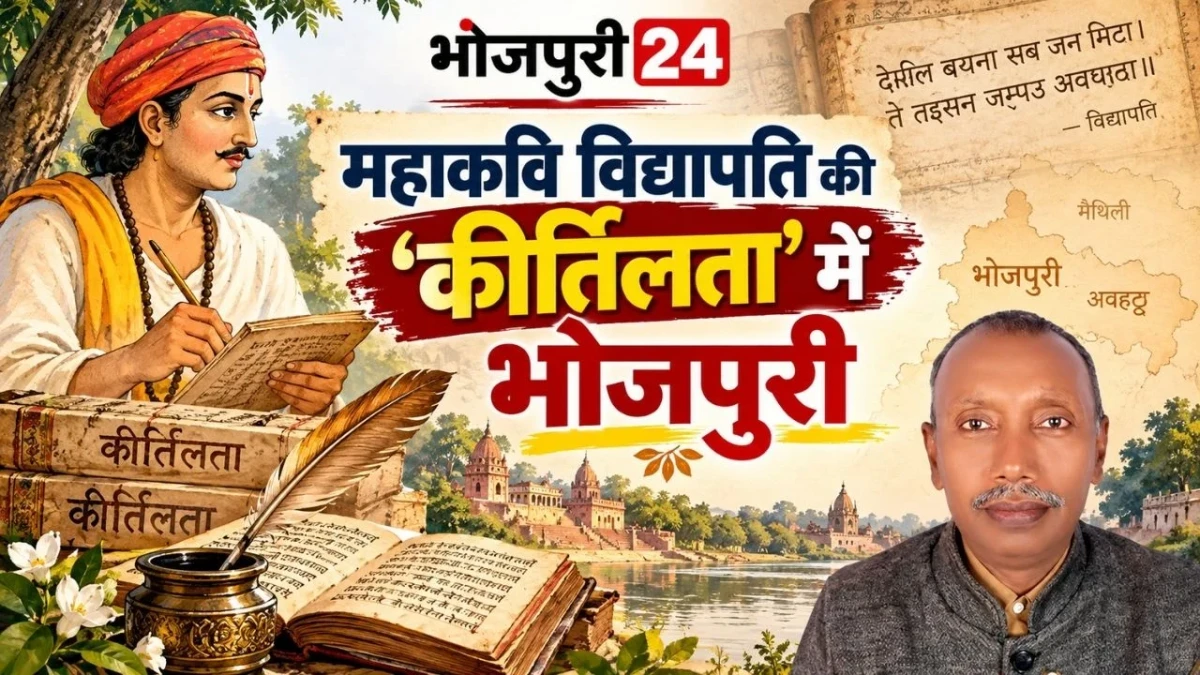
-The works of the great poet Vidyapati serve as a vital reference point for understanding the history, literary tradition, and cultural heritage of the Bhojpuri language. In his research-based article titled *'Vasudevsharan Agrawal ki Drishti mein Vidyapati'* (Vidyapati through the eyes of Vasudevsharan Agrawal), Dr. Gopal Thakur explores the historical role of Bhojpuri by analyzing the language and linguistic characteristics found in Vidyapati’s celebrated work, *'Kirtilata'*.

EMPHASIS ON PRESERVING VERNACULAR LANGUAGES
12-OCT-ENG 15


RAJIV NAYAN AGRAWAL
ARA----------------------------The works of the great poet Vidyapati serve as a vital reference point for understanding the history, literary tradition, and cultural heritage of the Bhojpuri language. In his research-based article titled *'Vasudevsharan Agrawal ki Drishti mein Vidyapati'* (Vidyapati through the eyes of Vasudevsharan Agrawal), Dr. Gopal Thakur explores the historical role of Bhojpuri by analyzing the language and linguistic characteristics found in Vidyapati’s celebrated work, *'Kirtilata'*.
The article emphasizes that understanding the history of Indian languages requires studying not only classical literature but also vernacular languages, regional dialects, and the linguistic traditions of the common people. The author believes that instead of merely viewing vernacular languages as dialects of Hindi, one should seriously acknowledge their independent linguistic existence and literary contributions.
The great poet Vidyapati was a scholar of Sanskrit and possessed a deep understanding of Prakrit literature. According to the article, he employed the *Avahattha* language in his famous work *'Kirtilata'* to connect with the common people. The author notes that Vidyapati prioritized the natural ease and popularity of the vernacular tongue in his writing. The article cites the following lines by Vidyapati:
“Desil bayana sab jan mittha.
Te taisan jampau Avahattha.”
These lines convey that words spoken in the native tongue sound sweet to everyone; therefore, the poet wishes to compose his work in such a language. This example illustrates that the tradition of linking literature with the language of the common people has long existed in Indian literature.
In his article, Dr. Gopal Thakur presents a perspective that differs from prevailing interpretations regarding the language of *'Kirtilata'*. He argues that it is inappropriate to view *Avahattha* merely as an early form of Maithili. According to him, this language also exhibits several linguistic features characteristic of Bhojpuri.
The article cites words such as *dia*, *pia*, *bhaia*, *maia*, *baua*, and *nauaa*. Through these examples, the author draws attention to the linguistic similarities shared by Avahatta, Bhojpuri, and Maithili. He also incorporates verbal forms and characteristics of word formation into this discussion.
However, this represents the author's own linguistic analysis and argument. Further study is required, based on the views of various scholars and linguistic research regarding the language of Vidyapati.
The article commends the work of scholar Vasudevsharan Agrawal regarding the editing and interpretation of *Kirtilata*. According to the author, Agrawal conducted an extensive study of the work's vocabulary, grammatical structure, and the Prakrit, Avahatta, and Arabic-Persian terminology employed within it.
Also read: Bhojpuri stalwart Avinash Chandra Vidyarthi, who penned the saga of the language's glory.
This contributed significantly to understanding *Kirtilata* and examining its linguistic nature. The article further notes that when re-examining ancient literature, it is essential to review earlier editions and interpretations to gain a better understanding of the historical evolution of languages.
Dr. Gopal Thakur’s article is not limited solely to Vidyapati’s language; it also raises broader questions concerning the identity of regional languages, their historical development, and the role of folk traditions in the study of Indian languages.
The author advocates for a re-evaluation of the works of writers such as Pandit Damodar, Jyotirishwar, Kabir, and Tulsidas—alongside Vidyapati—specifically in the context of the characteristics of the vernacular languages used in their writings. This discourse is significant for Bhojpuri because the richness of a language is defined not merely by its contemporary literature but also by its historical roots, folk traditions, vocabulary, and cultural contributions.
Also read: Dr. Gorakh Prasad Mastana – A gem of Bhojpuri songs, poetry, and ghazals.
To bring Bhojpuri's heritage to the forefront, it is essential to conduct further research into ancient texts, folk songs, manuscripts, and regional linguistic traditions. This will facilitate an evidence-based understanding of Bhojpuri's history and help convey it to the new generation.
Source: A research article by Dr. Gopal Thakur titled ‘Vidyapati in the Eyes of Vasudeva Sharan Agrawala’, which discusses the linguistic elements of Bhojpuri in the context of Vidyapati’s *Kirtilata* and the *Avahatta* language.
What's Your Reaction?
 Like
0
Like
0
 Dislike
0
Dislike
0
 Love
0
Love
0
 Funny
0
Funny
0
 Wow
0
Wow
0
 Sad
0
Sad
0
 Angry
0
Angry
0






Comments (0)