
DISCUSSION ON SOCIAL JUSTICE IN THE MAHABHARAT WAR
-A thought-provoking seminar was organized on Friday at the auditorium of the Shri Krishna Chetna Samiti to mark the auspicious occasion of Krishna Janmotsav. The theme of the seminar was ‘Social Justice in the Mahabharata War,’ featuring a serious dialogue on concepts such as *Dharma* (righteousness/duty), duty, equality, and justice, drawing upon episodes from the Mahabharata. Speakers highlighted that the Mahabharata is not merely a tale of war but a text that offers profound guidance on justice systems, morality, and societal responsibility. The objective of the program was to strengthen social harmony and a just perspective by understanding the ideas of Shri Krishna and the core messages of the Mahabharata within today's social context.

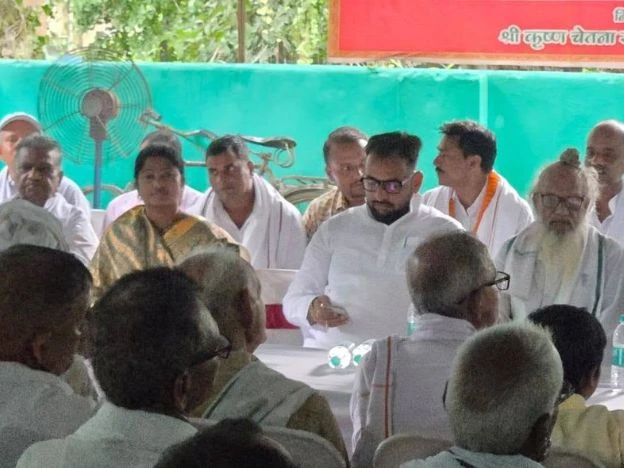
DISCUSSION ON SOCIAL JUSTICE IN THE MAHABHARAT WAR
6-SEP-ENG 8


RAJIV NAYAN AGRAWAL
ARA--------------------------A thought-provoking seminar was organized on Friday at the auditorium of the Shri Krishna Chetna Samiti to mark the auspicious occasion of Krishna Janmotsav. The theme of the seminar was ‘Social Justice in the Mahabharata War,’ featuring a serious dialogue on concepts such as *Dharma* (righteousness/duty), duty, equality, and justice, drawing upon episodes from the Mahabharata. Speakers highlighted that the Mahabharata is not merely a tale of war but a text that offers profound guidance on justice systems, morality, and societal responsibility. The objective of the program was to strengthen social harmony and a just perspective by understanding the ideas of Shri Krishna and the core messages of the Mahabharata within today's social context.
Janmashtami Seminar: The event was presided over by the organization's president, Nand Kishore Yadav. In his presidential address, he stated that Krishna Janmotsav is not just a festival of celebration and tradition, but also an opportunity to reaffirm the resolve to establish truth, justice, and righteousness in life. He noted that the Mahabharata contains numerous episodes demonstrating that the battle for social justice is fought not only with swords but also through ideas and wisdom. The president further remarked that when injustice rises in society, steadfastness in leadership, policy, and the public interest becomes essential—and the life of Shri Krishna exemplifies this very steadfastness.
The seminar was inaugurated through the ceremonial lighting of a lamp by MLA Radhacharan Sah, MLC Sonu Rai, and former MLC Laldas Rai. The lighting of the lamp created an atmosphere blending devotion with contemplation; attendees described it as a symbol of the light of knowledge, justice, and consciousness. Following the inauguration, the guests remarked from the dais that the episodes of the Mahabharata remain as relevant today as they were in that era; while the nature of societal challenges may evolve, the fundamental conflict between justice and injustice persists. Speaking as the keynote speaker, MLA Radhacharan Sah stated that by acting as Arjuna's charioteer during the Mahabharata war, Lord Krishna conveyed the message that leadership is not merely about issuing orders; rather, it is about providing guidance and showing the right path during times of crisis. He noted that when Arjuna laid down his bow and arrows before the battle began—overcome by emotional attachment and indecision—Krishna imparted the teachings of the Gita to him. Through the Gita's message regarding the eternal and imperishable nature of the soul, Krishna explained to Arjuna that turning away from one's duty is tantamount to straying from the path of justice. The MLA added that Krishna's teachings awakened Arjuna's sense of duty, prompting him to take up his bow once more and fight. Linking this episode to the perspective of social justice, the MLA remarked that when a society or an individual remains silent in the face of injustice, they too, in a way, abet unrighteousness (*adharma*); therefore, standing up for justice is the true path of righteousness (*dharma*).
MLA Radhacharan Sah further observed that the essence of the Gita is not merely spiritual but also social, as it inspires individuals to move beyond inaction and embrace responsibility. He urged the youth present not to view the Mahabharata merely as a story or a tradition, but to draw lessons from it regarding life decisions, character building, and social responsibility. He stated that the Gita's message—of remaining steadfast in support of duty and truth—becomes all the more relevant when rights are violated, weaker sections are oppressed, or attempts are made to make truth bow before falsehood.
Subsequently, MLC Sonu Rai stated in his address that Lord Krishna made every possible effort as an emissary of peace to avert the war. He elaborated on how Krishna tried to reason with both the Kaurava and Pandava factions to prevent bloodshed and achieve a just resolution. However, his efforts did not succeed due to Duryodhana's obstinacy, arrogance, and unjust stubbornness. The MLC stated that this episode illustrates that the first step toward establishing justice is always an attempt at dialogue, compromise, and peace; however, when the party perpetrating injustice refuses to accept justice in any way, conflict becomes inevitable.
Sonu Rai further remarked that when Duryodhana attempted to imprison Shri Krishna, the latter revealed His *Virat Swaroop* (Cosmic Form). Citing this event, he noted that it became clear at that very moment what the consequences of *Adharma* (unrighteousness) would be. He also interpreted this as a warning that injustice cannot be legitimized through the sheer force of authority, power, or a majority. According to him, the *Virat Swaroop* signifies not merely a miracle but also the message that Truth and *Dharma* are vast in nature and ultimately triumph. He added that even today, if any individual or system seeks to normalize injustice, they should remember this lesson from the Mahabharata: the end of *Adharma* is inevitable.
Referring to a significant episode from the Mahabharata, former MLC Laldas Rai mentioned that prior to the war, both Duryodhana and Arjuna had approached Shri Krishna seeking support. Duryodhana asked for the *Narayani Sena* (Krishna's army); Shri Krishna granted this request and sent the army with him, while He Himself chose to become Arjuna's charioteer. He stated that this episode reflects Shri Krishna's impartiality and His commitment to standing on the side of *Dharma*. The former MLC noted that although Shri Krishna did not take up arms in the actual battle, He provided counsel, wisdom, and guidance upheld *Dharma* (righteousness). Explaining this from the perspective of social justice, he noted that for any major transformation, the most crucial role is often played by defining direction and strategy, rather than merely displaying brute force.
Laldas Rai further remarked that Duryodhana chose the army because he believed in raw power, whereas Arjuna chose Shri Krishna because he prioritized *Dharma*, ethical principles, and sound guidance. This is why victory ultimately sided with righteousness. He added that this narrative teaches us that establishing justice in society requires not just resources and numbers, but also the right leadership and ethical decision-making. He urged the audience to adopt the principle in both their personal and social lives that decisions should always align with righteousness and justice.
Other speakers and social activists present at the seminar also shared their views. They observed that the message of social justice in the *Mahabharata* lies not merely in the outcome of the war, but in the actions and moral choices of each character. Citing episodes such as the Pandavas' struggle, the humiliation of Draupadi and her resistance, Bhishma’s vow, Vidura’s wisdom, and Krishna’s diplomacy, the speakers highlighted that the issue of justice concerns not only state power but also societal sensitivity and collective consciousness. They emphasized that as long as society fails to raise its voice against injustice, the audacity of the perpetrators continues to grow.
During the event, it was also noted that social justice signifies more than just economic or political equality; it encompasses equal treatment regarding dignity, opportunities, and rights. This perspective is evident throughout Shri Krishna’s life, as he consistently stands with the weak, the oppressed, and the cause of truth. The seminar also discussed the vital role of education, dialogue, and awareness in the contemporary struggle for social justice. Young people were encouraged to connect the messages found in ancient texts with their lives today and to play an active role in fostering social harmony.
Yadav Ram Sakal Singh Bhojpuria welcomed the guests. Welcoming all visitors, speakers, and citizens present, he remarked that such events foster positive ideas in society and inspire the new generation to lead a value-based life rooted in culture. Bhubaneswar Yadav delivered the vote of thanks. Expressing gratitude to all the members, guests, and audience members who supported the event, he stated that the organization would continue to host seminars on such topics to strengthen the spirit of justice, morality, and mutual respect within society.
The event was attended by Harendra Mukhiya, former Zila Parishad Vice-Chairman Lalbihari Yadav, Hakim Prasad, Aarti Devi, Shailendra Kumar, Garhani Pramukh Vinod Yadav, Kapil Yadav, Malik Yadav, Sonu Rajak, Deputy Pramukh Raj Pal Yadav, Kanhaiya Yadav, Sudarshan Yadav, Engineer Sudarshan Yadav, Mahendra Giri, Mandal RJD State General Secretary Manoj Singh, Mahesh Yadav, Arun Yadav, Kapil Dev Akela, Satyanarayan Yadav, Rajnish Yadav, and Mahavir Babu, among others. Attendees described the program as enlightening and inspiring, noting that understanding the messages of the Mahabharata could help promote justice and harmony in society. The event concluded with a resolve that the inspiration drawn from the Krishna Janmotsav celebration should not remain confined to the stage but should also be reflected in the behavior, mindset, and decisions of society.
What's Your Reaction?
 Like
0
 Dislike
0
 Love
0
 Funny
0
 Wow
0
 Sad
0
 Angry
0









Comments (0)