
LAKADIYA BRIDGE BECOMES A DEATH TRAP
The temporary arrangement made in connection with the Lakadiya Bridge—currently under construction over the Cher River near Rudranagar village in the Shahpur police station area of Bhojpur district—has proven fatal. The diversion route, originally created for public convenience during the bridge's construction, has now become a threat to the lives of ordinary citizens. The tragic deaths of two young men so far serve as clear evidence of the extent to which safety standards and local conditions were disregarded during the construction process. Constructed at a height of only about three feet above the riverbed, this diversion raised alarm bells from the very first day of the monsoon; yet, neither was the arrangement improved in time, nor were necessary warnings or safety measures implemented.

LAKADIYA BRIDGE BECOMES A DEATH TRAP
6-SEP-ENG 9


RAJIV NAYAN AGRAWAL
ARA----------------------------The temporary arrangement made in connection with the Lakadiya Bridge—currently under construction over the Cher River near Rudranagar village in the Shahpur police station area of Bhojpur district—has proven fatal. The diversion route, originally created for public convenience during the bridge's construction, has now become a threat to the lives of ordinary citizens. The tragic deaths of two young men so far serve as clear evidence of the extent to which safety standards and local conditions were disregarded during the construction process. Constructed at a height of only about three feet above the riverbed, this diversion raised alarm bells from the very first day of the monsoon; yet, neither was the arrangement improved in time, nor were necessary warnings or safety measures implemented.
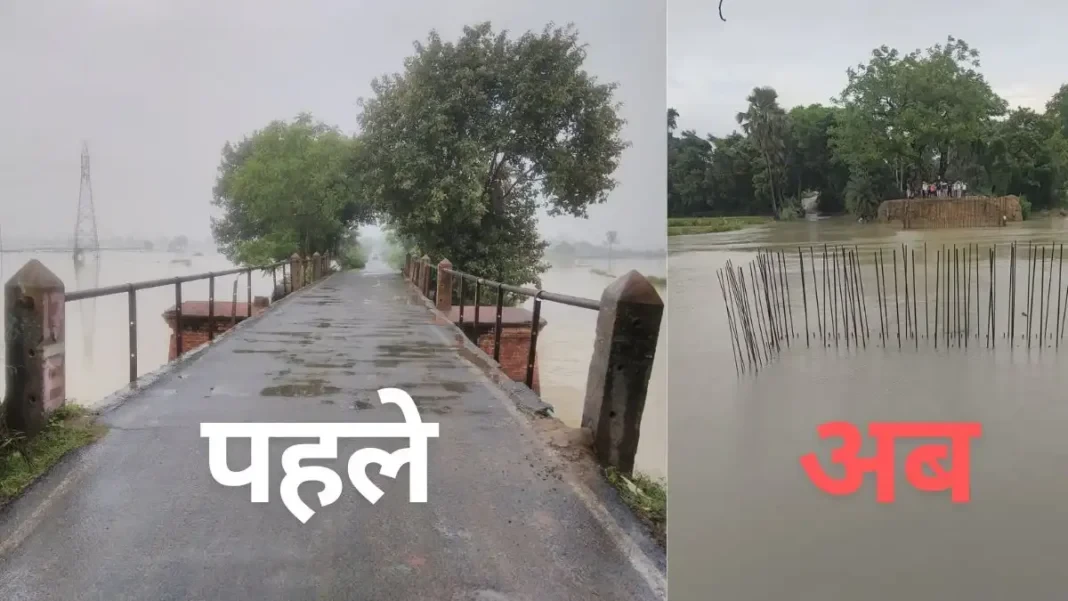
Observing the bridge's current state in the photograph, it is evident that a sturdy, functional bridge was demolished without adequate planning, alternative arrangements, or risk assessment. This was the very bridge that previously facilitated smooth traffic flow and served as a reliable means of transport for residents of nearby villages. The situation now is such that the rising water levels have completely blocked the route, disrupting the daily lives of thousands of local residents. Locals state that there was no immediate need to demolish the old bridge. Had the administration and the construction agency exercised even a modicum of prudence, the new bridge could have been built alongside the old one—a common practice elsewhere. Cases such as the Barka village bridge or the Kharauni four-lane project serve as examples; there, existing bridges were not demolished—thereby endangering the public—during construction. Instead, new bridges were built alongside the old structures to ensure uninterrupted traffic flow.
Today, this issue is no longer confined to the technicalities of construction work; it has evolved into a critical matter directly affecting the lives, safety, education, health, and livelihoods of thousands of people. This route is not merely an ordinary rural road; it holds the significance of a "lifeline" for the region. This road connects three major national highways, and the presence of the Banahi railway station along the route further enhances its utility. Unfortunately, the negligence of the construction agency, a lack of oversight, and a woefully inadequate diversion arrangement have claimed the lives of the young sons of two families. According to locals, the potential for the situation to deteriorate with the very first monsoon showers was evident, and reports to this effect had even been published. Yet, the contractor (or construction agency) remained unmoved. No steps were taken to raise the height of the diversion, install robust barricading, or provide adequate lighting and signage for nighttime travel.
A look at historical data and past water levels reveals that this problem was entirely predictable. Local records and experience indicate that from late July through September, the Chher River typically maintains a water flow depth of five to ten feet. In other words, rising water levels during the monsoon are not an anomaly but a natural, annual occurrence. Despite this, a diversion was constructed dangerously close to the riverbed with the assumption that people would somehow manage to pass—a mindset that is not only irresponsible but directly endangers lives. As water levels rise, the current over the diversion becomes swift and the surface slippery. Consequently, the route turns into a death trap for two-wheeler riders, cyclists, pedestrians, and especially those traveling at night.
Most critically, the old bridge and its connecting road were demolished at the very outset of the new bridge's construction. As a result, villagers were left with no alternative route for commuting. Typically, such major projects are executed in phases to avoid disrupting public movement; here, however, the opposite occurred—the existing facility was dismantled first, and the temporary alternative was left weak and unsafe. Now, with the route blocked by water, people are forced to either take a long detour or risk traversing the unsafe path. Both scenarios impose a significant economic, mental, and physical burden on ordinary citizens. This problem is not limited to Rudranagar or a few surrounding villages; its impact extends across a wide area because this road connects NH-84 in the Shahpur region, the Patna-Buxar four-lane NH-922, and the Ara-Mohania NH-30. The disruption of this link road—which connects these three national highways—has severed direct connectivity to key areas such as Shahpur, Banahi, Bihiya, and Jagdishpur. Consequently, journeys that previously took little time now require people to travel several extra kilometers. Farmers, small traders, daily wage laborers, school-going children, and working professionals are all affected. Local commerce is suffering due to difficult access to markets, and the transportation of essential commodities—such as vegetables, milk, and grain—from villages to towns is being obstructed.
Students and patients are bearing the brunt of the road closure. Students who commute daily to schools, colleges, or coaching centers are facing significant difficulties. Many children are now forced to either drop out of their studies and stay home or take a longer, more expensive route—an option not feasible for every family. Some parents state that children are afraid to cross the diversion during the rainy season; this fear is understandable, as a single slip-up amidst the strong currents, mud, and slippery conditions It could lead to a major accident. This situation is also affecting young people preparing for competitive exams alongside their regular studies, as the disruption in routine breaks the continuity of their learning and impacts their future plans.
The situation is even more concerning regarding healthcare services. Patients trying to reach hospitals in Shahpur—especially those in emergencies—risk not receiving timely treatment. For pregnant women, the elderly, the critically ill, and accident victims, even a few minutes are crucial. Blocked roads force ambulances and private vehicles to take alternative routes, increasing travel time and often exacerbating the situation. Villagers state that while commuting via the diversion was already unsafe, it has become completely unviable now that the area is waterlogged.
This negligence has sparked immense outrage among the locals. Villagers allege that despite repeated complaints, verbal requests, and attempts to draw attention to the issue, no concrete action has been taken. People are also questioning why—given the well-known fact that the water level in the Chher River rises during the monsoon—this reality was not factored into the height of the diversion during the bridge's construction. At the very least, basic safety measures—such as adequate elevation, night lighting, and warning signage—could have been implemented.
Local experts believe there are flaws at both the "planning" and "monitoring" stages of this project. Traffic management and public safety are mandatory requirements in any bridge construction project, yet here, they were treated as mere formalities. Adequate alternative arrangements should have been made before demolishing the old bridge to ensure safe and continuous movement for the public. If constructing a new bridge was essential, the old bridge could have remained operational while the new one was built alongside it, allowing traffic to be shifted only upon completion. This approach would not only have minimized the risk of accidents but also prevented disruptions to the region's economy, education, and healthcare services. All in all, the bridge currently under construction over the Cher River has become a symbol not of development for the region, but rather of negligence and flawed decision-making. While the public demands the speedy completion of the project, the foremost priority must be to ensure that no other family has to lose a son, brother, or father. True development is that which is safe, sustainable, and grounded in placing the public interest above all else.
What's Your Reaction?
 Like
0
 Dislike
0
 Love
0
 Funny
0
 Wow
0
 Sad
0
 Angry
0








Comments (0)