
UNSUNG CHILD MARTYRS OF KOELWAR:KAPILDEV RAM’S SACRIFICE ON AUGUST 14, 1942 AND THE CONTINUING NEGLECT OF HIS MEMORY
On 14 August 1942, as the Quit India Movement swept across British India with the force of a monsoon storm, a 14-year-old boy from a modest family in Koilwar, in what is today Bhojpur district of Bihar, stood on the railway tracks near the Koilwar bridge and paid the ultimate price for freedom. His name was Kapildev Ram. Shot in the chest by British soldiers, bayoneted, and trampled under boots, he continued to chant “Bharat Mata ki Jai” and “Vande Mataram” until his final breath. His last words, spoken in the local dialect to his grieving mother, remain one of the most moving testaments to the spirit of the freedom struggle. Yet more than eight decades later, his memorial is encroached upon, his statue stands amid garbage and commercial clutter, and official recognition remains elusive. This is the story of a child martyr whose sacrifice illuminates both the extraordinary courage of ordinary Indians and the incomplete work of remembering them.

UNSUNG CHILD MARTYRS OF KOELWAR:KAPILDEV RAM’S SACRIFICE ON AUGUST 14, 1942 AND THE CONTINUING NEGLECT OF HIS MEMORY
14-AUG-ENG 2


RAJIV NAYAN AGRAWAL
ARA-------------------------On 14 August 1942, as the Quit India Movement swept across British India with the force of a monsoon storm, a 14-year-old boy from a modest family in Koilwar, in what is today Bhojpur district of Bihar, stood on the railway tracks near the Koilwar bridge and paid the ultimate price for freedom. His name was Kapildev Ram. Shot in the chest by British soldiers, bayoneted, and trampled under boots, he continued to chant “Bharat Mata ki Jai” and “Vande Mataram” until his final breath. His last words, spoken in the local dialect to his grieving mother, remain one of the most moving testaments to the spirit of the freedom struggle. Yet more than eight decades later, his memorial is encroached upon, his statue stands amid garbage and commercial clutter, and official recognition remains elusive. This is the story of a child martyr whose sacrifice illuminates both the extraordinary courage of ordinary Indians and the incomplete work of remembering them.
The date itself carries a quiet poignancy. Kapildev fell on 14 August 1942, exactly five years before the nation he died for would finally awaken to independence on 15 August 1947. He never lived to see the tricolour rise over a free India. His short life and violent death nevertheless form part of the vast, often unrecorded human cost that made that freedom possible. In an age when national memory is frequently reduced to a handful of celebrated icons, the story of this adolescent from rural Bihar forces us to confront the broader reality of the freedom struggle: that it was sustained not only by towering leaders but by thousands of anonymous or semi-anonymous men, women, and children who answered the call when it came.
The Storm of 1942: Quit India and the Flame in Bihar
The Quit India Movement, launched by Mahatma Gandhi on 8 August 1942 with the call of “Do or Die,” was the most intense phase of India’s freedom struggle. With the Second World War raging and Japanese forces advancing towards India’s eastern borders after the fall of Singapore and Burma, the Congress leadership demanded an immediate end to British rule. Gandhi and other top leaders were arrested almost immediately after the resolution was passed at the Bombay session of the All India Congress Committee. What followed was a spontaneous, often leaderless uprising that spread like wildfire across the country. In the absence of the senior leadership, students, peasants, workers, and local activists took charge. Government offices were attacked, railway lines and telegraph wires were cut, and parallel administrations were briefly established in some areas.
In Bihar, the response was particularly fierce. The province, already restless under colonial exploitation, heavy taxation, and the lingering memory of earlier movements, saw widespread disruption of communications and determined efforts to sabotage the British war machine. Bihar’s strategic importance was considerable. The province formed a critical link in the railway network connecting Calcutta (then the wartime capital of British India in the east) with northern and western India. Troop movements, supplies, and administrative control all depended on the uninterrupted functioning of these lines. Any serious disruption in Bihar therefore carried both practical and symbolic weight.
The Shahabad region, which included present-day Bhojpur, was especially active. Local Congress workers, students, and ordinary villagers organised themselves into groups that targeted symbols of colonial authority. Railway stations, post offices, and police outposts came under attack. In many places the movement took on a distinctly rural character, with peasants joining students and small-town youth. Koilwar, strategically located near the Son River and on the vital rail and road route between Ara and Patna, became one of the flashpoints. The Koilwar bridge and the tracks nearby were seen as critical infrastructure of the colonial state. Disrupting them was both a practical act of resistance and a powerful symbolic challenge to British power.
It was into this charged atmosphere that Kapildev Ram stepped. He was not a trained revolutionary with a long record of political activity. He was a boy of fourteen who responded to the call of the hour with a clarity and courage that still astonish those who hear his story.
A Boy from an Ordinary Home
Kapildev Ram was born into a simple family in Koilwar. His father was Basant Dusadh and his mother Belasiya Devi. The family belonged to a community that, like millions of others across rural India, lived close to the soil and far from the centres of power. Life was hard, opportunities limited, and the idea of formal education or a comfortable future remote for most children of his background. In the social hierarchy of the time, families such as his occupied a modest and often precarious position. Yet the currents of the national movement reached even such homes. Stories of Gandhi’s salt satyagraha, of the sacrifices of Bhagat Singh, Chandrashekhar Azad, and Khudiram Bose, of the daily humiliations of colonial rule, circulated through villages via wandering activists, local Congress workers, and simple word of mouth.
By the summer of 1942, Kapildev was fourteen. Remarkably, he had been married only a few days earlier. In the social world of rural Bihar at the time, early marriage was common. The yellow of the wedding turmeric had not yet fully faded from his skin when he answered the call of the nation. That a newly married adolescent chose to risk everything for the larger cause speaks volumes about the intensity of the moment and the depth of patriotic feeling that had taken root even among the youngest. Marriage in such settings often marked the beginning of adult responsibilities. Kapildev’s decision to leave those responsibilities behind, even temporarily, in favour of the national struggle reveals the extraordinary hold that the idea of freedom had acquired over ordinary lives.
His companions that day included other young men of similar age and spirit: Gupta, Ramprasad Bismil, Jaggu Lal, Rambahadur, Jamakant, Rama Kanu, Awadh, Doman, Jagannath, and Jhandrika Mishra, among others. These were not professional revolutionaries equipped with secret arms caches or elaborate plans. They were local youths driven by a shared conviction that the time had come to strike at the roots of British authority. In the leaderless phase of the Quit India Movement, such groups operated with remarkable autonomy. They decided on targets, coordinated actions, and accepted the risks involved. The railway line near the Koilwar bridge was one such target.
The Day of Martyrdom: 14 August 1942
On the morning of 14 August 1942, Kapildev and his group set out to disrupt government work and damage the railway line near the Koilwar bridge. They uprooted sections of track and threw the rails into the nearby Son River. The act was deliberate and dangerous. The Howrah–Delhi main line was a vital artery of British military and administrative control. Interfering with it was an act of open defiance that the colonial authorities could not ignore.
British forces, already on high alert after days of unrest across Bihar, responded swiftly once informers carried word of the sabotage. Soldiers, often referred to in local accounts as “gore Tommy,” arrived on the scene and challenged the young rebels. When the group refused to retreat or surrender, the soldiers opened fire. A bullet struck Kapildev in the chest. Even as he fell, he continued to shout the slogans of the movement. Witnesses later recalled that the sight of the wounded boy still defiantly chanting enraged the soldiers further. One widely circulated account describes a soldier using the butt or bayonet of his rifle to tear open his abdomen and then crushing the exposed intestines under heavy boots. Despite this extreme brutality, Kapildev is said to have kept raising the cry of “Vande Mataram” for a considerable time.
His companions carried the grievously wounded boy to Koilwar hospital. News of the shooting reached his mother. Belasiya Devi arrived to find her son dying. In her lap, Kapildev spoke his final words in the Bhojpuri dialect that still resonates with emotional power:
“Taniko gam na karihen maiya, bete sansar ba. Tohre aisan maiya ke awaru darkar ba. Babuji se kahat bani, haath jod batiya. Peeth goli lagal naikhe, lagal bate chhatiya. Besi ber naikhe maiya tore kahanam ba. Kokhiya ke laaj rakhal bete ke kamaal ba. Babuji se poochh le maiya inke kahanam ba. Milal na azadi jekara jiyale dhikkar ba.”
A careful English rendering captures the essence and the dignity of these words: “Do not grieve even a little, Mother. There are many sons in the world. Mothers like you are still needed. Tell father with folded hands that the bullet did not hit my back; it struck my chest. I did not have much time to listen to your words, Mother. A son’s greatness lies in protecting the honour of the mother’s womb. Ask father what he has to say. Life without freedom is a curse.”
In other versions of the oral tradition preserved in the region, the words take slightly different forms, but the core message remains consistent. He had given his life for the country. The wound was in the chest and not the back—an insistence on facing the enemy rather than fleeing. Freedom was worth more than life itself. With those words, the 14-year-old closed his eyes forever.
The insistence on the location of the wound is particularly significant. In the cultural world of the time, a wound in the back could be interpreted as a sign of flight or cowardice. By emphasising that the bullet had struck his chest, Kapildev was affirming both his personal courage and the moral legitimacy of the struggle. His concern for his mother’s grief, his request that she continue to live with purpose, and his quiet dismissal of a life without freedom together form a remarkable statement from a dying adolescent.
Local Memory and the Making of a Memorial
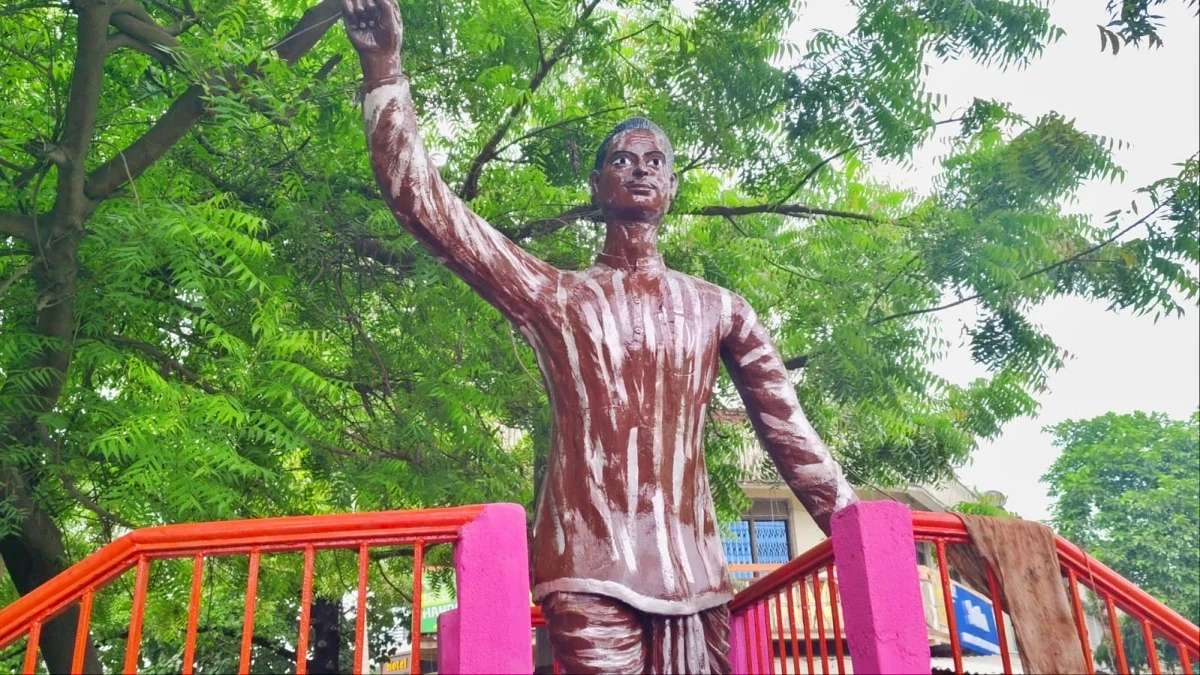
In the years that followed, the story of Kapildev Ram lived on in the memory of Koilwar and the surrounding villages. Two men in particular played a crucial role in ensuring that the physical site of his sacrifice would not be lost: the freedom fighter Ramprasad Lal, also known as Bhola Bismil, who had been a childhood companion and fellow participant in the movement, and the social worker Rampravesh Ram. Through their sustained efforts, a modest memorial was constructed at the place where Kapildev had been buried. Later, a statue was installed at a busy intersection on the Ara-Patna main road, and the crossing was named Shahid Kapildev Chowk.
These local initiatives reflected a common pattern across India. In countless towns and villages, communities themselves took responsibility for commemorating their martyrs when formal state recognition lagged. The naming of a chowk and the installation of a statue were acts of collective memory-making. They asserted that the sacrifice of an ordinary boy from an ordinary family deserved a place in the public landscape. Every year on 14 August, local residents gather at the memorial and the statue to offer flowers and remember the boy who died so young. The continuity of this practice across generations is itself a form of resistance against forgetting.
Yet the annual tributes also highlight a painful contrast. While ordinary people continue to honour Kapildev, official participation remains minimal or absent. Administrative machinery rarely organises formal programmes. There is little evidence of sustained efforts to document his story in school textbooks, official histories of the freedom movement in Bihar, or national commemorative projects. Family members, including his grandson Ashok Kumar and others who have spoken publicly over the years, have repeatedly expressed deep hurt at this official indifference. They note that the memorial on their ancestral land is in poor condition and that few people beyond a small circle visit regularly. They have appealed for proper governmental recognition so that the “lamp” of his sacrifice is not allowed to go out.
Encroachment and Everyday Disrespect
The physical state of the memorial and the statue today is a source of particular anguish. Shahid Kapildev Chowk is one of the busiest intersections in the area. Over the years, encroachers have occupied the space around the statue. Handcarts, temporary stalls selling chaat, samosas, and fruit, and parked auto-rickshaws have gradually closed in on the site. Vendors discard dirty plates, paper, and other waste directly at the base of the memorial. The result is an accumulation of garbage and a pervasive foul smell that surrounds the statue of a boy who died for the nation.
This is not merely an aesthetic problem. It is a form of daily disrespect that erodes the dignity of public memory. A memorial is meant to create a space of quiet reflection and reverence. When that space is reduced to a commercial free-for-all, the message received by successive generations is that the sacrifice itself has little enduring value. Local residents and family members have pointed out this neglect repeatedly, yet effective administrative action to clear the encroachments and restore the site has been lacking. The contrast between the solemnity of the annual flower-offering ceremony and the everyday disorder surrounding the statue could not be sharper.
The situation around Kapildev’s memorial is, unfortunately, not unique. Across India, many freedom fighters’ memorials suffer from similar problems of encroachment, poor maintenance, and administrative apathy. The difference in Koilwar is that the martyr in question was a child. The visual of a 14-year-old’s statue standing amid filth carries an especially sharp moral charge. It forces a confrontation with the question of how a society that celebrates Independence Day with great ceremony can allow the physical markers of its foundational sacrifices to fall into such disrepair.
The Larger Question of Forgotten Martyrs
Kapildev Ram’s story raises broader questions about how independent India has remembered the full spectrum of its freedom struggle. The national narrative has rightly celebrated the towering figures—Gandhi, Nehru, Bose, Patel, Azad, and others—and the more dramatic episodes such as the 1857 revolt, the non-cooperation movement, the Civil Disobedience campaigns, and the INA trials. Yet the thousands of ordinary men, women, and children who responded to the call of 1942 in towns and villages across the country often remain footnotes or local legends.
Bihar alone produced many such figures. In the Koilwar area itself, several other young men are remembered as having fallen during the same wave of resistance. Local accounts mention names such as Suryadev Kumar, Mithu Mahto, Brajesh Nandan Prasad Verma, Hatim Ali, and Jayaram Singh among those who participated actively and, in some cases, laid down their lives. The fact that a stone plaque at the Koilwar block headquarters lists Kapildev Ram along with other local martyrs is a positive, if limited, form of recognition. Still, official histories, school curricula, and national commemorative events rarely give these local heroes the space they deserve.
There are practical reasons for this neglect: incomplete archival records, the difficulty of verifying oral accounts decades later, and the sheer number of participants in a mass movement. There are also deeper cultural and political reasons. In the decades after independence, the focus of nation-building often shifted toward development, institutional politics, and the celebration of a relatively narrow set of icons. Local and subaltern histories, particularly those of communities that remained socially and economically marginal, received less attention. Kapildev belonged to a community that has historically faced disadvantage. Whether this fact contributed to the relative obscurity of his story is a question worth asking honestly, even if definitive answers remain elusive.
At the same time, the persistence of local memory is itself significant. The fact that residents of Koilwar still gather every 14 August, that family members continue to narrate the story across generations, and that local journalists periodically revisit it shows that the flame has not been extinguished. What is missing is the amplification and institutionalisation of that memory by the state and by educational institutions. Oral history projects, regional museums, and curriculum reforms could all play a role in bringing such stories into the wider public consciousness.
Why This Story Matters Today
In an age of rapid social change, contested national narratives, and the constant churn of new political symbols, the story of a 14-year-old who died with the words of freedom on his lips retains a particular moral clarity. It reminds us that the freedom struggle was not only the work of sophisticated political leaders and urban intellectuals. It was also the work of children who left their homes, newly married adolescents who chose duty over personal happiness, and ordinary villagers who decided that the honour of the mother’s womb—the dignity of the nation—was worth more than life itself.
Kapildev’s last words to his mother are especially powerful. He did not speak of glory or revenge. He spoke of the need for mothers like her to continue living with purpose, of the importance of facing the enemy rather than turning one’s back, and of the emptiness of a life without freedom. In those few sentences lies a philosophy of citizenship that remains relevant: freedom is not a gift to be enjoyed passively; it is a responsibility that sometimes demands the highest sacrifice. The insistence that the bullet struck his chest rather than his back is both a personal assertion of courage and a quiet lesson in the ethics of resistance.
There is also a practical lesson. Memorials that are allowed to decay or be encroached upon cease to perform their function as sites of public education and inspiration. Clearing the encroachments around Shahid Kapildev Chowk, restoring the memorial to a condition of dignity, and ensuring that the annual observation of his martyrdom day receives official recognition would be modest but meaningful steps. Including his story, and those of other local martyrs of 1942, in regional history curricula would help new generations understand that the freedom they inherit was paid for in the blood of people who looked very much like themselves—young, ordinary, and unprepared for the violence they nevertheless chose to confront.
Family members have suggested over the years that larger infrastructure projects in the area, such as the new bridge over the Son River, could be named in his honour. Whether or not that specific proposal is taken up, the underlying demand is clear: the state should treat the memory of such martyrs with the seriousness it deserves. Recognition need not always take the form of grand monuments. Consistent official participation in the annual remembrance, proper maintenance of existing sites, and the inclusion of local histories in educational materials would themselves constitute a form of respect.
Conclusion: Keeping the Lamp Burning
Kapildev Ram lived only fourteen years. In those short years he managed to embody the highest ideals of the freedom movement. On 14 August 1942 he stood on a railway track in Koilwar, faced the guns of an empire, and refused to retreat. Shot, mutilated, and dying, he still found the strength to reassure his mother and to affirm that the bullet had found his chest and not his back. His body was buried, a modest memorial was raised by local efforts, a chowk was named, and a statue was installed. And then, slowly, the official world moved on.
The people of Koilwar have not moved on. Every year they return to the site with flowers and remembrance. Journalists occasionally retell the story. Descendants continue to speak of the pain of neglect and the need for proper recognition. The responsibility now lies with a wider public and with the institutions of the republic. A nation that forgets the children who died for it risks forgetting the meaning of the freedom those children helped to win.
The yellow of the wedding turmeric may have faded from Kapildev’s skin long ago. The blood he shed on the tracks near the Son River has long since mixed with the soil of Bihar. But the words he spoke in his mother’s lap still carry the force of a challenge: life without freedom is a curse. The least a free nation can do is to keep the memory of such a life free from the curse of indifference.
On this and every 14 August, as the country prepares to celebrate Independence Day the following morning, it would be fitting to pause and remember the 14-year-old from Koilwar who never lived to see the dawn of freedom, yet helped to bring it closer with the last strength of his body and the unbreakable resolve of his spirit. His story is not merely a local legend. It is a reminder that the price of liberty was paid in countless small places by countless ordinary people, some of them still children, whose names deserve to be spoken with the same reverence we reserve for the great leaders of the national movement. Keeping that memory alive is not an act of nostalgia. It is an act of gratitude and a continuing responsibility.
What's Your Reaction?
 Like
0
Like
0
 Dislike
0
Dislike
0
 Love
0
Love
0
 Funny
0
Funny
0
 Wow
0
Wow
0
 Sad
0
Sad
0
 Angry
0
Angry
0









Comments (0)