
RSS CANNOT BE UNDERSTOOD WITHOUT CONTEMPORARY INDIAN POLITICS:PROF. SURESH
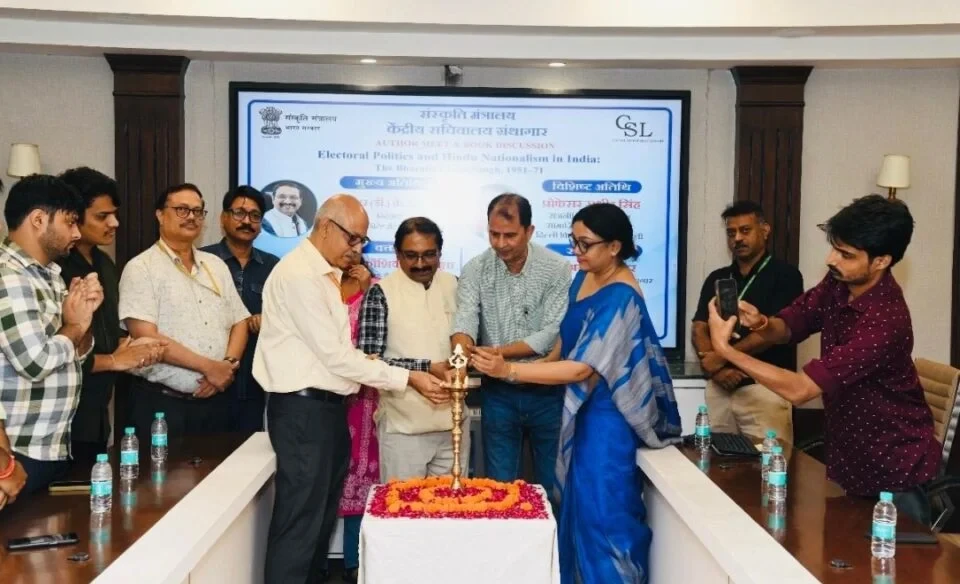
A book launch and discussion was organized by the Central Secretariat Library, Ministry of Culture, Shastri Bhawan, New Delhi as part of its outreach program. The famous book ‘Electoral Politics and Hindu Nationalism in India: The Bharatiya Jana Sangh, 1951–1971’ by Delhi University Professor Kaushiki Dasgupta was launched in the programme. The book is published by Routledge, UK.

RSS CANNOT BE UNDERSTOOD WITHOUT CONTEMPORARY INDIAN POLITICS:PROF. SURESH
29-AUG-ENG 1


RAJIV NAYAN AGRAWAL
DELHI---------------------------A book launch and discussion was organized by the Central Secretariat Library, Ministry of Culture, Shastri Bhawan, New Delhi as part of its outreach program. The famous book ‘Electoral Politics and Hindu Nationalism in India: The Bharatiya Jana Sangh, 1951–1971’ by Delhi University Professor Kaushiki Dasgupta was launched in the programme. The book is published by Routledge, UK.
Chief guest of the program Prof. Of. Yes. Suresh, Director, India Habitat Center and former Vice-Chancellor, described the study of the history of the Bharatiya Jana Sangh as important for understanding contemporary Indian politics. He said that the study of the formation, expansion and political challenges of the Bharatiya Jana Sangh, which later became an important link in the political development of the Bharatiya Janata Party (BJP), is especially helpful in understanding the current political scenario.
Pro. Suresh Prof. Kaushiki congratulated Dasgupta for his extensive academic research on this subject and said that the book provides an opportunity for serious discussion on various aspects of the early history of Jan Sangh and its political development.
The special guest of the program, Dr. Sudhir Singh, Professor, Department of Political Science, University of Delhi, highlighted the contemporary relevance of the history of Jan Sangh. Referring to the contributions and political struggles of Dr. Shyama Prasad Mukherjee, the founder of Jan Sangh, he said that to understand the evolution of Indian politics, an objective study of the political movements and leadership of that period is necessary.
The author of the book, Prof. Kaushiki Dasgupta discussed in detail the establishment of Bharatiya Jana Sangh and its early development. He particularly underlined the role of Dr. Syama Prasad Mukherjee and the early political expansion of Jan Sangh. He also shared his academic journey and key research questions he faced while writing the book. He said that through the book he has tried to understand Indian electoral politics and the development of Hindu nationalism in a historical perspective.
Highlighting the central theme and its features of the book, Dr. Ajit Kumar, Director, Central Secretariat Library, said that this book draws attention to the relatively less discussed history of Indian politics, in which many political leaders and their contributions later influenced the political development of the country. He said that such academic works help the new generation of researchers to understand the historical sources and political processes of Indian politics.
In the discussion organized on the book, Prof. of Jamia Millia Islamia. Bharti Sharma, Prof. of Delhi University. Manish Karmawar, advocate Piyush Pushkar and other academicians, researchers and subject experts participated. The participants expressed their views on various historical and political questions raised in the book. A large number of professors, scholars, academicians and researchers from various universities and colleges of Delhi participated in the programme. During the discussion, the audience asked questions on various aspects related to the theme of the book, political development of Jan Sangh, electoral politics, Hindu nationalism and contemporary Indian politics. The active participation in the question and answer session transformed the program into a meaningful and thought-provoking academic discussion.
The objective of the program was to promote academic dialogue on important chapters of Indian political history through the book and to provide an opportunity to researchers and readers to understand the evolution of Indian politics from a historical perspective.
What's Your Reaction?
 Like
0
Like
0
 Dislike
0
Dislike
0
 Love
0
Love
0
 Funny
0
Funny
0
 Wow
0
Wow
0
 Sad
0
Sad
0
 Angry
0
Angry
0













Comments (0)