
RAKHI:SACRED THREAD OF PROTECTION
-Raksha Bandhan, also known as Rakhi, stands as one of India’s most cherished festivals, celebrating the enduring bond of love, care, and mutual protection. Observed on the full moon day of the Hindu month of Shravana, usually falling in July or August, the festival centres on the simple yet profound act of a sister tying a sacred thread, the rakhi, around her brother’s wrist. In return, the brother offers gifts and a solemn promise of lifelong support. The name itself derives from Sanskrit: “Raksha” meaning protection and “Bandhan” meaning bond or tie. Beyond its surface ritual, Raksha Bandhan weaves together mythology, history, religious devotion, social cohesion, and evolving modern values into a living tradition that continues to resonate across generations and geographies.

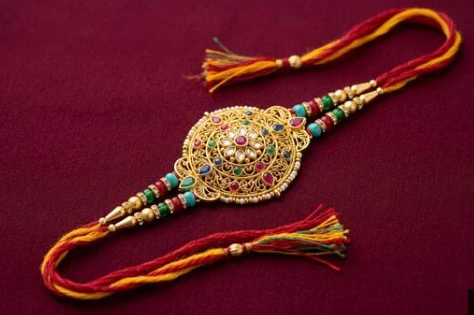
RAKHI:SACRED THREAD OF PROTECTION
28-AUG-ENG 4


RAJIV NAYAN AGRAWAL
ARA---------------------------Raksha Bandhan, also known as Rakhi, stands as one of India’s most cherished festivals, celebrating the enduring bond of love, care, and mutual protection. Observed on the full moon day of the Hindu month of Shravana, usually falling in July or August, the festival centres on the simple yet profound act of a sister tying a sacred thread, the rakhi, around her brother’s wrist. In return, the brother offers gifts and a solemn promise of lifelong support. The name itself derives from Sanskrit: “Raksha” meaning protection and “Bandhan” meaning bond or tie. Beyond its surface ritual, Raksha Bandhan weaves together mythology, history, religious devotion, social cohesion, and evolving modern values into a living tradition that continues to resonate across generations and geographies.
The origins of Raksha Bandhan stretch deep into Hindu scriptures and folklore, with multiple narratives explaining its emergence. One of the most widely narrated accounts, especially resonant with the theme of divine intervention from the netherworld, involves Goddess Lakshmi, Lord Vishnu, and the demon king Bali. According to this Puranic tradition, King Bali, renowned for his extraordinary generosity and devotion, had conquered the three worlds through his prowess and charitable deeds. To restore balance, Lord Vishnu appeared in his Vamana avatar, a dwarf Brahmin, and requested three paces of land as alms. Bali readily agreed. Vishnu then expanded to cosmic proportions, covering the earth and heavens in two strides. For the third, Bali offered his own head in humble surrender.
Moved by this act of pure devotion, Vishnu granted Bali dominion over Patala, the netherworld, and further promised to remain by his side as guardian and doorkeeper. This divine vow, however, meant Vishnu left his celestial abode of Vaikuntha, leaving Goddess Lakshmi desolate and lonely. Determined to bring her husband home, Lakshmi descended to Patala disguised as an ordinary woman seeking shelter. Bali, true to his charitable nature, welcomed her and treated her with kindness. On the auspicious day of Shravana Purnima, Lakshmi tied a protective thread, a raksha sutra, around Bali’s wrist, accepting him as her brother and praying for his long life and prosperity. When Bali offered her any boon in return, she revealed her true identity and requested the release of her husband from his protective vow. Honouring the sacred bond of the rakhi and the spirit of dharma, Bali freed Vishnu, allowing the divine couple to return to Vaikuntha. This episode is often cited as the foundational moment that established the tradition of tying a protective thread on Shravana Purnima, transforming a personal act of love and strategy into a festival of sibling-like protection.
This narrative underscores several enduring themes: the power of devotion, the sanctity of a given word, the clever yet affectionate use of kinship bonds, and the idea that protection flows both ways. It roots the festival not merely in familial affection but in a cosmic drama of duty, love, and eventual harmony.
While the Lakshmi-Bali story holds a special place, Hindu tradition preserves several other legends that enrich the festival’s meaning. In the Bhavishya Purana, the god Krishna advises Yudhishthira about the protective power of a consecrated thread. He recounts how Indrani, also known as Sachi, the wife of Indra, tied a raksha bandhan on her husband’s wrist before a decisive battle against the asuras. Empowered by the sacred thread and accompanying mantras, Indra emerged victorious. This early reference shows that the protective thread was not originally limited to siblings; it served as an amulet of safety in times of conflict.
Another beloved tale comes from the Mahabharata era involving Lord Krishna and Draupadi. When Krishna injured his finger while handling the Sudarshana Chakra or during another incident, Draupadi immediately tore a strip from her sari and bound the wound. Deeply moved by her spontaneous care, Krishna vowed lifelong protection. He fulfilled this promise during the infamous disrobing episode in the Kaurava court, when Draupadi’s dignity was miraculously preserved through an endless supply of cloth. This story elevates the rakhi from a mere thread to a symbol of reciprocal loyalty and divine guardianship.
A further legend involves Yamuna and her brother Yama, the lord of death. After a long absence, Yama visited his sister. Yamuna welcomed him with affection, prepared a feast, and tied a protective thread on his wrist. In response, Yama granted her immortality and declared that any brother who receives such a thread from his sister with pure intent would enjoy longevity and well-being. These multiple narratives illustrate that Raksha Bandhan emerged from a confluence of protective rituals rather than a single event, gradually crystallising around the brother-sister relationship while retaining broader associations of care and safety.
Beyond mythology, historical episodes have reinforced the festival’s significance. In the sixteenth century, Rani Karnavati of Chittor, facing invasion by Bahadur Shah of Gujarat, is said to have sent a rakhi to the Mughal emperor Humayun, appealing to him as a brother for protection. Humayun, honouring the sacred thread, diverted his forces to her aid, even though he arrived too late to prevent the fall of the fort. This account, whether fully historical or embellished by tradition, highlights how the rakhi could transcend religious and political boundaries to invoke honour and duty.
In the early twentieth century, during the 1905 partition of Bengal under British rule, Rabindranath Tagore reinterpreted Raksha Bandhan as a powerful instrument of communal harmony. He encouraged Hindus and Muslims to tie rakhis on one another’s wrists as a gesture of solidarity against colonial divide-and-rule policies. This innovative use transformed a family ritual into a public symbol of national unity and interfaith brotherhood, a legacy that continues in certain regions to this day.
Ancient textual references further ground the practice. The Atharvaveda mentions protective threads known as pratisara, and various Puranas prescribe the tying of raksha on Shravana Purnima for the well-being of individuals across social classes. Over centuries, these diverse strands of ritual, legend, and history converged into the festival known today.
Religiously, Raksha Bandhan occupies a distinctive place in the Hindu calendar. It coincides with other observances such as Upakarma, the changing of the sacred thread by Brahmins, and regional variants like Narali Purnima among coastal communities or Gamha Purnima in Odisha. The central ritual of tying the rakhi is accompanied by the recitation of a traditional mantra that invokes the protection once granted to King Bali: “Yen baddho Bali Raja danavendro mahabalah, tena tvam pratibadhnami rakshe ma chala ma chala” — “I bind you with the same raksha that bound the mighty demon king Bali; O protection, remain steadfast.”
The festival affirms core Hindu values of dharma, reciprocal duty, and the sanctity of relationships. It reminds devotees that protection is not solely physical but also moral and spiritual. Sisters pray for their brothers’ health, prosperity, and righteousness, while brothers undertake a vow that extends beyond material safety to emotional and ethical support. In this sense, Raksha Bandhan functions as a yearly renewal of sacred commitments, reinforcing the idea that human bonds, when sanctified by intention and ritual, participate in the larger cosmic order of care and responsibility.
Socially, the festival plays a vital role in strengthening family and community ties. In traditional settings, especially in rural India, married women often returned to their parental homes for Raksha Bandhan, reaffirming connections with brothers who might later serve as protectors or supporters in times of need. The exchange of gifts, sweets, and shared meals fosters intergenerational bonding and reinforces kinship networks that form the backbone of Indian social life.
The festival also promotes values of trust, loyalty, and mutual respect. It encourages individuals to look beyond immediate self-interest and acknowledge enduring obligations. In many households, the day becomes an occasion for resolving minor familial tensions, expressing gratitude, and celebrating the simple joys of sibling companionship. Regional variations add further richness: in some areas the day includes cattle worship or agricultural prayers; in others it merges with celebrations of divine love or sea offerings. These diverse practices illustrate how a single festival can accommodate local cultures while upholding a shared ethical core.
Moreover, Raksha Bandhan has historically served as a quiet assertion of social harmony. By extending the protective bond beyond blood relations to include cousins, friends, or even strangers in moments of crisis, it nurtures a broader sense of fraternity. The thread becomes a visible marker of chosen kinship, reminding society that protection and care are not confined to biological ties alone.
At the heart of Raksha Bandhan lies the unique relationship between brother and sister. Unlike other familial bonds that may be defined by hierarchy or economic roles, the sibling relationship is often characterised by a blend of affection, rivalry, shared childhood memories, and lifelong companionship. The festival elevates this relationship by formalising it through ritual. The sister’s act of tying the rakhi expresses prayerful concern and emotional investment; the brother’s reciprocal promise acknowledges responsibility and care.
This mutual exchange fosters emotional security. Sisters feel reassured that they have a steadfast ally, while brothers experience the warmth of being cherished and trusted. In many families, the bond becomes a source of strength during life’s transitions — education, marriage, career challenges, or personal losses. Even when siblings live far apart, the annual ritual serves as a powerful reminder of continuity and belonging. The festival thus cultivates empathy, patience, and the willingness to prioritise another’s well-being, qualities essential for healthy interpersonal relationships in any society.
Importantly, the tradition has always contained seeds of reciprocity. While the classic narrative emphasises the brother’s protective role, the underlying stories — Lakshmi’s strategic care for Vishnu, Draupadi’s spontaneous aid to Krishna — demonstrate that protection and support flow in both directions. Modern interpretations increasingly emphasise this mutuality, recognising sisters as equally capable of offering emotional, practical, and even financial support.
In the present day, Raksha Bandhan continues to thrive while adapting to changing social realities. Urbanisation, migration, and global diaspora have transformed celebration patterns. Siblings separated by continents now exchange digital rakhis, participate in video-call ceremonies, and send gifts through online platforms. Virtual celebrations ensure that physical distance does not sever emotional ties. Eco-conscious trends have gained prominence, with plantable seed rakhis, organic cotton threads, and biodegradable designs replacing plastic or synthetic ones, aligning the festival with environmental awareness.
The scope of the ritual has expanded inclusively. Many women tie rakhis to sisters, female friends, or colleagues as symbols of mutual empowerment. Lumba rakhis for sisters-in-law have grown popular, welcoming women into extended family networks. Some communities tie rakhis to trees, soldiers, teachers, or community helpers, broadening the idea of protection to encompass nature, public service, and social responsibility. These innovations reflect a shift from a primarily gendered, hierarchical understanding toward a more egalitarian celebration of care and solidarity.
Commercial aspects have also flourished. Markets overflow with elaborate rakhis, gift hampers, and festive merchandise, while brands offer special promotions. Yet critics note that excessive commercialisation risks reducing a deeply emotional ritual to a transactional exchange. Balancing tradition with modernity remains an ongoing conversation within families. Younger generations often blend traditional aarti and tilak with contemporary expressions of affection, creating hybrid celebrations that feel authentic to their lived experience.
Socially progressive interpretations further emphasise gender equality. In many households today, the festival is framed as a mutual pledge of support rather than a one-way protective vow. Sisters are recognised as independent agents capable of protecting and guiding their brothers, just as brothers continue to offer care. This evolution preserves the festival’s emotional core while aligning it with contemporary values of partnership and respect.
Raksha Bandhan’s continued vitality stems from its capacity to address fundamental human needs: the desire for connection, the assurance of care, and the ritual affirmation of responsibility. In an age of rapid change, fragmented families, and digital isolation, the festival offers a yearly opportunity to pause, reconnect, and reaffirm bonds that matter. Whether celebrated through ancient mantras in a village courtyard, a video call across oceans, or a simple thread tied between friends, the essence remains the same — a visible, tactile expression of love that carries the weight of a promise.
The festival also serves as a gentle reminder of larger ethical principles. Just as Lakshmi’s rakhi restored cosmic harmony and Indrani’s thread secured divine victory, the modern rakhi can inspire individuals to extend protection and goodwill beyond the family circle. In moments of social tension, the historical precedent of Tagore’s interfaith rakhis offers a model for building bridges. In environmental crises, the emerging practice of tying rakhis to trees points toward ecological responsibility. In personal relationships, the emphasis on mutual support encourages healthier, more balanced dynamics between siblings of all genders.
Ultimately, Raksha Bandhan endures because it speaks to something universal. The thread may be temporary, fading with time and wear, but the bond it symbolises is intended to last. It teaches that protection is not merely physical strength but the quiet, steady presence of someone who cares. It celebrates the joy of giving and receiving affection without calculation. And it affirms that in the intricate web of human relationships, the simplest gestures — a thread, a prayer, a promise — can hold profound meaning.
As families continue to gather each Shravana Purnima, whether in ancestral homes or through glowing screens, they participate in a living tradition that has journeyed from the depths of Patala to the complexities of the modern world. In doing so, they keep alive not only a festival but a timeless vision of care, duty, and the sacred ties that bind us to one another.
What's Your Reaction?
 Like
0
 Dislike
0
 Love
0
 Funny
0
 Wow
0
 Sad
0
 Angry
0











Comments (0)