
FREEING THE HIMALAYAS FROM POLLUTIION SHOULD BE OBJECTIVE OF MOUNTAIN PILGRIMAGES:LALIT GARG
The Himalayas are not merely a mountain range; they form the foundation of India's cultural consciousness, spiritual faith, and natural vitality. Their peaks hold memories of deep penance, their rivers carry the lifeblood of millions, and their valleys have drawn devotees to countless religious sites for centuries. The entire Himalayan region, including Himachal Pradesh, is home to numerous major Hindu pilgrimage sites. While visiting these places is an act of faith for devotees, the unfortunate reality is that the line between pilgrimage and tourism has become increasingly blurred in recent years

FREEING THE HIMALAYAS FROM POLLUTIION SHOULD BE OBJECTIVE OF MOUNTAIN PILGRIMAGES:LALIT GARG
10-OCT-ENG 6


RAJIV NAYAN AGRAWAL
ARA----------------------------The Himalayas are not merely a mountain range; they form the foundation of India's cultural consciousness, spiritual faith, and natural vitality. Their peaks hold memories of deep penance, their rivers carry the lifeblood of millions, and their valleys have drawn devotees to countless religious sites for centuries. The entire Himalayan region, including Himachal Pradesh, is home to numerous major Hindu pilgrimage sites. While visiting these places is an act of faith for devotees, the unfortunate reality is that the line between pilgrimage and tourism has become increasingly blurred in recent years. The intrusion of recreation, revelry, and a consumerist lifestyle—alongside the pursuit of *darshan* (divine viewing) and spiritual experience—is taking a heavy toll on the fragile mountain ecosystem. The very attribute that defines the Himalayas is also its greatest vulnerability: its environment is extremely delicate. In high-altitude areas, the soil layer is thin, the regenerative capacity of vegetation is limited, and the natural decomposition process of waste is far slower than in the plains. Despite this, we are funneling hundreds of thousands of people into these regions simultaneously. Long queues of vehicles, parking congestion, unplanned expansion of hotels and eateries, and the accumulation of plastic bottles, food wrappers, polythene, and disposable items are continuously damaging the natural beauty and environment of the mountains.
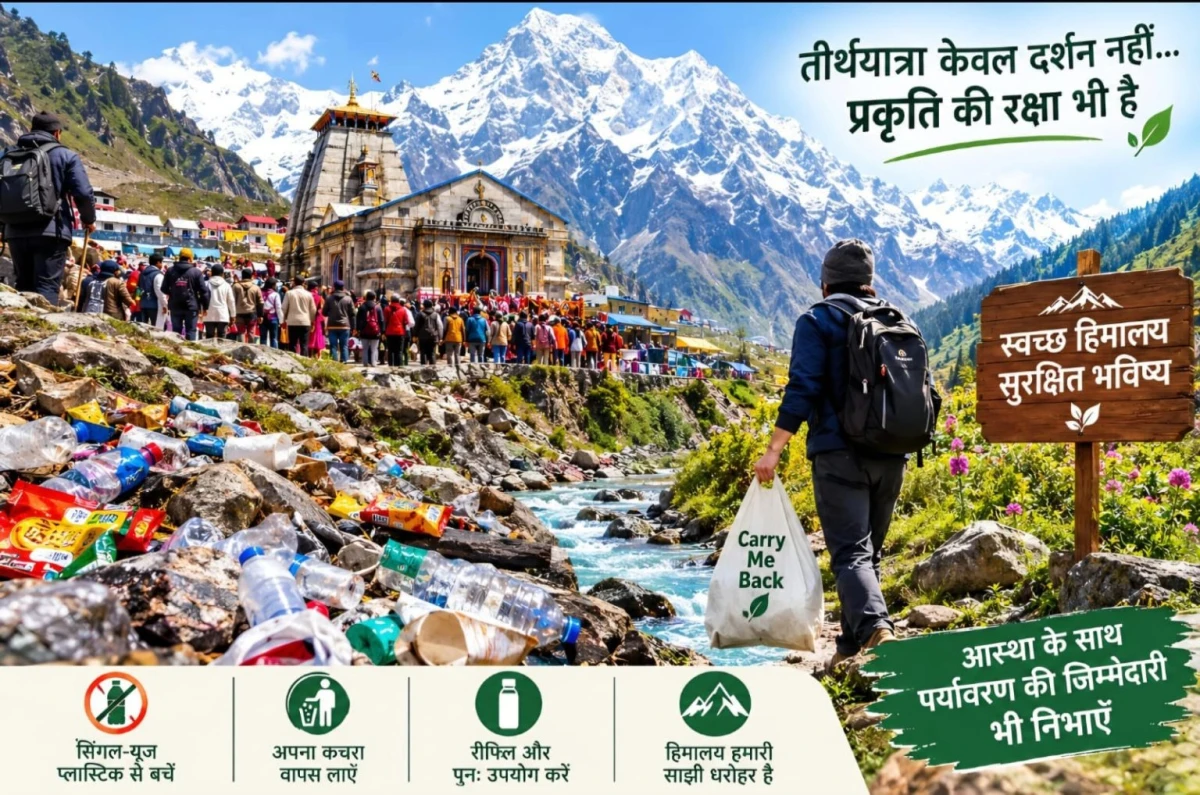
Reports indicating that over 800 tonnes of waste were collected during the Char Dham Yatra by mid-September this year highlight the severity of this crisis. The accumulation of 50.3 tonnes of waste between April and August in a highly sensitive area like Kedarnath is a matter of particular concern. This fact is significant because a plastic bottle discarded in high-altitude regions does not simply remain a bottle; it persists in the environment for a long time, posing a threat to the soil, water sources, and wildlife. The irony is striking: the very place a person visits seeking spiritual purification, restraint, and renunciation is where they leave behind a trail of waste. Can such a journey truly be called a pilgrimage? A pilgrimage is not merely about reaching a temple; it is a journey of inner transformation. If, after bowing our heads in the temple, we litter the very mountains whose sanctity drew us there in the first place, our faith remains incomplete.
In this context, the ‘Carry Me Back’ campaign offers a significant ray of hope. The fact that approximately 5,000 pilgrims brought back over 12 tonnes of compressed plastic along an 18-kilometer route demonstrates that when devotees are actively involved, they can play a crucial role in environmental conservation. This is not just a waste-collection drive but an effort to shift the mindset surrounding pilgrimages. Such campaigns should be scaled up and implemented across pilgrimage sites in Himachal Pradesh, Uttarakhand, and other Himalayan regions. The experience from the Amarnath Yatra also points in a positive direction; despite a 17 percent increase in the number of pilgrims, the volume of waste generated per pilgrim dropped by 15 percent—thanks to the use of reusable utensils and expanded water-refilling facilities. This proves that environmental pressure can be alleviated if convenient and scientifically sound systems are put in place. Therefore, merely appealing to devotees is not enough; the administration must establish systems where eco-friendly behavior becomes the easiest option.
The uncontrolled surge in crowds at religious and tourist sites in Himachal Pradesh is part of this broader crisis. The seasonal surge in visitor numbers at Shimla, Manali, Dharamshala, Chamunda, Jwalaji, Chintpurni, Naina Devi, and other religious and tourist destinations places a strain on traffic, water supply, sewage systems, solid waste management, and local resources. The carrying capacity of mountain regions differs significantly from that of cities in the plains. Therefore, the popularity of a pilgrimage or tourist site should not be measured solely by the success of attracting ever-increasing numbers of people. It is time to shift the mindset from "more tourists mean more development" to "environmental sensitivity dictates responsible tourism." Scientific studies should be conducted to determine the carrying capacity of pilgrimage sites, and daily or seasonal visitor limits should be set accordingly. Effective controls on single-use plastics must be implemented, water refill stations increased, deposit-return schemes for bottles and packaging introduced, and systems for waste segregation at the source established. Shopkeepers, hoteliers, and vendors must be held accountable for the waste they generate.
Most importantly, there needs to be a change in the pilgrim's mindset. Mountains are not mere playgrounds for our recreation; they are the natural heritage of our future generations. The riverbank where we offer prayers supports the lives of millions living downstream. The forest we capture in photographs is the very forest that maintains the ecological balance of the mountains. Throwing plastic on the slopes of the mountain we revere as 'Devbhoomi' (Land of Gods) is an insult to our own faith. Natural disasters such as excessive rainfall, floods, landslides, and avalanches in Nepal and the Himalayan region have served as warnings that tampering with mountain ecosystems can have dire consequences. While it may not be scientifically accurate to attribute every disaster directly to tourism or pollution, it is certain that unplanned construction and excessive human pressure Deforestation and inadequate waste management can heighten the vulnerability of mountainous regions.
Today, the Himalayas have become a source of immense concern. Over the past few decades—particularly in the Himalayan states—indiscriminate exploitation of natural resources in the name of development has occurred alongside widespread pollution caused by religious tourism. Furthermore, construction activities that violate regulations and tamper with nature are being undertaken, leading to devastation through floods and landslides. A crucial question arises: what should be the yardstick for development in hill states? If construction is deemed necessary for development, it must be planned in a way that ensures resilience against disasters. It is commonly observed that the drive to promote tourism and religious pilgrimages has led to the erection of massive structures that are not only incapable of withstanding floods and landslides but are also environmentally detrimental. The expected level of governmental vigilance regarding such construction has been disregarded.
The Himalayas bestow upon us so much—water, forests, biodiversity, climate balance, culture, and spiritual energy. In return, our responsibility extends beyond merely visiting to offer prayers; we must also protect this natural environment. If a pilgrim can carry a bottle of water up the mountain, they can certainly bring the empty bottle back down. This simple resolve can pave the way for significant change. Faith and the environment are not adversaries; rather, they complement each other. The true essence of a pilgrimage is realized only when the pilgrim returns not just with *prasad* (sacred offering) from the temple, but also with a sense of responsibility towards nature. Only when governments put systems in place, local communities participate actively, and devotees pledge to bring back their waste, can the sanctity of the Himalayas be preserved. Merely calling the Himalayas 'Devbhoomi' (Land of the Gods) will not ensure its protection; its sanctity can be preserved only by treating it with the reverence befitting such a sacred land. This constitutes a true pilgrimage, an expression of gratitude towards nature, and the fulfillment of our moral obligation to future generations.
What's Your Reaction?
 Like
0
Like
0
 Dislike
0
Dislike
0
 Love
0
Love
0
 Funny
0
Funny
0
 Wow
0
Wow
0
 Sad
0
Sad
0
 Angry
0
Angry
0











Comments (0)