
FISH CONTROVERSY IN AYODHYA:Dr. GHANSHAYAM BHARATIYA
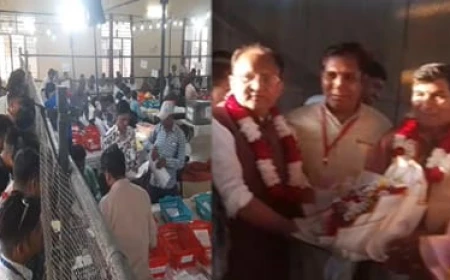
The controversy surrounding fish in Ayodhya—likened to a 'Mahabharata' (epic battle)—erupted on the last Monday of the holy month of Sawan, when a 'fish and rice' meal was served at a felicitation ceremony for Congress leader Ramnihal Nishad.


FISH CONTROVERSY IN AYODHYA:Dr. GHANSHAYAM BHARATIYA
8-SEP-ENG 12


RAJIV NAYAN AGRAWAL
ARA--------------------------The controversy surrounding fish in Ayodhya—likened to a 'Mahabharata' (epic battle)—erupted on the last Monday of the holy month of Sawan, when a 'fish and rice' meal was served at a felicitation ceremony for Congress leader Ramnihal Nishad.
The month of Sawan—a time that brings faith and devotion to life amidst gathering monsoon clouds—has passed, but this particular Sawan will long be remembered for the fierce controversy sparked by the consumption of fish. This is largely because the politics played over fish in Ayodhya—a city revered as a seat of faith—does not bode well for the future of politics. Any discussion regarding this 'fish battle'—which saw fish travel from a political 'pond' to the frying pan on the sacred soil of Ram's city—could be dismissed as trivial. It could also be argued that by blowing the 'fish and rice' party out of proportion, attempts are being made to divert public attention from essential and genuine issues.
It is worth noting that on August 24—the last Monday of Sawan—Congress leader Ramnihal Nishad organized a felicitation ceremony at a marriage lawn in Tarun Bazar, located approximately 31 km from the Ram Janmabhoomi site. Congress State President Ajay Rai attended the event. Before arriving at the venue, Mr. Rai offered prayers at Ram Janmabhoomi and Hanuman Garhi. He then proceeded directly to the event that would become the catalyst for this political 'Mahabharata.' The controversy was ignited when a video of the meal service went viral. The video showed people eating fish and rice—and doing so on Ekadashi, an auspicious day of fasting during Sawan. This single detail prompted various parties to draw their 'arrows' and launch attacks at one another.
Originating in Ayodhya, the matter escalated through media coverage and a flurry of accusations and counter-accusations, eventually becoming a topic of discussion on an international level. Questions regarding religious faith, tradition, and the decorum of public spaces fueled the controversy. In no time, the 'fish and rice' issue shifted from a religious battleground into a heated political and social debate. Statements emerging from various quarters further intensified the atmosphere. While one side cites the sanctity and dignity of the holy city alongside the sentiments of devotees, the other dismisses it as a routine activity, arguing that an unnecessary controversy is being manufactured. Social media has only added fuel to the fire; the issue is being portrayed as if consuming fish and rice during the holy month of Sawan constitutes a grave sin. Meanwhile, a heated exchange involving uncivil language between Congress spokesperson Kunwar Singh Nishad and Saint Raju Das of Hanumangarhi during a TV debate further escalated the matter.
Large numbers of devotees from across the country and abroad visit Ayodhya daily; consequently, even the most minor incident here becomes a subject of widespread discussion. Locals believe that any dispute should be resolved peacefully, keeping the holy city's identity and communal harmony in mind. Despite this, the controversy surrounding the 'fish party' is gradually taking on a political hue.
Congress State President Ajay Rai explicitly stated that he visited Hanumangarhi, offered prayers, and then attended the event, leaving directly for Lucknow afterward. Since he was observing an *Ekadashi* fast that day, the question of consuming anything did not even arise. He boldly declared that if anyone could prove he had eaten fish and rice, he would retire from politics. Yet, people continue to blow the issue out of proportion.
Politics
It also emerged that the event was organized by the Nishad community. It is common knowledge that the Nishad community's primary occupation involves fish farming, catching, and trading; naturally, fish would be a staple of their diet. On the other hand, when a piece of beef is found near Hindu neighborhoods—even due to a Muslim individual's error—it deeply offends Hindu religious sentiments. Similarly, when a large section of Hindus abstains from non-vegetarian food during the month of Sawan, ostentatiously consuming meat in their presence is tantamount to provocation. The grievance stems not just from the act of eating itself, but from the fact that a video of the meal was circulated widely. It stands to reason that the person who filmed and circulated the video must have also been present at the party.
What is particularly noteworthy is that the Nishad community was singled out over this 'fish party.' Both the ruling party and the opposition pointed fingers at this community, even though the Nishad community is second to none when it comes to faith and religious devotion. Disheartened by this, educated members of the Nishad community raise a thought-provoking question: Is committing crimes like theft, murder, robbery, or rape during the month of Sawan—or any other holy occasion—not as sinful as simply eating fish during Sawan?
There is another point—perhaps a bit unusual, yet relevant to mention in this context. I recall that from my childhood until about twenty years ago—a time when the number of *Kanwariyas* in rural areas was negligible compared to big cities—the elders of the household would set out on the morning of Nag Panchami (a major festival during Sawan) to offer milk and puffed rice (*lava*) to the Serpent Deity. Young women and girls would enjoy swings hung from trees. Adolescent boys, armed with sticks, would beat effigies of dolls—thrown into the village pond by the girls—and return home with soaked chickpeas received from them in exchange. Afterward, the youth would engage in wrestling and *Kabaddi* matches, and *Alha* folk singing performances would take place at various spots. Amidst all this, the elders—regardless of their caste or community—would invariably purchase meat and consume it during the day. Moreover, guests visiting one another’s homes were often welcomed with these non-vegetarian dishes. Back then, no one’s faith was offended. However, in the last two decades or so With the rise in the number of participants in the Kanwar Yatra, significant restrictions have been imposed on the consumption and sale of meat and fish. A ban should also be considered for the goat sacrifices performed year-round at the Tarkulha Temple in Gorakhpur, Uttar Pradesh, and during the *Ashtami* and *Navami* days of Navratri at the ancient Durga Temple in Sabukpur, Ambedkar Nagar.
The question arises: while consuming meat or fish is unlikely to drive a person to commit a crime, alcohol consumption can lead to a wide range of criminal acts. Despite this, allowing the open sale of alcohol while banning meat and fish during the month of *Sawan* amounts to nothing less than a double standard. Typically, those selling meat and fish are poor individuals with limited capital, whereas liquor traders are wealthy tycoons. Shutting down the businesses of the poor and small-scale vendors while leaving the liquor trade untouched raises a significant question—one to which there is likely no easy answer.
What's Your Reaction?
 Like
0
Like
0
 Dislike
0
Dislike
0
 Love
0
Love
0
 Funny
0
Funny
0
 Wow
0
Wow
0
 Sad
0
Sad
0
 Angry
0
Angry
0







Comments (0)