
THE ARAVALLI CONCERN: BEYOND SLOGANS—A BATTLE OF SURVIVAL: LALIT GARG
The controversy surrounding the new definition of the Aravalli mountain range is now taking the form of a mass movement. The concern for saving the Aravallis is not merely an emotional appeal, but a lifeline for India's environmental future. The Aravalli range, stretching from Gujarat to Delhi, is one of the oldest mountain ranges on Earth. This mountain is not just a pile of stones, but a natural shield for water, forests, biodiversity, climate balance, and human life. Today, when attempts are being made to fragment this mountain range under the guise of mining, urbanization, and development, the question is no longer just about the environment, but about the very existence of humanity. We must hope that the governments' concern for the Aravallis does not go in vain and yields positive results. The mining, neglect, and greed in the hilly areas must be addressed. There is no doubt that due to the governments' neglect, large parts of the Aravallis have not only been mined, but this shield protecting the common people and nature has also been destroyed. The age of the Aravallis is estimated to be millions of years from a geological perspective. It is even older than the Himalayas. This is why the Aravallis appear relatively lower and eroded, but their importance is far deeper. Rainwater harvesting, groundwater recharge, and control of desertification in large parts of Rajasthan, Haryana, Gujarat, and Delhi are possible only because of the Aravallis. The Aravallis act like an invisible wall in preventing the Thar Desert from spreading eastward. Today, the environmental crisis has become multifaceted – water scarcity, air pollution, loss of biodiversity, climate change, and uncontrolled urban expansion. A common solution to all these challenges is the conservation of natural structures like the Aravallis. Unfortunately, mining and construction activities have inflicted deep wounds on this mountain range. The indiscriminate mining of stone, marble, and other minerals has not only hollowed out the mountains but has also endangered the surrounding villages, rivers, and forests. A petition to save the Aravalli range, which is constantly under threat, has been pending in court since 1985. However, it is due to this petition that approximately 90 percent of the Aravalli range is now under protected status. The time has come to declare the entire Aravalli range completely free from mining. If mining continues, the environmental cost will far outweigh any economic benefits.

THE ARAVALLI CONCERN: BEYOND SLOGANS—A BATTLE OF SURVIVAL: LALIT GARG
3-JAN-ENG 7


RAJIV NAYAN AGRAWAL
ARA---------------------------The controversy surrounding the new definition of the Aravalli mountain range is now taking the form of a mass movement. The concern for saving the Aravallis is not merely an emotional appeal, but a lifeline for India's environmental future. The Aravalli range, stretching from Gujarat to Delhi, is one of the oldest mountain ranges on Earth. This mountain is not just a pile of stones, but a natural shield for water, forests, biodiversity, climate balance, and human life. Today, when attempts are being made to fragment this mountain range under the guise of mining, urbanization, and development, the question is no longer just about the environment, but about the very existence of humanity. We must hope that the governments' concern for the Aravallis does not go in vain and yields positive results. The mining, neglect, and greed in the hilly areas must be addressed. There is no doubt that due to the governments' neglect, large parts of the Aravallis have not only been mined, but this shield protecting the common people and nature has also been destroyed.
The age of the Aravallis is estimated to be millions of years from a geological perspective. It is even older than the Himalayas. This is why the Aravallis appear relatively lower and eroded, but their importance is far deeper. Rainwater harvesting, groundwater recharge, and control of desertification in large parts of Rajasthan, Haryana, Gujarat, and Delhi are possible only because of the Aravallis. The Aravallis act like an invisible wall in preventing the Thar Desert from spreading eastward. Today, the environmental crisis has become multifaceted – water scarcity, air pollution, loss of biodiversity, climate change, and uncontrolled urban expansion. A common solution to all these challenges is the conservation of natural structures like the Aravallis. Unfortunately, mining and construction activities have inflicted deep wounds on this mountain range. The indiscriminate mining of stone, marble, and other minerals has not only hollowed out the mountains but has also endangered the surrounding villages, rivers, and forests. A petition to save the Aravalli range, which is constantly under threat, has been pending in court since 1985. However, it is due to this petition that approximately 90 percent of the Aravalli range is now under protected status. The time has come to declare the entire Aravalli range completely free from mining. If mining continues, the environmental cost will far outweigh any economic benefits.
The Supreme Court has, from time to time, made serious observations regarding the protection of the Aravalli range. The court's stance has been clear: activities that harm the environmental balance must be stopped, and the destruction of nature in the name of development cannot be legitimized. Despite this, attempts have been made at various levels to permit mining through the interpretation and reinterpretation of rules. Defining mountains based on criteria such as "100 meters in height" and considering structures below that height as suitable for mining is a dangerous trend. This argument is not only scientifically flawed but also contrary to environmental understanding. The Aravalli range has been riddled with holes due to mining.
Mountains are not defined solely by their height, but also by their geological structure, water retention capacity, and ecosystem. Mountains less than 100 meters high are just as important as taller mountains. If this argument is accepted, the entire Aravalli range could gradually be divided into small sections and destroyed. This approach prioritizes short-term economic gain over long-term environmental security. Some initiatives by the Rajasthan government can be considered commendable in the direction of conservation, such as the notification of forest areas, action against illegal mining, and stricter environmental clearances. However, parallel to these efforts, there are also policy loopholes that encourage mining and real estate activities. Based on the facts and figures presented by the central government, it is argued that controlled mining can lead to development. However, experience shows that the word "controlled" often becomes meaningless in practice. Even though Forest and Environment Minister Bhupendra Yadav is clarifying that mining is permitted in only 277 square kilometers, he has assured that the new definition will not increase mining but will instead curb illegal mining.
Pitting development against the environment is an old mistake. True development is that which is in harmony with nature. The conservation of the Aravalli range is not an anti-development step, but a prerequisite for long-term development. In areas where the Aravalli range has been damaged, water levels have dropped, temperatures have risen, and biodiversity has decreased. The role of the degradation of the Aravalli range in the toxic air and water crisis of Delhi-NCR cannot be ignored. Wildlife in the Aravalli range is almost extinct. Alternatives to mining must be considered. Mining is primarily for stone, and the tradition of building beautiful houses with stones has been going on for centuries; this tradition needs to be re-evaluated. We need to think about other resources for building houses and buildings. While many houses can be built, the mountains that are cut down will never stand again. Where will environmental and nature conservationists find these mountains? The Supreme Court has expressed concern about the encroachment on forests in Uttarakhand as well as in the Aravalli range. But along with the courts, governments must also adopt a strict stance on the environment, nature, mountains, hill forests, and wildlife, and give them the highest priority. It must be kept in mind.
Comparatively, many countries around the world have preserved their ancient mountain ranges and natural formations as national heritage. The Alps in Europe, the Rocky Mountains in America, and the Yellow River basin in China are examples. Mining and construction are strictly controlled in these areas because there is a clear understanding that economic prosperity at the expense of nature is not sustainable. India also needs to adopt this mindset. The Aravalli range is not just a source of water; it is a sanctuary of biodiversity. The flora and fauna found here play a crucial role in maintaining ecological balance. Deforestation and mining destroy wildlife habitats, leading to increased human-wildlife conflict. This problem is not only environmental but also social.
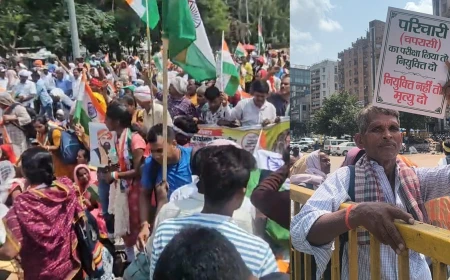
Today, movements are taking place across the country for the conservation of the Aravalli range. These movements indicate that society is no longer willing to remain silent. Dialogue between citizens, environmentalists, the judiciary, and policymakers is essential. This is the time to move beyond emotional slogans and make concrete policy decisions – a complete ban on mining, reforestation, water conservation projects, and the participation of local communities. If we sow the seeds of love for nature and environmental protection today, we will reap the fruits of clean air, sufficient water, and a secure future tomorrow. If the Aravalli range survives, India will prosper; this is not just a line of poetry, but a scientific truth. Protecting Mother Earth is not only our right but also our duty. If we prioritize greed today, future generations will not forgive us. Ultimately, the question of the Aravalli range is not just about a mountain range, but about a mindset that distinguishes development from destruction. History remembers only those societies that progressed by maintaining a balance with nature. Let us also write that history, where every voice becomes a powerful force, and where life, along with the Aravalli range, is ensured in abundance.
What's Your Reaction?
 Like
0
 Dislike
0
 Love
0
 Funny
0
 Wow
0
 Sad
0
 Angry
0











Comments (0)