
STORYTELLING HAS INSPIRED THE HUMAN MIND FOR MILLENNIA: Dr. ANIL SULABH
-Storytelling has inspired the human mind for millennia. It leaves the deepest impact on the minds of children. Stories heard from grandmothers provided mental nourishment to many great men and women and fostered virtues within them. Stories should be crafted in a way that entertains the mind while guiding society in a positive direction.

STORYTELLING HAS INSPIRED THE HUMAN MIND FOR MILLENNIA: Dr. ANIL SULABH
15-JUNE-ENG 4


RAJIV NAYAN AGRAWAL
PATNA--------------------------Storytelling has inspired the human mind for millennia. It leaves the deepest impact on the minds of children. Stories heard from grandmothers provided mental nourishment to many great men and women and fostered virtues within them. Stories should be crafted in a way that entertains the mind while guiding society in a positive direction. They should not become a medium for venting personal frustrations or propagating negative ideas that fragment society. It is the duty of writers to address societal flaws and steer society towards well-being. Only works that make the world more beautiful can be considered truly great.
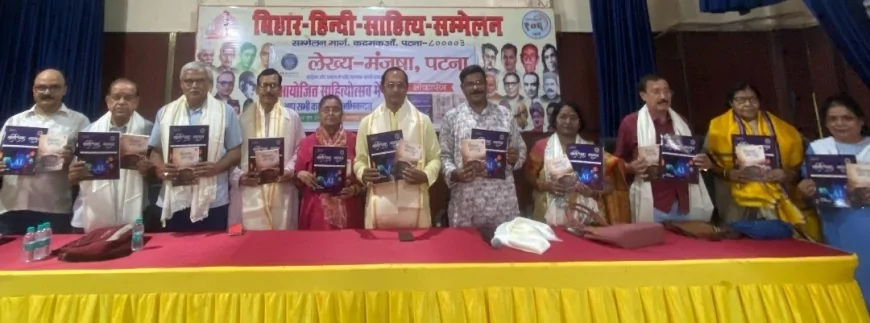
Dr. Anil Sulabh, President of the Bihar Hindi Sahitya Sammelan, made these remarks on Sunday while inaugurating a literary festival organized by the literary organization 'Lekhya-Manjusha', Patna, under the aegis of the Sammelan. He noted that the short story genre is rapidly gaining popularity within narrative literature. It possesses the power to create a profound impact through great subtlety. Emerging writers should pay special attention to its decorum, nuance, and conciseness. There is no room for elaborate description or verbosity; its beauty and strength lie in brevity, subtlety, and conciseness.
On this occasion, Dr. Sulabh also launched the 38th issue (marking the 10th year) of the quarterly magazine *Sahityik Spandan*—edited by Vibharani Srivastava, President of Lekhya-Manjusha—and the anthology of poems titled *Vihval Hriday Dhara*.
Following the inaugural session, a storytelling session commenced, featuring insights from senior writers Dr. Dhruv Kumar and Dr. Anita Rakesh. The session began with Maharashtra-based writer Neena Mandilwar and Priyanka Srivastava 'Shubhra' raising questions regarding the elements of storytelling. In this session, Dr. Pramod Kumar presented critical essays, while Dr. Richa Verma and Ranjana Singh read out their respective reviews of Dr. Satish Raj Pushkarna’s short story ‘Vishwas’ (Trust). Additionally, Nutan Sinha read a piece from her memoirs.
The second session was dedicated to short story readings. The stories presented were: ‘Kroor Intezaar’ (Cruel Wait) by Madhuresh Narayan, ‘Thappad’ (The Slap) by Dr. Usha Singh, ‘Marich’ by Poonam Katriyar, ‘Bharose Ki Umr’ (The Age of Trust) by Asha Raghudev, ‘Kabaad’ (Scrap) by Sagarika Rai, ‘Daitya Ka Darja’ (Status of a Demon) by Amrita Sinha, ‘Yeh Bhi Desh Seva’ (This Too is Service to the Nation) by Dr. Shashi Bhushan Singh, ‘Samay Ka Pher’ (The Turn of Time) by Prof. Sunil Kumar Upadhyay, ‘Apshakun’ (Bad Omen) by M.K. Madhu, ‘Toote Chand Ke Bahaane’ (Through the Broken Moon) by Suman Kumar (a student of Kilkari), ‘Andar Ka Yuddh’ (The Inner War) by Khushi Kumari, ‘Dararein Bharti Nahin’ (Cracks Do Not Heal) by Atul Rai, ‘Bhanwar’ (Whirlpool) by Anurag Kumar, and ‘Krishna’ by Urmila Verma. Vibharani Srivastava conducted the proceedings, and Ravi Bhushan Srivastava proposed the vote of thanks.
What's Your Reaction?
 Like
0
 Dislike
0
 Love
0
 Funny
0
 Wow
0
 Sad
0
 Angry
0








Comments (0)