
LET RAKHI EVOLVE FROM A MERE PROTECTIVE CHARM INTO A PLEDGE FOR WOMEN’S DIGNITY:LALIT GARG
--Raksha Bandhan is not merely a thread tied around the wrist; it is a symbol of the vast consciousness of Indian culture, wherein love, trust, responsibility, intimacy, and protection are inextricably linked. However, in changing times, there is a need to understand the significance of this festival anew. Gone are the days when a woman's safety was considered solely the responsibility of men.

LET RAKHI EVOLVE FROM A MERE PROTECTIVE CHARM INTO A PLEDGE FOR WOMEN’S DIGNITY:LALIT GARG
27-AUG-ENG 6


RAJIV NAYAN AGRAWAL
ARA--------------------------Raksha Bandhan is not merely a thread tied around the wrist; it is a symbol of the vast consciousness of Indian culture, wherein love, trust, responsibility, intimacy, and protection are inextricably linked.
However, in changing times, there is a need to understand the significance of this festival anew. Gone are the days when a woman's safety was considered solely the responsibility of men.
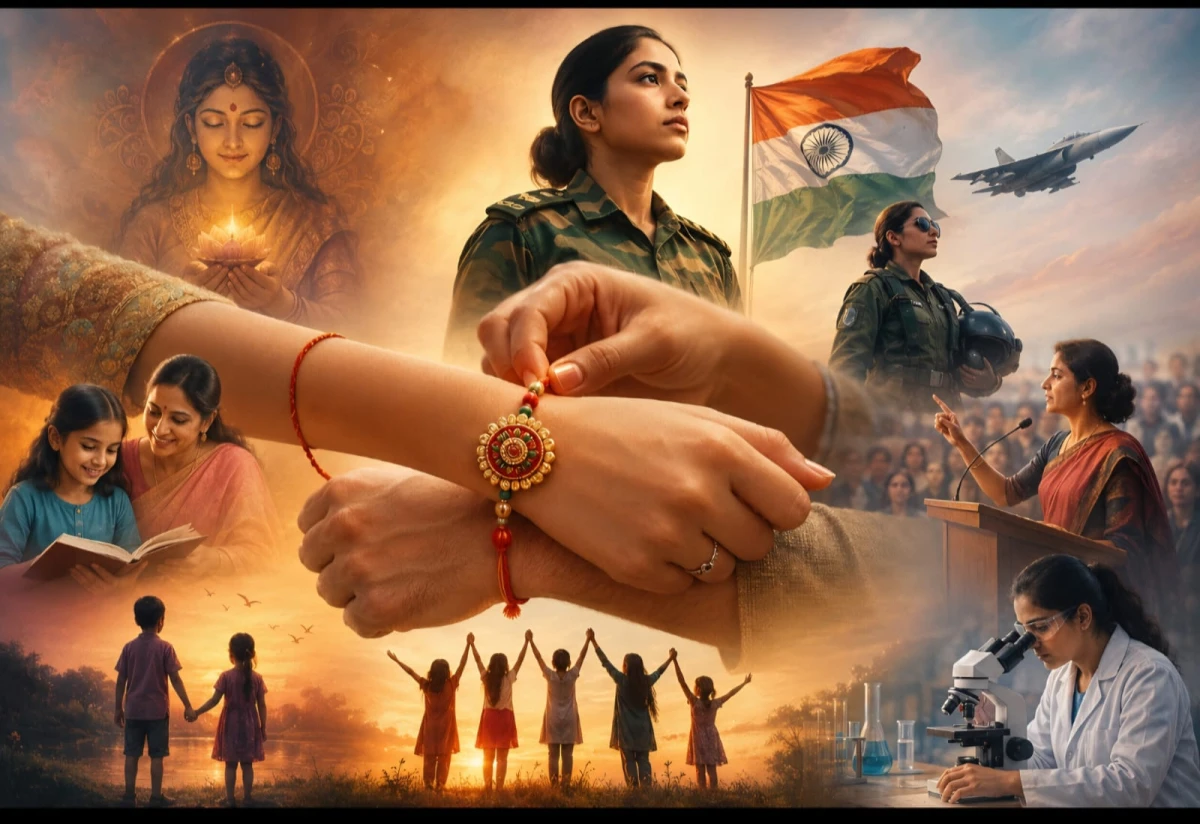
Today, women are charting their own life paths, carving out identities in fields ranging from education, science, administration, politics, and the military to industry, sports, and space exploration.
Therefore, the most pertinent question regarding Rakhi today should not be whether a brother will protect his sister or not; rather, it should be: can we build a society where no woman has to depend on anyone's benevolence for her safety, freedom, dignity, and dreams?
In the Indian concept of Raksha Bandhan, the meaning of 'Raksha' (protection) is profound and expansive. A Sanskrit adage states, "Rakshati iti Rakshah"—meaning, one who protects is the protector. But protection of what? Not merely of the physical body, but also of honor, freedom, cultural values, ideas, and life principles. In this broader sense, Raksha Bandhan can transcend its status as a mere family festival to become a celebration of social philosophy.
References to the *Raksha-sutra* (protective thread) in Indian tradition date back to ancient times. In the Vedic tradition, this thread was regarded as a symbol of auspiciousness, resolve, and protection. Click here to learn the history of Raksha Bandhan.
Whether it is the legend of Indra and Indrani or the tradition of a *Guru* tying the protective thread on a disciple's wrist, a deep sentiment runs through them all: the acceptance of responsibility towards those with whom one is connected. It is not about protecting someone by deeming them weak, but about fulfilling relationships with a sense of responsibility. This is precisely what lends new significance to Raksha Bandhan today.
Throughout Indian history, the *Rakhi* has often transcended the boundaries of blood ties and religion to embody the essence of human connection. In Rajput tradition, the custom of tying the protective thread on the wrists of warriors heading to battle was linked to prayers for their valor and victory. While the story of Queen Karnavati of Mewar and Humayun—centered on the *Rakhi*—may be recounted in various ways across history and folklore, its cultural message is clear: the *Rakhi* transcends the biological bond between siblings to become a human pact of trust and protection.
The episode involving Draupadi and Shri Krishna in the *Mahabharata* resonates with this same sentiment. The story of Draupadi binding a piece of cloth around Krishna’s injured wrist and his subsequent protection of her honor has become a symbol of the compassion, intimacy, and sense of duty inherent in the sibling bond within the Indian consciousness.
The modern significance of this story is that a relationship is not merely about taking; it is about standing by one another. Protection is not a one-way street; love entails mutual responsibility.
Women today have given a new dimension to this traditional concept. They are no longer merely recipients of protection but are active participants in safeguarding the family, society, and the nation.
Women in the Indian Armed Forces are guarding the borders, female pilots are projecting the nation's might in the skies, scientists are contributing to space missions, sportswomen are holding the Tricolour high on the global stage, and women in administrative services are shaping policy.
In this context, the *Rakhi* thread compels us to reflect: if the woman whom we once labeled *Abala* (helpless/weak) and sought to protect can dedicate her life to defending the nation, why should society lag behind in upholding her honor and rights?
This is the new philosophy of *Raksha Bandhan*: it is not about protecting women, but about honoring their capability. The most effective way to ensure a woman's safety is not to curtail her freedom, but to transform society's mindset.
Merely telling a daughter to "be careful because the world is unsafe" is insufficient. It is far more important to teach a son that respecting a woman's freedom, dignity, and choices is the true mark of manhood. When a Rakhi is tied around a brother's wrist, it should not merely symbolize a pledge to protect his sister; it should also inspire a resolve in him to stand against injustice, indignity, and violence directed at any woman.
Today, the issue of women's safety is not confined to streets, workplaces, or public spaces alone. The digital age has created new security challenges. Cyber harassment, online defamation, the misuse of private photographs, digital fraud, and abusive behavior towards women on social media are the new perils facing modern society.
Therefore, a new pledge should be added to the Rakhi celebration today: a commitment to safeguarding women's digital dignity as well. Yet, there is another dimension of protection that we often overlook—economic self-reliance.
A woman who possesses education, skills, employment, and the capacity to make economic decisions commands a far greater sense of self-respect.
Thus, if Raksha Bandhan is to truly become a festival of women's empowerment, a brother should not merely give gifts to his sister but become a partner in realizing her dreams. He should support her endeavors in education, business, research, the arts, her career, or social work. The most beautiful Rakhi is one that, when tied around a sister's wrist, gives wings to her dreams.
Indian culture has never viewed women merely as objects requiring protection. Our ethos has always been embodied in the sentiment: "Where women are honored, there the gods reside."
Scholars like Gargi and Maitreyi carved out independent identities within the tradition of knowledge. Rani Lakshmibai displayed extraordinary valor on the battlefield. Ahilyabai Holkar established an ideal of governance and public welfare. Savitribai Phule lit the torch of women's education.
In modern India, from Kalpana Chawla to numerous female scientists and astronauts, women have proven that talent knows no gender.
Therefore, we must build a bridge between the memories of the past and the consciousness of the present through Raksha Bandhan. Preserving our culture is meaningful only when it propels life forward rather than holding it back.
Tradition is not merely something to be repeated; it is something that generates new meaning with the passage of time. The spiritual dimension of Raksha Bandhan is also profoundly significant.
The greatest insecurity in the world is not external, but internal. Fear, anger, greed, ego, jealousy, and malice undermine a person's inner peace.
From the perspective of Jain philosophy, true protection comes not from external armor, but from self-restraint and self-awakening. Only when a person learns to protect themselves from their own inner vices do they become a source of security and peace for others.
In this light, the *Raksha-sutra* (protective thread) should be tied not merely around our wrists, but first around our conscience.
Raksha Bandhan also reminds us that a nation is not secured solely by its borders. A nation is secure when its daughters are safe, when there is trust within families, empathy in society, character among the youth, and when citizens understand their duties alongside their rights.
While soldiers at the border safeguard the nation's geographical integrity, values, education, and empathy within the home and family ensure its social security.
Parents should resolve to provide equal opportunities to both sons and daughters. The future of Raksha Bandhan lies in a shift of mindset—where protection means safeguarding rights rather than usurping them; love signifies respect for freedom rather than a sense of ownership; brotherhood implies partnership rather than mere guardianship; and culture means carrying our finest values into the future rather than retreating into the past.
A *Rakhi* tied around the wrist may fade with time, but if the resolve associated with it is truly embodied in life, it endures for generations. Therefore, let there be a new resolve this Raksha Bandhan: we will ensure women are not merely safe but respected; not just protected but empowered. We will not obstruct their paths but walk alongside them in pursuit of their dreams. This is the new meaning of Rakhi, the modern interpretation of Indian culture, and the true power of that thread—which, starting from a single wrist, can bind the entire society together in a bond of humanity, self-respect, and national spirit.
What's Your Reaction?
 Like
0
 Dislike
0
 Love
0
 Funny
0
 Wow
0
 Sad
0
 Angry
0










Comments (0)