


































































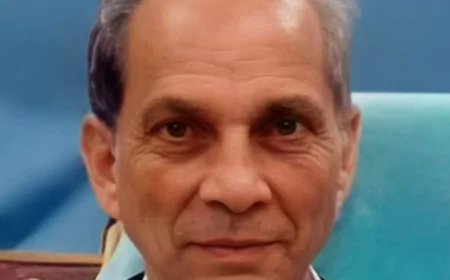



MAMATA BANERJEE’S ISOLATION IN DELHI: A SHIFT WITHIN THE TMC? : DEVANAND SINGH
Mamata Banerjee’s isolation during her Delhi visit has given political analysts food for thought, suggesting that a wave of significant change is sweeping through the Trinamool Congress (TMC).

MAMATA BANERJEE’S ISOLATION IN DELHI: A SHIFT WITHIN THE TMC? : DEVANAND SINGH
9-JUNE-ENG 7


RAJIV NAYAN AGRAWAL
ARA-----------------------------Mamata Banerjee’s isolation during her Delhi visit has given political analysts food for thought, suggesting that a wave of significant change is sweeping through the Trinamool Congress (TMC).


Following the defeat in the West Bengal Assembly elections, Chief Minister and Trinamool Congress (TMC) chief Mamata Banerjee’s visit to Delhi has become a topic of discussion in political circles. The focus of this conversation is not merely her electoral loss, but the unusual political atmosphere observed upon her arrival—one that many political observers view as a sign of growing discontent and a potential leadership crisis within the TMC.
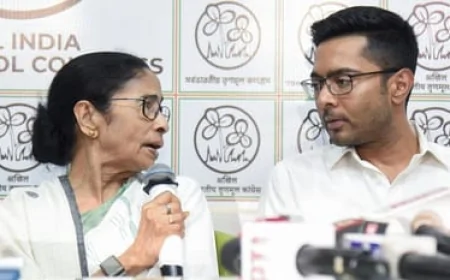
Over the past decade and a half, whenever Mamata Banerjee visited Delhi, large numbers of MPs, party leaders, and supporters would turn out to welcome her. The route from the airport to her residence would typically be charged with political activity and a display of strength. This time, however, the picture was different. Upon arriving in Delhi after the election defeat, Mamata Banerjee was seen with a relatively small group of leaders. Only a select few were visible around her, while the absence of several party MPs became a subject of political speculation.
Symbolic events hold significant weight in politics. The presence or absence of a crowd to welcome a leader is not merely a matter of numbers; it also signals the internal state of the organization and the level of confidence in the leadership. Consequently, Mamata Banerjee appearing relatively alone in Delhi is not being viewed as an ordinary occurrence.
According to media reports, there have been accounts of separate meetings held by disgruntled MPs prior to Mamata Banerjee’s arrival in Delhi. If these reports hold substance, it clearly indicates that discontent within the party is no longer confined to the individual level but could be taking an organized form. For any political party, the greatest challenge following an electoral defeat is maintaining organizational unity. The situation becomes even more complex when questions regarding leadership arise in the wake of a loss.
In this entire sequence of events, the statement made by senior TMC MP Sukhendu Sekhar Roy also holds particular significance. Her statement that "when decline begins, it consumes everything" is not being viewed merely as a casual remark. Political analysts interpret it as an indirect message to the party leadership. A senior leader making such a public comment indicates that the restlessness within the organization is no longer confined to closed-door discussions.
However, it is also true that introspection and discontent are natural in any party following an electoral defeat. Similar situations have been observed in the BJP, Congress, Samajwadi Party, and other regional parties after they lost elections. Therefore, it would be premature to draw definitive conclusions about the TMC's future based solely on the dissatisfaction of a few leaders. Yet, it can certainly be said that Mamata Banerjee now faces the challenge not only of contending with opposition parties but also of keeping her own party united.
For a long time, TMC politics has revolved around Mamata Banerjee's personality. The party's identity, strategy, and a significant portion of its support base have been tied to her leadership. However, recent developments suggest that questions are beginning to arise within the party regarding leadership style, organizational structure, and the future course of action. If these issues are not addressed in time, the discontent could deepen.
The scene witnessed with Mamata Banerjee in Delhi carries political significance that extends beyond just a visit. It can be seen as an indicator of the turmoil within the TMC, growing concerns regarding leadership, and potential future challenges. In the coming days, it will become clear whether this is merely temporary resentment following an election loss or the beginning of a major political restructuring within the Trinamool Congress.
For now, it can certainly be said that Mamata Banerjee's isolation in Delhi conveys a politically significant message. This message is being viewed as a serious warning—not just for opposition parties but for the TMC leadership itself—that managing the organization after the electoral defeat is going to be far more difficult than before.
What's Your Reaction?
 Like
0
Like
0
 Dislike
0
Dislike
0
 Love
0
Love
0
 Funny
0
Funny
0
 Angry
0
Angry
0
 Sad
0
Sad
0
 Wow
0
Wow
0