
SANGAMESHWARNATH TEMPLE AT KOELWAR
The *Shivling* at the Sangameshwarnath Temple, situated at the sacred confluence of the Ganga and Son rivers, is unique. It is believed that the forms of Shiva, Gauri, and Ganesh can be seen within it. Learn the mythological story behind the installation of this *Shivling* by Goddess Saraswati. The confluence of the Ganges and the Son rivers is situated 25 km northeast of the Bhojpur district headquarters and 20 km southeast of the Saran (Chhapra) district headquarters.

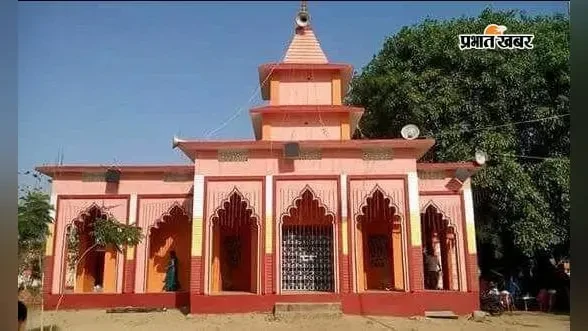
SANGAMESHWARNATH TEMPLE AT KOELWAR
4-AUG-ENG 14


RAJIV NAYAN AGRAWAL
ARA------------------------The *Shivling* at the Sangameshwarnath Temple, situated at the sacred confluence of the Ganga and Son rivers, is unique. It is believed that the forms of Shiva, Gauri, and Ganesh can be seen within it. Learn the mythological story behind the installation of this *Shivling* by Goddess Saraswati. The confluence of the Ganges and the Son rivers is situated 25 km northeast of the Bhojpur district headquarters and 20 km southeast of the Saran (Chhapra) district headquarters.
According to mythological beliefs, this site once marked the confluence of the Ganges, Saryu, and Son rivers; however, geographical conditions changed over time, and the Saryu began merging with the Ganges near Revelganj, about 10–15 km west of the original site.
Since the Son holds the status of a 'Mahanad' (great river) among rivers, this confluence of the Ganges and the Son represents a unique union—the only one of its kind in the world—between a river personified as female (Ganges) and one personified as male (Son).
At the mouth of this confluence, in the Bindganwa area of Koilwar block, stands the *Shivling* of Sangameshwarnath, a site of great mythological significance. Popular belief holds that merely catching a glimpse of the Sangameshwarnath *Shivling* absolves a person of all sins.
Mythological traditions state that the *Shivling* installed in the Sangameshwarnath temple was established by Goddess Saraswati. Legend has it that an assembly presided over by Lord Brahma was underway, with various sages and deities taking turns chanting Vedic hymns; in a moment of over-enthusiasm, Sage Mandpal faltered in his vocal rendition.
Witnessing this, Sage Durvasa—the son of Maharshi Atri and Mata Anusuya, who was present in the assembly—became enraged and confronted Sage Mandpal. Goddess Saraswati, seated beside Brahma, smiled at the scene; this provoked Durvasa further, and he cursed her to live a hellish existence on Earth for one year, stating that she would be liberated from the curse only after that period.
When Goddess Saraswati sought a way to be absolved of the curse Upon arriving on Earth, she first reached this confluence site; captivated by the enchanting scenery, she bathed in the sacred waters of the Mandakini River, fashioned a *Shivling* out of sand, and performed worship. That very *Shivling* is enshrined today in the Sangameshwarnath Temple.
The account of Goddess Saraswati creating a *Shivling* from sand and worshipping it is found in the *Harshacharita*, authored by Banabhatta. Similarly, Maryada Purushottam Ram visited this site while traveling to Janakpur with his guru, Vishwamitra; he bathed at the confluence and worshipped the *Shivling*, an event recorded in the *Bala Kanda* of the *Ramayana*.
Adi Guru Shankaracharya also mentions this site in his book, *Saundarya Lahari*, and it is referenced in the 'Balarama Yatra' section of the *Mahabharata*. The *Shivling* installed in the Sangameshwarnath Temple reveals three distinct forms when viewed from different directions.
When viewed from the front, the form of Lord Shiva appears; from the left, that of Lord Ganesha; and from the right, the form of Goddess Gauri becomes visible. Additionally, a *Trishul* (trident) installed beside the *Shivling* remains in a state of constant vibration.
According to legend, Goddess Saraswati pleased Lord Mahadev and received the boon of liberation from a curse; Lord Shankar then told her that, since the *Shivling* was crafted by her hands, He would forever reside there within it alongside Gauri and Ganesha.
Sant Yoganand Ji Maharaj, the temple's *Mahant* (head priest), states that devotees are cleansed of their sins simply by beholding the *Shivling* at the Sangameshwarnath Temple.
People travel from far and wide to perform rituals for *Kaal Sarp Yog* on the occasion of Nag Panchami. During the holy month of *Sawan*, devotees from the surrounding areas also flock to the temple to seek blessings from the *Shivling*. Despite the site being ancient and of immense religious significance, the temple's importance remains largely unknown to the public due to the neglect and apathy of the administration and elected representatives.
Locals have repeatedly appealed to officials and elected representatives to develop the area for tourism and integrate it into a religious tourism circuit, but these efforts have yielded no results. However, whatever the reason, due to a lack of information, people remain unaware of this highly significant religious site and its importance.
What's Your Reaction?
 Like
0
Like
0
 Dislike
0
Dislike
0
 Love
0
Love
0
 Funny
0
Funny
0
 Wow
0
Wow
0
 Sad
0
Sad
0
 Angry
0
Angry
0












Comments (0)