
WHAT IS THE GREATEST ASSET—THE ONE SPARKED BY GEN-Z’ANGER?
-It is true that education and knowledge have little to do with degrees or competitive exams; however, that does not mean the leaking of NEET and NET papers is a trivial matter. It represents a massive failure on the part of the government and the system.

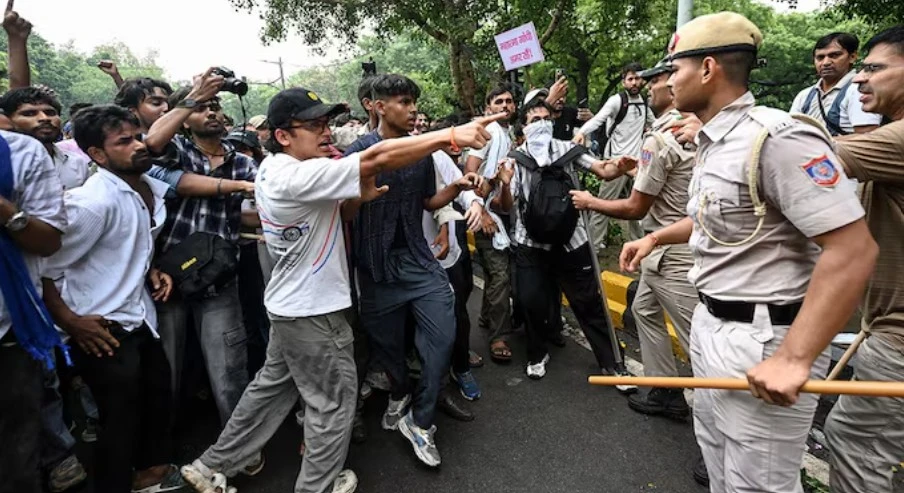
WHAT IS THE GREATEST ASSET—THE ONE SPARKED BY GEN-Z’ANGER?
31-JULY-ENG 1


RAJIV NAYAN AGRAWAL
ARA-------------------------It is true that education and knowledge have little to do with degrees or competitive exams; however, that does not mean the leaking of NEET and NET papers is a trivial matter. It represents a massive failure on the part of the government and the system.
After all, the futures of 30 to 32 lakh students were at stake. Their hard work risked going to waste—some had put in a year of effort, others two or three, and some had made even more attempts. And let us not forget the dreams of their parents, which were shattered time and again.
Yet, the youth proved their mettle. A government that never used to bow down was finally forced to yield. Thousands of young people from across the country converged at Jantar Mantar, shaking Delhi and the central establishment to their core. This anger was not merely about the NEET and NET paper leaks; it encompassed much more. This outrage points toward various underlying issues and their deeper implications.
Better late than never, the central government acknowledged this anger—or perhaps, was compelled to do so. The government is well aware that India’s population of young people up to the age of 30 is approximately 750 million—exceeding the combined populations of the United States and the European Union. The Gen-Z demographic alone—those aged 15 to 27—numbers around 370 million.
A harsh reality for our country is that agricultural income is under immense pressure. This is why we, the youth, are moving away from the rural economy. A service-oriented economy is concentrating opportunities for us in urban centers. Ironically, even these cities are failing to provide adequate opportunities for the youth.
The question now arises: why did a government that had dismissed the opposition as incompetent bow down before Gen-Z?
This movement was deeply rooted in modern technology. Memes, short videos, and cartoons were proliferating at such a breakneck pace that it became impossible to track their speed. Facebook, Instagram, and YouTube were flooded with them—as if these platforms had been created solely to propel this movement forward.
The youth staging peaceful protests—especially those from Patna, Buxar, and Ara—set a remarkable example.
They would approach police personnel armed with batons and ask, "Uncle Policeman, when will you use those batons? When will you fire the water cannons? We want to dance! Have you run out of tear gas?"
Furthermore, certain reasons for the government’s capitulation—or the movement's success—became evident: these Gen-Z youths had little to do with mainstream politics. Unlike farmers, they didn't have crops withering in the fields while they protested at Jantar Mantar. They held no jobs or factories that could be targeted by scrutinizing their bank accounts or unleashing the Income Tax Department or the ED upon them. Nor did they harbor any lust for power or office that could be exploited to sow discord through inducements.
Moreover, the government, police, and administration struggled to comprehend the language and style of this new generation. Their protest tactics were entirely novel. If the police brandished batons, the protesters would sing the National Anthem; at times, they even showered flowers on the very officers who were raining blows upon them. Support poured in from every corner of the country—some sent food, while others provided essential supplies.
Witnessing these developments, the government surely must have reflected on the historic 'JP Movement'—which, too, had originated as a student protest. This is precisely why, for the first time, the protesters' demands were met, resulting in the resignation of a cabinet minister.
Another distinctive feature of this Gen-Z movement was that they brought forward a serious, respected figure like Sonam Wangchuk. Wangchuk was the face of the movement—a man who could not be made to bow under pressure, and indeed, he never did. A poster displayed at Jantar Mantar or Patna’s Dak Bungalow Crossing was remarkably apt: "Our education system lacks only two things—first, education, and second, a system!" One could say that this anger was not merely about paper leaks; there was much more to it. This outrage points to various underlying issues and their complexities. It was only after some delay that the government grasped this anger—or perhaps it would be more accurate to say that understanding it became a necessity for them.
What's Your Reaction?
 Like
0
Like
0
 Dislike
0
Dislike
0
 Love
0
Love
0
 Funny
0
Funny
0
 Wow
0
Wow
0
 Sad
0
Sad
0
 Angry
0
Angry
0







Comments (0)