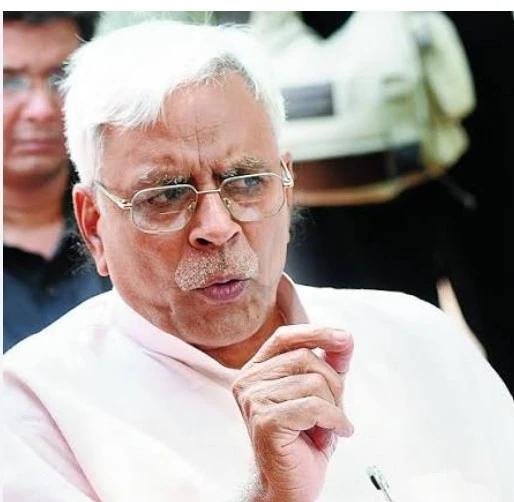
Senior socialist leader Shivanand Tiwari—who closely observes politics not just in Bihar but across the country and perceives a distinct character in social movements—has expressed a serious concern. He noted that the desire for change has reached the lower strata of society.
PATNA----------------------------Senior socialist leader Shivanand Tiwari—who closely observes politics not just in Bihar but across the country and perceives a distinct character in social movements—has expressed a serious concern. He noted that the desire for change has reached the lower strata of society.
In recent times, student protests have taken place in Bihar, at Delhi's Jantar Mantar, and in other states. Students staged protests over the NEET paper leak issue, and Union Education Minister Dharmendra Pradhan was compelled to resign. The central government was forced to yield. During this period, students faced lathi-charges. In Siwan, Bihar, a constable even brandished an AK-47 and fired shots into the air. Meanwhile, in Jharkhand, a student protest is underway regarding irregularities in the JPSC examination. Viewing these events in a broader context, senior socialist leader Shivanand Tiwari has expressed serious concern. He noted that an aspiration for change is evident among the youth and the marginalized sections of society.
Shivanand Tiwari discussed this at length in a social media post. He remarked that the restlessness among the youth and their desire for change are intense. Moreover, this impact is now visible even among school children. Recently, we witnessed students staging a protest and raising slogans against the school management and the prevailing state of disarray. The outcome was that the school administration had to provide a written assurance that fans would be installed, bathrooms cleaned and repaired, and other necessary arrangements completed by a specific date. This indicates that the desire for change has permeated to the very grassroots level of society.
He further questioned how this change would actually come about, emphasizing the need to address the root cause. A mere change of government does not alter everything. The government changed in 1977 as well; people held high hopes at the time, yet everyone witnessed what followed. In fact, shortly after the country gained independence, Suraj Narayan Singh—a prominent and popular leader from Bihar—wrote to Mahatma Gandhi asking what kind of freedom this was. At that time, his region—particularly Mithila—was grappling with starvation. Prices were skyrocketing, and people were unable to get enough food. When people organized processions to protest this and tried to convey their grievances to the administration, the police subjected them to brutal lathi-charges. Continuing the anecdote from Bihar's Mithila region, Shivanand Tiwari recounted how, amidst that anguish, he had asked Gandhiji: "If the same atrocities against the people continue, then what kind of freedom is this?" I recall an incident from 1964 when I was imprisoned; three or four leaders of the railway movement were already incarcerated there. One of them was a man who had been employed by the railways during the British era. I asked him what the atmosphere among the people was like when the country gained independence. He described a celebratory mood across the nation—a sense of jubilation akin to Holi or Diwali. People felt that a new era was about to begin.
However, he noted that this enthusiasm was short-lived. I asked why that happened.
Continuing the account of that exchange, Tiwari writes that the man’s reply was: "When we agitated against the British, the very police inspector whose baton struck us was found sitting in the same police station even after independence. The Collector, the SP, and the entire administration that had oppressed the people under British rule continued to function in the exact same manner. Power changed hands, but the system did not. Consequently, the enthusiasm and euphoria of freedom gradually faded away. Much the same situation prevails today. Therefore, a mere change of power will not suffice; drawing lessons from past experiences, we must seriously consider transforming the system itself."
He further writes that while he is proud of their active participation in the 1974 movement, the current situation goes even beyond that.The level of consciousness and understanding we see among today's youth was absent during the Bihar Movement. In fact, I would go so far as to say that had Jayaprakash-ji not assumed a leadership role, that movement might never have taken place at all. Over time, awareness and understanding have grown, and there have been unprecedented changes in communication technology. Consequently, these changes play a significant role in the remarkable scale and reach of the movement we are witnessing today. This sentiment is now spreading across the entire country.
He further added that if the government believes it can suppress this movement or this awakening through the use of force, there is currently no indication that this will happen. However, there must also be serious deliberation regarding the nature of the change. If only the faces change while the entire system continues to operate in the old manner, the impact of this change will eventually fade—as we have seen in the past—and the public will once again fall into despair. Therefore, I believe the most pressing need today is to deeply consider what fundamental changes should be made to the administrative system that has persisted since the British era. Unless the system itself is transformed, a mere change in power will not resolve the underlying problems.


 Like
0
Like
0
 Dislike
0
Dislike
0
 Love
0
Love
0
 Funny
0
Funny
0
 Wow
0
Wow
0
 Sad
0
Sad
0
 Angry
0
Angry
0











Comments (0)